Author Archives: Dan Perry

About Dan Perry

Dan created this blog to document his South America trip, which covered every country on the continent and lasted over two years. He currently lives in Madison, WI.

San Pedro Cave

June 11, 2007
Day 621

Picture of cave.

The lake inside of Gruta de San Pedro.

I would like to do a four-day trek from Sorata, and I started looking for people to go with as soon as I got here. This has been difficult because the few tourists who are here just want to relax for a few days. For some reason, Sorata still hasn't made it onto the tourist radar screen. I did leave a note on the guide association's bulletin board, so maybe I'll still be able to find some people to go with.

In the meantime, I decided to do a day-walk to Gruta San Pedro, a cave near the town of San Pedro, about a three-hour walk from Sorata. The walk went past some impressive scenery similar to what could be found in Nevada (except for the big mountain in the background).

The cave itself had a narrow entrance, but soon opened into a huge room, which was lit with fluorescent bulbs. A guide led three Chileans and myself to the back of the cave, where there was a small lake. People used to go diving there to look for gold until a few years ago when someone drowned. There were a couple of paddle boats in the water available for an extra fee, but I declined and walked around the water.

I decided to walk back to Sorata on the treacherous narrow path that led along a cliff rather than walk down the same boring jeep track. Some kids told me they were going to Sorata too and led me all the way down to the river. Then they started walking the wrong way. I told them Sorata was the other way and they figured out that they actually lived in a different Sorata than the one I was going to. I had to go all the way up to the top of the hill and ended up walking almost twice as far as I would have on the jeep track. Who had the bright idea of naming two towns so close together the same thing?

The photo album for this entry is here.

Minibus to Sorata

June 10, 2007
Day 620

Picture of Sorata.

Sorata, Bolivia.

I jumped on a bus to Sorata today. Actually, it was just a van that seated about fifteen people. When the bus left, all of the seats were filled, but the driver felt he could still do more, so we proceeded to pick up more passengers, who had to stand in the doorwell and sit on the roof. I got the luxury of not being able to lean back because one of the standers had half his body on my seat back. And this was the best ride my $1.75 would buy.

The journey first went to El Alto, in the altiplano far above La Paz. There must have been a market or festival of some sort that day because the streets were horrendously chaotic. When we finally got to the outskirts of the city, we were free to drive through the rest of the relatively unpopulated region. There were a few towns along the main road and some villages in the hills where life hasn't changed much in the last 500 years. The strangest thing is when someone gets off the bus in the middle of nowhere and starts walking toward nothing. This happens at least every half hour on this type of bus ride.

We drove along the length of the Cordillera Real, the mountain range near La Paz, until we passed Illampu, at which point we began our long descent to the valley below. The road down was modern with some parts having pavement, “Do Not Pass" signs (although our driver ignored them), and yes, even a few guardrails. The majority of the road had none of these, however, so the drive was pretty scary.

Eventually we arrived in Sorata, at an altitude of 2700 meters. The vegetation had gone from nothing but some grass to tropical with palm trees in the central plaza, hills covered with forests, and lots of green pastures. The area proved quite scenic, and I have been assured that there is a lot to do around here.

The photo album for this entry is here.

Altitude Adjustments

June 5-9, 2007
Day 615-619

Going up to high altitude is not an easy thing for me. I feel tired, lethargic, malaise, and can't walk up five stairs without breathing heavily. Luckily this only lasts a few days, and now I think I'm back to normal. I'm planning to do some trekking in the area, so getting acclimated is vital. The good thing is that all that is needed to acclimate is time, something I have plenty of.

Jamie had to go to Cuzco to continue his trip, but before he left, we got together with some of his Bolivian friends he met on the Death Road earlier this year. We drove out to the countryside for a barbecue. It was strange driving past mansions, shopping malls, and Burger Kings on the way. It's a side of Bolivia I hadn't seen before. The landscape was like the Nevada desert with huge red and yellow rock pillars jutting out from the rolling hills of the area. It was a fantastic region to visit. Too bad I didn't know I was going there or I would've brought my camera.

Riding the Altiplano

June 4, 2007
Day 614

I took a minibus from Villa Tunari to Cochabamba. It was the first vehicle I had been in for a month other than one night when a bunch of us took a bus to a neighboring town for Chinese food. I found it difficult to leave town after having been there for so long.

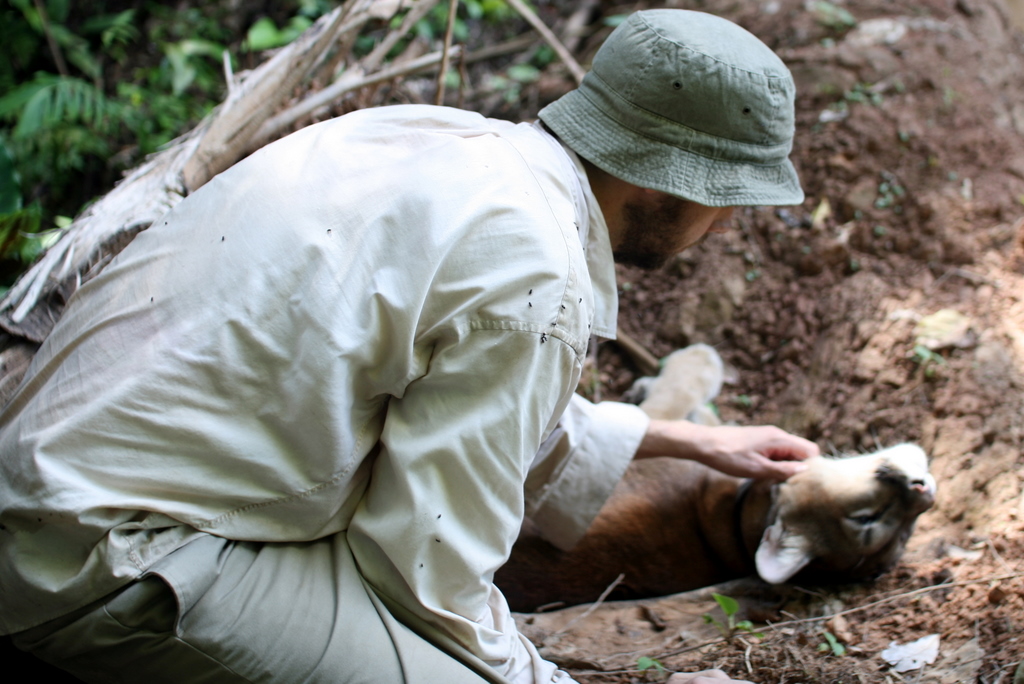
Cochabamba is at the base of the altiplano at about 2500 meters. I stayed there for a day to break up my trip to La Paz and to acclimate myself a bit more slowly to the altitude. The city claims to have a climate of eternal spring, and the weather while I was there lived up to that reputation: Warm without a cloud in the sky. I met up with a guy named Jamie, who was working with a puma named Sonko in Villa Tunari. We are going to travel to La Paz together.

Cochabamba Calls

June 2 - June 3, 2007
Day 612-613

I took a minibus from Villa Tunari to Cochabamba. It was the first vehicle I had been in for a month other than one night when a bunch of us took a bus to a neighboring town for Chinese food. I found it difficult to leave town after having been there for so long.

Cochabamba is at the base of the altiplano at about 2500 meters. I stayed there for a day to break up my trip to La Paz and to acclimate myself a bit more slowly to the altitude. The city claims to have a climate of eternal spring, and the weather while I was there lived up to that reputation: Warm without a cloud in the sky. I met up with a guy named Jamie, who was working with a puma named Sonko in Villa Tunari. We are going to travel to La Paz together.

Last Week With Simba

May 25 - June 1, 2007
Day 604-611

Picture of Simba.

Alvaro, Simba, and I at the beach.

Simba must have known that I was going to be leaving soon because he got quite jumpy in my last week at the park. It seemed like every time he had any kind of positional advantage on me he attacked. On top of that, he got smarter and sneakier in the end. Once after having a rest while tied to a tree, he started walking around, which usually means he's ready to go. Except this time, he just seemed to be testing how far the rope would reach because when he couldn't walk any further, he went back to his resting spot. Then instead of laying down, he crouched in his usual attack stance. He must have known that neither Nick nor I would dare entering his range when he was in that position, because he closed his eyes and turned his head as if to say, "It's OK guys, I'm just sleeping. You can come near me and I won't attack you." Yeah right. Another time when we put him on the long metal runner to go down a hill, he instantly ran halfway down and hid in the trees. He knew that as soon as we came looking for him, he'd be able to jump from his hiding spot and easily attack us. Instead, we stayed put and lied to him: "We see you Simba, come out of there." We actually had no idea where he was at the time. Eventually he tired of his game, emerged from the trees, and walked to us like a nice little puma.

One of his attacks was particularly bad. My shoe came untied at the top of a tall, steep hill. I figured if I didn't tie it right away I'd fall face-first down the hill. Simba was ahead of me halfway down the hill when I squatted down to tie my shoe. As soon as he saw that I was near the ground, he came charging at me, bit me hard in the thigh, and wrapped his claws around my arms. I wrestled with him for a few minutes and tried to get Nick to take his short leash so I could get away from him, but the rope was wrapped several times around my leg. I got his mouth away from me, but his claws kept digging in. Finally I was able to stick my leg straight up so Nick could unravel the rope. In the end my arms were good and bloody, but I couldn't get mad because I knew that Simba was just playing. Whenever he sharpens his claws on a tree, he does to the bark what the Swedish Chef does to lettuce, so I'm sure he could have done a lot worse to me if he wanted.

Picture of Simba.

Simba smelling another cat's urine.

Several of the other volunteers this last week haven't been as lucky as me. About four people sprained their ankles while walking their pumas and were put out of commission. One guy got bitten by something on his leg and it got infected so badly it produced a baseball-sized puss pocket and he was in too much pain to walk. Then Li Shu, the park's biggest puma, decided to test a new volunteer and attacked him so hard he broke his arm. I was fortunate to walk away from the park with only a few bumps, bruises, bites, and scratches.

I began training a Spaniard named Alvaro to take over for me a few days before I left. He's the most interesting guy I've met in months. A few years ago he got married for one month. He got divorced but liked his wedding ring too much to take it off. Then he was living with a different girlfriend for several years and decided on a whim to quit everything and go traveling. Two weeks later, he was on a plane to South America. Now he wants to travel for six months, but he only has $3000. That's easily possible in Bolivia, but pushing it in the rest of the continent. His main way of saving money is by skipping meals. We'll see how long that lasts. The really strange thing is that he's afraid of getting robbed, but he doesn't have a camera or anything else expensive to rob, and he has long hair, a big beard, a collection of Black Sabbath shirts, and bears an uncanny resemblance to Charles Manson. If I were a robber searching for a victim, he'd be the last person I'd choose.

Picture of Alvaro.

Alvaro shows off his skills on the saw.

Working with Simba was tough going for poor old Alvaro. On his first day, we took Simba to the beach again and he got completely worn out. Then I told him that we only had seen about 20% of Simba's trails and he almost fell over. Later we did Simba's long trail, and I gave Alvaro the rope for the first time at the end where it was relatively easy. Within three seconds, Alvaro was sliding and rolling down the hill and ended up upside-down at the bottom. Simba just couldn't resist that opportunity and lunged for his neck, luckily in a playful fashion. I think Alvaro broke the record for quickest time to get jumped. Another time we were on a hill and Simba turned around and had a sneaky look on his face that said he was going to jump for sure. Alvaro's reaction was to clasp his hands together and say, "Simba, I just want you to know that I love you, so please don't jump me." I don't know if Simba understood it, but he looked confused and actually backed down from the game. In the end, Alvaro didn't mind the attacks, but he didn't want to walk on the long trails every day. He went back to working with his first love, the birds.

My last day was quite sad. I tried to give Simba a hug, but he just wanted to give me some more of his love scratches. I'll miss him.

Picture of monkey.

Pumas aren't the only animals in the park.

Still, I knew it was time for me to go. I had many infected wounds that refused to heal in the humidity of the jungle. The leather on my shoe got torn apart from end to end and I'm not sure if I'll be able to fix it. The weather continued to be cold and rainy with only one day where the sun came out for a bit. Every other day I had to walk around all day in the rain with no way of escaping. It was so cold I started shivering as soon as I sat down. A month under those conditions was enough for me.

Despite the minor problems, I've really enjoyed working at the park. A lot of people have complained about the administration, how inefficiently things sometimes run, and that it's too expensive. It's true that normally you don't think of volunteering as something you should pay for, but it only costs $5 per day, which includes a place to sleep. Most of the park's money comes from the volunteers (some comes from outside donations as well), and there's no way the park could run without us paying something. I know the park isn't an ideal situation for the volunteers or the animals (the park doesn't even own the land and more of the forest gets chopped down every day), but considering that it's located in Bolivia (the poorest country in South America), and that anyone can come in and start working right away without any previous notice, I'd say it's actually run pretty well. Walking with Simba will undoubtedly go down as one of my best experiences in South America.

Worst part of working at the park: Having to walk across an extremely dangerous bridge on the way to and from work each day. It's part of the main route between Santa Cruz and Cochabamba, so there's constant traffic, the bridge is barely wide enough for one big truck, let alone two passing each other, there's no sidewalks to hide from the traffic, and vehicles constantly pass each other despite the fact that the bridge is so narrow and there's a blind curve right after it. I seriously felt like I was risking my life every time I walked across it.

Best part of working at the park: Being able to fart and blame it on the puma.

More Crazy Puma Antics

May 16-May 24, 2007
Day 595-603

Picture of Simba.

Simba walking along the beach.

The last week has been more of the same routine. I make the long walk with Nick up to Simba's cage, walk Simba around all day, then return him to his cage before dark. The weather has been miserable lately with at least the last five days being cold and rainy. I can't even remember what it feels like to be dry during the day. The sun is a distant memory. And this is the dry season!

The puma people seem to have formed their own clique. We always get together for each meal and for parties at night. We rarely see the monkey people. All of us are infinitely glad we work with pumas because the monkey people have to start earlier, end later, and get pooped on all day by the ungrateful beasts. All we have to deal with is the occasional mauling.

The only problem amongst the puma people is that there are constant arguments. Everyone thinks their puma is the best and is prepared to state their case for endless hours to prove it. My puma Simba, for example, is a jungle puma, so he's smaller than most of the rest of the pumas, which are of the mountain variety. However, he's more colorful and affectionate than any of the mountain pumas, and his trails are the toughest to walk. Roy is big and strong but he walks like he's gay. Li Shu is huge but doesn't attack much. And so on and so forth. Someone once proposed a "Puma Death Match" to decide once and for all which one is the best, but somehow I don't think that idea would go over too well in an animal shelter.

Every day continues to be a new adventure for walking Simba. We went to the beach again one day, and Simba greatly enjoyed taking a swim just like last time. He was a big baby once he got out of the water and was all wet, though. He barely walked the rest of the afternoon.

Picture of Nick and Simba.

Nick walking with Simba.

One day Simba saw four other cats, including one ocelot. Every puma's cage is located far away from each of the others for obvious reasons, but the park isn't big enough for each of them to have their own paths. Some of Simba's trails are shared with other cats', and sometimes the pumas run into each other. It usually isn't a good experience because they want to kill each other, so we try to avoid it. One other cat is tough enough to deal with, let alone four.

Seeing four cats was already more than enough excitement for a puma to have in a single day, but there was much more for Simba that day. Oh yes, when we got to the usual river we walk down, we spotted a wild ocelot. I had heard of wild cats living in the area, but this was the first visual confirmation. Near the ocelot siting, Simba suddenly jumped into the trees and started digging around for something. When he came out, he had a dead capuchin monkey in his mouth! He walked around the river with it for a bit, but decided it wasn't good enough to eat and dropped it. The monkey people figured it was one of theirs so they asked us to bring it back the next day. That's right, we had to bring a grain sack back to the river (about an hour walk), collect the rotting specimen, and carry it all the way back down to the casa, and of course Simba might have a thing or two to say about us messing with the animal he found. The situation sounded like one of those stupid Internet banner ads: "Catch the dead monkey in the grain sack and keep it away from the puma." I had Simba's leash at the time we found the monkey again, so Nick agreed to take it all the way back as long as I kept Simba away from it. And since he succeeded in his quest, he won a free bar of soap to wash his hands! If only the real Internet banner ads delivered prizes that good.

Another day Simba ran to a tree and started digging in the ground next to it. Dirt was flying up everywhere, and I decided that once Simba got his mind on something like digging, he was unlikely to think of anything else for awhile, so I tied him to a tree. Soon his head was under the ground, then his front legs, and about ten minutes later, all I could see was his wagging tail sticking up through the hole he had dug. Suddenly I heard a noise and saw a large mammal that had escaped through a back door run away from the tree. I must not have been thinking too well because the blur I saw running looked like Simba at first, and I thought he had escaped. However, soon Simba emerged from the second hole and I saw that all was well. For the next hour, Simba wanted to stick around the hole just in case the animal he almost killed came back for more. We had to drag him away from the area in the end.

Picture of me and Simba.

Me walking Simba.

The other continuing saga is that the locals keep cutting down the trees on Simba's trails. One particular place, called the "five points" because it's where five trails come together, used to be a dense forest. Now it's just a bunch of fallen trees, some of which have fallen on top of other trees and are bound to fall the rest of the way to the ground soon, causing a dangerous situation for the volunteers. The frustrating thing is that none of the trees have even been removed from the park. That area is on private land, so we can't do anything about it, either. The saddest thing is that this is what has become of Simba's life. All we're trying to do is simulate to the best of our ability how his life would have been if humans hadn't taken him out of the jungle when he was a baby, but it doesn't look like that will be possible. Simba's future is going to include being terrified by the sounds of chainsaws at least twice per week.

I only have one more week left here and it's crazy how quickly the time is flying because I have somewhat of a daily routine now. I have loved my experience here so far, but I will be ready to leave soon. Being in the cold, pouring rain every day while sliding around in the mud and trying to avoid getting eaten alive is wearing me down. Maybe I should have thought it through a bit better when I left the paradise beaches of Brazil.

Walking the Puma

April 30-May 15, 2007
Day 579-594
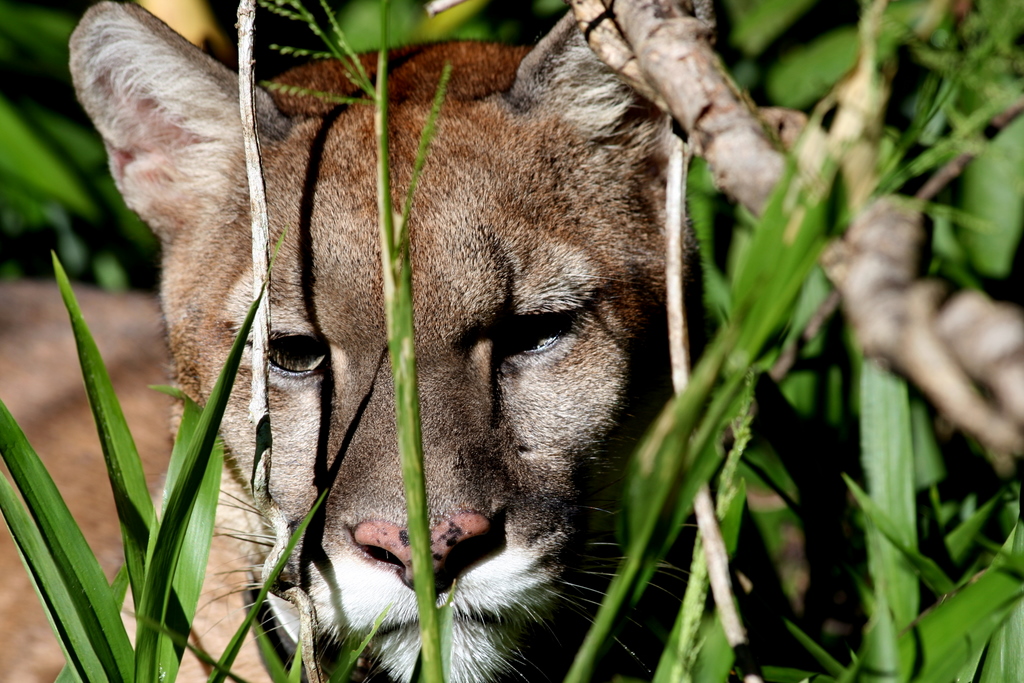
Picture of Simba.

Simba the puma.

...Actually, more like letting the puma walk me.

For the next leg of my South American journey, I went to Villa Tunari to do some volunteer work at the Inti Wara Yassi park. It's an animal shelter started in 1996 by Nena Baltazar Lugones, and today it has grown into a large park and rehabilitation center with a goal of taking in animals native to the Bolivian rain forest and eventually releasing them back into the wild. Some of the animals come from circuses, and others are former pets, many of which had been abused by their previous owners. The park is mainly supported by volunteers from all over the world.

When I first showed up at the park at around lunchtime, I was greeted by many smiles and told that someone would be able to show me around soon. I looked at the people a little closer and noticed that the common theme was that most had bandages and/or scratches covering their arms and sometimes faces. The scratches came from monkeys, pumas, ocelots, and nasty little animals called tyras, but most people were covered with bites from mosquitoes and sand flies. Someone informed me that we couldn't use insect repellent because it poisoned the animals, who often liked to lick (and obviously bite) humans. I began wondering what I was signing up for.
Picture of me and Simba.

Me scratching Simba.

Nena seemed genuinely grateful that I was there and told me that if I could commit to a month, I could work with a puma. Big cats seemed right up my alley and much more desirable than monkeys, so I agreed and was quickly assigned to walk a puma named Simba. He's around five years old and was owned by a family in La Paz until he got too big for them to handle. Reading the general puma information I noticed that every puma in the park has escaped at least once, and Simba is no exception. A few years ago he attacked one of the volunteers when his partner was away and easily escaped when he was tied to a waist-high tree. A farmer found him a week later in the town wand wasn't very happy of course. It took three weeks to get Simba back to normal.

The rest of Simba's file was less scary. He's one of the more affectionate pumas at the park and will love you if you love him. Unfortunately with a puma like Simba who has been around humans his whole life, he'll never be able to live in the wild, so the intention of the park is to give him the best life possible. He's not an aggressive wild animal, but he's not tame either, so any attempts to control him will be met with maulings.
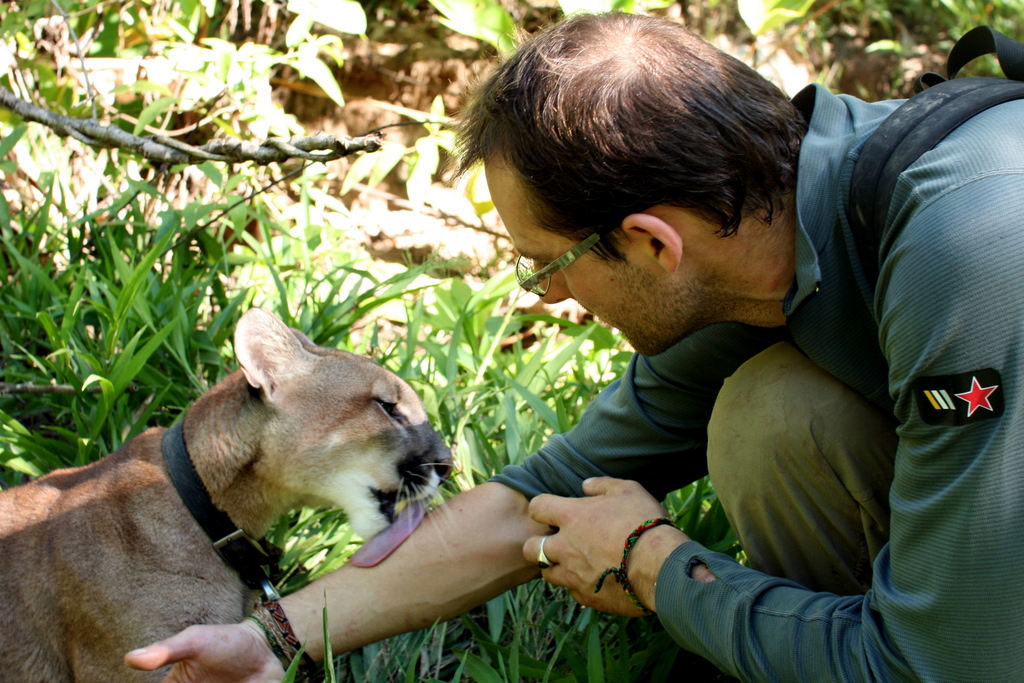
Picture of Martin.

Simba licking Martin's arm.

Pumas always work with two people, and I was paired with a Scotsman named Martin who had already been working with Simba for a few weeks. On my first day, we walked a long trail for about twenty minutes straight uphill to his cage. I was already covered with sweat before I even met Simba. When we got to his cage, he eagerly awaited us with his back pressed against the wire mesh so we could pet him a bit. Next, he went to the top level of his cage and made love to his blanket, as per his daily routine. When he was done, we briefly put him on his runner, a long rope between two trees, so we could clean his cage. Finally, we were ready to walk. Of course Martin took Simba's rope at first, but my heart was already pounding as I was walking through the jungle with a wild puma. It's crazy that somebody with absolutely no experience with wild animals can just walk into a place and start walking a puma with no training at all. Only in Bolivia.

We walked with Simba up and down a series of trails all day. I have been told that Simba has the toughest trails of all the pumas. I didn't dispute this at the end of the day when I was absolutely exhausted. And on the first day, we just did his "short" trail.

Every day since then has been more or less the same routine. We walk with Simba most of the day and feed him his daily ration of about 1.5 KG of raw beef and chicken at the end of the day. Sometimes we walk almost constantly, and sometimes Simba wants to rest for several hours in the middle of the day. Luckily, his main resting place is in a convenient location with hammocks set up so we can get some rest too. Ultimately it's up to Simba where we go and for how long we walk and rest. He's the boss. There have been a few annoying distractions to disrupt the routine, though.
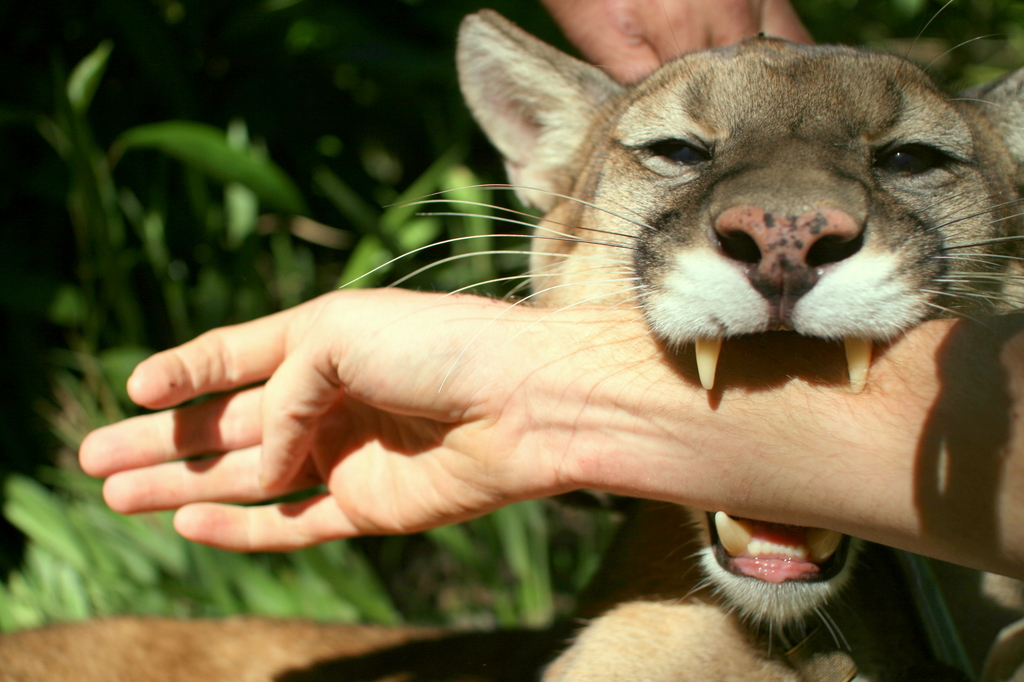
Picture of arm.

Simba eating my arm.

On my second day, everything was going fine until I heard the sound of a small engine purring nearby. Suddenly a guy from the town fired up his chainsaw full boar and began cutting down a tree. Simba freaked out and made a beeline for the safety of his cage. We barely got him back without being dragged across the ground. The mean men continued working throughout the day and Simba never recovered his composure enough to be able to walk on his trails.

A few days later, something similar happened when some guys started hacking away in the bush nearby with machetes. When we started heading for the cage, we saw that many of Simba's paths had been cut apart with brush lying all over the place. It all seemed pointless, and I wondered why we didn't just kick these guys off our land. The explanation was bizarre: We were the ones who were invading their land. So all this time the animal shelter has just rented the land, and whenever some guys feel like cutting down trees and wreaking general havoc with the animals, they can do so freely. This obviously made my job more difficult, but they've generally stayed away from Simba's trails since that day.
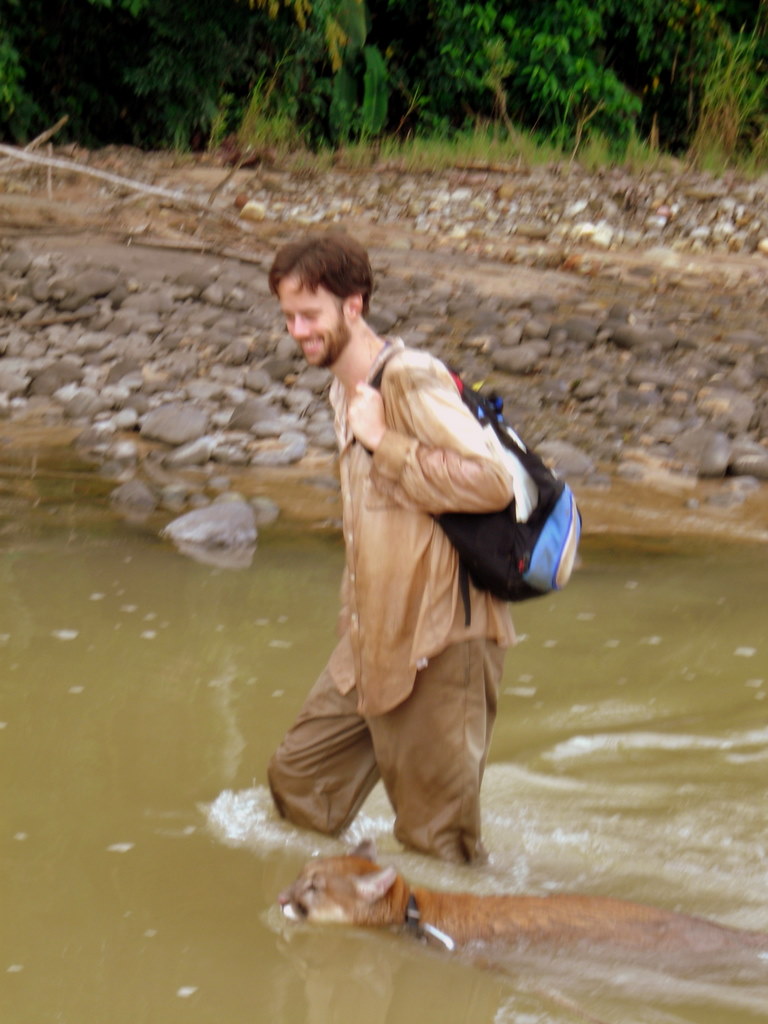
Picture of me and Simba.

Simba and I walking along the beach.

One day we took Simba down to the "beach," or the muddy river with a small amount of sand and a ton of sand flies. I wasn't too happy walking through the knee-deep water, but Simba loved it. He swam for hours and almost had to be dragged back. I had to deal with prune feet for several days afterwards.

For the most part, Simba is very gentle, but he has attacked me a few times. Once he saw me standing below him waiting for him to move and he had a go at me. He gracefully flew through the air and knocked me straight backwards to the ground. He was being more playful than vicious, though. He didn't even use his claws.

Another time, we had him tied to a tree and he crouched down like he was going to attack me. He ran at me, but he didn't have enough rope to get to me. Then he settled down and started walking down the path. I thought he was back to normal, but as soon as I unhooked him from the tree, he charged right at me. I wrestled with him for a minute and managed to get his paws off of me, but then he cheated and sank his sharp fangs into my hand. Then he got on his back and started kicking with all four paws, his mouth still firmly clamping down. Eventually I managed to overpower him, but I sustained some minor scratching damage in the process. It wouldn't have been so bad, but Simba timed his attack perfectly so he wasn't tied to anything when he flew at me. He's a smart cat.
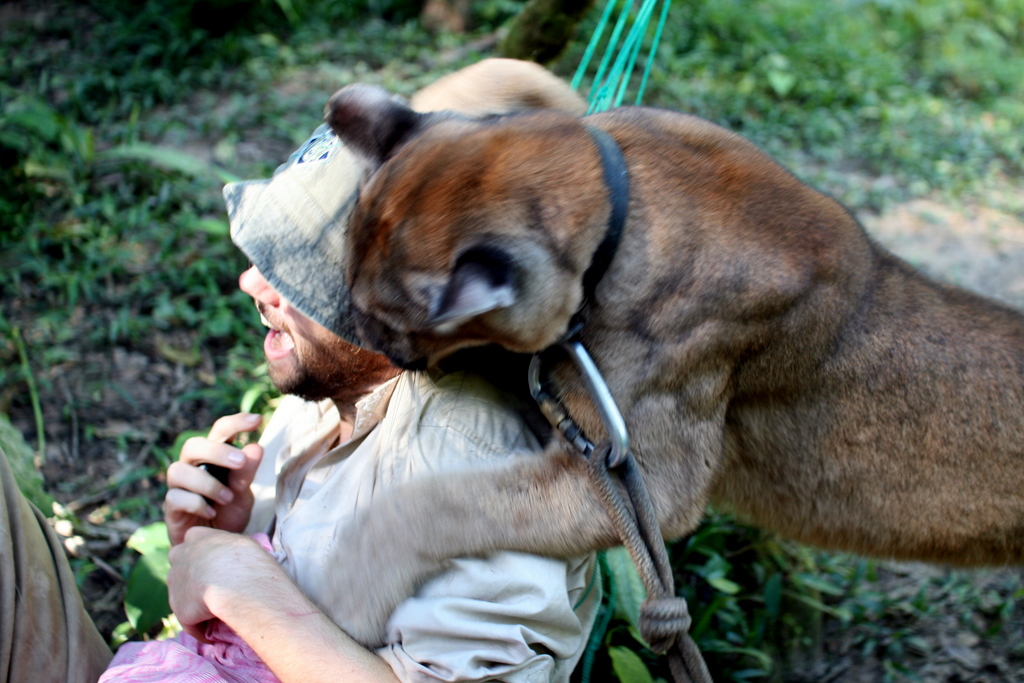
Picture of attack.

Simba attacking me.

Most of the time, however, Simba just wants to walk, lick our arms, and sniff around a lot. His mood changes quickly, so sometimes I feel like I'm taking care of a two-year-old who happens to have the power to kill me if he feels like it.

Martin left a couple days ago and a guy named Nick from Liverpool took over. It will already be my turn to hand over the reigns soon, assuming I don't get mauled to death before then, of course.

Almost every night, it's somebody's birthday or last day at the park, so there's usually a party at my hostel. The Israelis, who represent about half the volunteers, are typically the instigators. It's nice to have a social atmosphere, but it's impossible to get a good night's sleep here. But not much else happens in this sleepy little town, except one night.

About a week ago was the Miss Villa Tunari beauty pageant. The contest was promised to start at 7:00, but everyone knew better. I entered the basketball stadium that held the contest at 9:00 to learn that it was still nowhere near beginning. There were just a few people sitting around, but there was a major problem. The "Mega DJ" was playing a mixture of cumbia and reggaeton, already two of the worst forms of music ever invented, and in this case he happened to be playing the music louder than your typical jet engine. And on top of that, he constantly talked over every song and never played more than thirty seconds of any given track, so there was no way possible to enjoy it. My ears were in an intense pain after ten minutes and I had to leave. I don't understand how anyone possibly could have stayed in that building longer. It was pure torture.

I came back when the contest finally started about 11:00. There were originally only two contestants because all the rest of them got too embarrassed and backed out. They eventually coaxed a third girl to join, making the contest at least somewhat relevant. The pageant consisted of the three girls walking around the crowd in bikinis and dresses. There was no talent competition or even any words spoken from the girls. The vote was by applause and I was happy to get out of there as soon as it was done.

The rest of my days follow pretty much the same routine. Puma walking is a seven-day-a-week job, so I get a ton of exercise, require lots of sleep and food, and don't have much time for writing a blog, which is why this entry covers so much time. It's flying by very quickly, as I am already about halfway done. I never have stayed somewhere this long on my trip, so it's a good change of pace, but a tough challenge not to let my continuous surroundings bore me too much. So far so good.

The photo albums for this entry are here.

Relaxing in Santa Cruz

April 26-29, 2007
Day 575-578

I had been doing a lot of traveling lately, so I decided to relax for a few days once I got to Santa Cruz. The city really brings back memories from when I was here last year. There's the fried chicken restaurant where a Japanese guy tried selling me blinking frogs, the crooked money-changing men in the central plaza, the pretty women selling phone cards one block away, the chola women selling fresh squeezed orange juice all over the place for a quarter a cup, the large amount of SUVs that are way too expensive to be owned by Bolivians, and the delicious vegetarian restaurant that has the Ten Commandments prominently painted on the walls.

While in Santa Cruz, I did a lot of boring but necessary tasks: I got permission to stay in Bolivia for ninety days from the immigration office, bought some cold weather clothes for when I go to the mountains, got my hiking boots (which were falling apart) fixed, got my clothes machine washed for the first time in months, and relaxed and got re-energized for the next segment of my trip.

The Death Train Needs a New Name

April 24-25, 2007
Day 573-574

Confusion was the theme of the day. The guy who was supposed to give me my train ticket didn't show up on time. I somewhat expected this, so I walked around looking for a supermarket to buy some snacks for the train ride. When I got back to the hotel, the ticket guy's friend was there with my ticket. He wondered if I had gotten my exit stamp yet. I told him no because I had to make sure I got my train ticket first. Immigration was about to close, though, so I had to run to the bus station to get my stamp. This all could have been avoided if I had just gone to the bus station in the first place because the train ticket guy's office was located there. Of course he never told me this last night. The guy's friend said he had too many girls on his mind, and they were clogging up his brain. Figures.

With my train ticket and exit stamp, all I had to do was cross the border and find the train. That was easier said than done, too, because the city bus that goes to the border had just left. I had to wait forty-five minutes in the stifling mid-afternoon heat for the next bus to come. Luckily I left extra early because everyone I asked told me the train left at different times. On top of that, I still wasn't even sure there would be a train today because of the strike.

Getting into Bolivia was easy enough. I only got thirty days in the country, as is Bolivia's usual custom, but at least I didn't need to buy a visa. I heard rumors that Bolivia was going to require visas for Americans starting in March, but I guess they still haven't gotten around to it. It now seems like the requirement might be put off until June, but one can never be sure. The only thing I am sure of is that I could still enter the country for free for now.

Once across the border, I shared a cab to the train station with two Israelis. We had agreed on a price beforehand, but then the driver looked at our train tickets and told us we had to go to the second train station. None of us was even aware that there was a second station, but we had no way of knowing what was right at that point. The driver wanted to charge us double because the second station was 27 K's away. We talked him down a lot, but still had to pay more than our first price. The actual distance was more like 10 K's, so we already felt cheated.

When we got to the second station, it was almost empty. The train employees said that this was because the train wasn't coming for a couple more hours, but we could go back to the first station if we wanted to board it right away. So of course the taxi driver lied to us and already was long gone. We only lost about eighty cents each, though, so if that's the worst thing that happens to me in Bolivia I guess I'm doing alright.

In the station, little kids were walking around selling lemonade to support their families, not just for economic education. Independent workers were busy carrying peoples' luggage onto the train for tip money. Women walked around selling empanadas for twelve cents. Even just across the Brazilian border, it was obvious that I was back in Bolivia.

When the train finally did show up, it was much nicer than I had expected. The cars were set up like buses, with two seats on each side and an isle down the middle. The two TVs in my car were used to play some stupid movie with no dialog, nonstop screaming, and three songs constantly being played at once. Nobody on the train seemed bothered by this horrible noise.

The Death Train got its nickname because 100 years ago, a lot of people died on the train when it broke down in the sweltering heat with no access to water. My book says that it's a lot safer now, but you should still bring insect repellent because of the "zillions" of mosquitoes that make their way onto the train during the constant unexplained stops. However, the only time we stopped was at small towns to pick up new passengers, and there weren't any mosquitoes in site because of the sealed, air-conditioned cabins. The Death Train was a little bumpy, but not nearly as deadly as its nickname would suggest. The only problem was that it went at night, so I missed out on seeing the scenery of Bolivia's pantanal.