Author Archives: Dan Perry

About Dan Perry

Dan created this blog to document his South America trip, which covered every country on the continent and lasted over two years. He currently lives in Madison, WI.

Seattle Bound

Picture of open road.

July 26, 2014
Day 8
Selway River Trip Day 5

This was to be a long day, so we got an early start. Paradoxically, my kayak was more difficult to pack than it had been on our first day, despite the fact that I had eaten all of my food. We ran a few more small rapids, then started seeing some hikers and park rangers. When we reached the take-out at 11 a.m., we saw port-a-potty. We were officially back in civilization.

After packing our vehicles and taking a look at the class VI (“unrunnable”) Selway Falls, we drove one final time through the Bitterroot National Forest to Missoula, Montana. I could not have planned a better trip to end my stay in the United States. Beijing is a huge city, and the Selway gave me one last taste of exactly the opposite. I've had some amazing adventures in my five years as a member of the Hoofer Outing Club, and the Selway River was one of my favorites.

My next stop was to be Seattle, and I had come on this trip without any flights or hotel rooms booked. My lack of planning came in handy: Cathi Jo, one of the rafters in our group, was driving to Seattle that afternoon. We loaded our stuff into her car, said goodbye to the Madison contingent and made our way to I-90 for the last leg of my cross-country road trip.

Forested hills gave way to desolate flatland as we drove across Montana, Idaho and Washington. It was amazing how quickly the landscape changed. After making our way over a mountain pass, we headed downhill and were in Seattle at around midnight. It was my first time in the city, where my focus would shift to getting ready for China.

More photos from the Selway:
My photos
Dan York's photos

External Websites:
Hoofer Outing Club's Website

Paradise Camp

Picture of Selway.

July 25, 2014
Day 7
Selway River Trip Day 4

The advantage of the previous day's marathon was that today would be short. In fact, we only had about three miles to paddle until our next campsite. Nevertheless, because we were now aware of the other rafting groups, we got an early start to ensure that we would have first dibs on the Selway's best campsite.

After paddling for 200 yards, we reached the biggest rapid of our trip: Wolf Creek. We scouted it, and there appeared to be several runnable lines, but none would be easy. I was especially concerned about a hole near the top that looked sticky. After thinking about it for a long time, I decided to walk it. I figured I had a good chance of running it clean, and indeed, absent the previous day's swim, I would have tried it without much thought, but mentally, I just didn't have it in me. Better safe than sorry.

Most of our group ran Wolf Creek, and we got through it without any major issues. The river then became narrower and deeper. It was still crystal-clear – we could easily see the bottom, about twenty feet down. Less than an hour later, we reached Tee Kem Falls, our final rapid of the day. All of us ran it and stopped at our campsite, one hundred yards downstream.

It was only noon, so we had the rest of the day to relax, cliff jump, fish and watch the looks of disappointment as the other rafters passed us (the happy campers actually existed, and they were hung over). Several of us also passed around the Cosmo and Crystal finished her book, 1000 Days Between (I heard it was pretty good). At one point we decided to figure out how many people we could fit in the ducky. We started with eight, but capsized about ten feet from shore. We took five on our second attempt, and we actually made it all the way to the rapid before getting thrown off. It was about seventy-five degrees and sunny all afternoon. Despite the name of the Selway's put-in, this campsite was truly paradise.

For our final night on the Selway, we played bocce ball using rocks (no Brahman cattle were on the beach), played cards and drank our remaining alcohol. I woke up in the middle of the night, and the stars of the Milky Way were so bright, I almost thought it was morning.

The Longest Day

Picture of raft.

July 24, 2014
Day 6
Selway River Trip Day 3

This was to be our most difficult day on the river, and it didn't disappoint.

Shortly after we put in, we hit several class III drops. We scouted a couple of them (notably “Ladle”), but still moved quickly, considering our group's large size. Things were going smoothly when we stopped for lunch. We basked in the warm sunshine and had a chat with the Forest Service volunteers. It was shaping up to be another great day on the river.

Near the end of the day, with all of the large rapids supposedly behind us, our group pulled up to a surprise rapid. We didn't have time to scout everything, so most of our day was spent “reading and running,” which gave us the opportunity to improvise our lines, a style of kayaking that I normally enjoy.

I ran the first part of this rapid, hit an eddy and looked at what lay ahead. Just above the last drop, the river banked left and skirted the edge of a rocky wall that jutted from the shore. If I stayed too far right, I could get pinned against the wall, one of the greatest hazards on this river. It was the end of the day and I was fatigued, so I decided to try and stay out of the meatiest part of the current by running the rapid's left side. If successful, I would avoid the final drop, which looked big and sticky.

I navigated around a few rocks, fighting hard against the current, trying to stay left. This effort proved futile as the current dragged my boat to the right, turning me perpendicular to the river. I slammed against a rock and water rushed over me. I tried the counter-intuitive method of leaning into the rock so that the current would safely flow under my boat and shove me free. The hydraulic was too strong, though, and I got “window-shaded” – thrown upside-down as the current grabbed my upstream edge.

Picture of Selway.

Taking in the scenery during the flats.

Not only was I upside-down, but my paddle was in an awkward position, perpendicular to my boat. I tried to drag my paddle to the left and set up for a roll. This took a monumental effort – the river was thrashing me like a gazelle in a lion's mouth and slamming my head into several rocks. I finally managed to get my paddle out of the water, but before I could sweep to initiate my roll, I felt a huge force crash down on me from above as I went over a pillow drop. I clenched my paddle tight, but it was forced to the other side of my boat. I scraped my head along the rocky bottom and realized two things: I still hadn't gone over the rapid's final drop, and I was out of air. It was time to swim.

I let go of my paddle, pulled the grab-loop on my skirt and struggled to escape from my kayak. As my boat flooded with water, I hit the final drop and was ejected to the bottom of the river. My PFD lifted me to the surface and I gulped several breaths of air. I noticed my kayak bobbing next to me and grabbed it, but I couldn't see my paddle. And I wasn't free from harm yet.

I grabbed a rocky cliff with my free hand and took in my surroundings. I was stuck in a “room of doom,” where water from the rapid slammed into the cliff that jutted out from the river's right side. This formed a powerful vortex, and it had a solid hold on me. I finally located my paddle; it was still bobbing in the last drop. I was more concerned about my boat, though – our group carried two spare paddles, but no spare kayaks. I clenched my boat's handle tight and worked my way to the upstream side of the eddy, where I managed to scoot onto a rock, slightly above the water.

Two people were shouting at me from the opposite side of the river. I couldn't hear them over the water's roar, but I could see that they were getting ready to throw a rope to me. I figured I was too far away for the plan to work, but it would also be difficult for them to paddle across the powerful current and join me in the eddy. Then I saw another boat approach from above and remembered that Dan C had been behind me when I had run the rapid. He dropped into the eddy, grabbing my paddle along the way. Then he hooked up my boat to his “cow tail” and towed it across the river.

Picture of Dan.

I get submerged in a hole.

The only realistic way for me to escape the room of doom was to swim. I got into a protective stance with my forearms in front of my face, but now that the initial adrenaline had worn off, I felt pain on my left temple. I reached up to touch it and blood dripped down my hand. I just wanted to get out of there, so I dove in and swam. The current swept me downstream and pushed me into the rocky cliff, but luckily I got tossed around it, and not sucked underneath. I was free.

Rebecca did a great job of keeping me calm while she looked at my eye. Luckily, I just had a small cut near my eyelid. I relaxed for several minutes, trying to calm my nerves after the scary swim. Now that I was out of the water, I focused my gaze at the rocks near my feet, then at the distant mountains, hopeful that I wouldn't experience the dizzying symptoms of a concussion. I decided that even though I had gotten my bell rung, I was OK. But either way I didn't have much choice in the matter. It was getting late, and we had to continue.

We paddled through some smaller rapids, then passed the Forest Service volunteers as they were setting up camp. During our discussion at lunch, we had noted that we would be camping a bit downstream of them, so I figured we were almost done with our day. But then I noticed the rest of our group relaxing in an eddy. A few of us had fallen behind because of my swim, but if our campsite was coming up, why was everyone else waiting for us here?

It turned out that our campsite was taken. I didn't think this was possible, given that no other groups had launched on the same day as us. But the answer soon became clear – the group that had launched the day before us had decided to take a rest day. In our intended campsite. We were annoyed, but we couldn't get that mad at them – with enough time and food, we might have done the same thing. The next campsite was four miles downstream. We pushed ahead.

We hit two class III's and many II's over the next hour. Still shaken from my swim, I played it as safe as possible, and luckily I remained upright the whole time. As we rounded the final bend before our campsite, we noticed rafts. Rafts! I didn't understand how this was possible. We floated past the site, discussing what to do next, when the campers gathered 'round the shore to watch us. One was dressed like the Pope, another like a cow, and the rest in equally absurd costumes. I thought I was hallucinating – how hard had I hit my head? The campers shouted at us, offering whiskey and beer, but all I wanted was food, water and sleep. A few people in our group stopped to imbibe while the rest of us ignored the happy campers and continued downstream.

Shortly before sunset, we finally pulled into an empty campsite. This site was far nicer than the one occupied by the happy campers, so seeing (or imagining?) them was a blessing in disguise. I ate a quick supper, read a bit more Cosmo after Caitlyn relinquished it and passed out while it was still light outside.

More Dangerous than a Rattlesnake

Picture of Dan in kayak.

Getting my groove on.

July 23, 2014
Day 5
Selway River Trip Day 2

Water dribbled onto my head, waking me up in the middle of the night. Startled, I looked around and quickly realized that it was raining. I rolled over and wrapped my tarp around my body, figuring I could tough it out. Then a flash of lightning lit up the sky, followed by a loud thunderclap. Several other tents glowed as their occupants scrambled to put on their flys while wearing their headlamps. I gathered my belongings and walked over to Caitlyn's 1.5-person tent. Caitlyn and I had agreed that we would share her tent in case of rain, so she probably wasn't startled when I shoved my sleeping bag and mattress inside, inches from her head. She did give me a strange look when she saw my Cosmo, though. I struggled to fall back asleep under the pitter-patter of the impending storm.

The rain was gone by morning, though the sky was still cloudy. Caitlyn commandeered my Cosmo and intensely absorbed article after article while we ate a leisurely breakfast on the Selway's rocky shore. Our group's permit only listed a start date, so we could take as much time on the river as we needed. Soaking in the beautiful wilderness was as important as running the rapids on this trip, so we weren't in a hurry.

It was another easy day on the water. A couple of rapids were listed as class IV, but they were only III's at this level. The river became shallow and rocky at times, making it a more technical run, but after having run “Boy Scout” on the Wolf River in Wisconsin, I was prepared.

Picture of group on shore.

Our lunch break.

Contrary to what I had expected, we saw some other people on the water. They were volunteering with the US Forest Service, and they were running the river on rafts. It was probably the best way to get on the Selway, absent a permit, and with so much wilderness surrounding us, there was plenty of space for both of our groups.

The post-storm weather was chilly, but the frigid glacial runoff water was a bigger issue. I regretted not bringing a dry top and paddled as often as possible to stay warm. As for staying dry...that would defeat the purpose of whitewater kayaking, wouldn't it?

We camped at a site called “Rattlesnake Bar.” I assumed this moniker was an exaggeration, but then we saw a rattlesnake nestled up against a tree. We nicknamed it “Jake” and gave it plenty of space. It seemed docile, but I still had irrational thoughts of dozens of snakes crawling on my face and into my sleeping bag as I slept outside the confines of a tent.

When we sat on the trunk of a fallen tree and ate our supper, the wind suddenly picked up. Much of the forest on the opposite side of the river had been burned in a recent wildfire, yet most of the coniferous trees were still standing. The bare trunks and branches swayed as the howling wind grew stronger. Soon we heard a thunderous crack and watched as a tree snapped in half and slid down the hill, only stopping when it reached the muddy, eroded shoreline. Another tree broke, then another – we were witnessing the collapse of the forest as we ate. I looked around our campsite and noticed that more than half of the trees had been scarred in the fire. There was nowhere we could go that would be out of their striking distance, other than the middle of the river. I was no longer afraid of Jake the Snake – the charred remains of the forest posed a far greater threat.

As darkness ascended upon the Rattlesnake Bar, Cosmo's “Which Type of Feminist Are You?” quiz distracted us from the thought of being crushed by a tree in the middle of the night.

Launching on the Selway

Picture of Selway.

Paradise: the put-in for the Selway.

July 22, 2014
Day 4
Selway River Trip Day 1

We left camp at 8 a.m. and drove south, into Idaho. We did a quick check-in at the ranger's station at the entrance of the Bitterroot National Forest, then continued on a gravel road. The hills surrounding us were blanketed with spruce trees, many of which were dead. Perhaps an invasive beetle had eaten their bark? We continued to rumble along the narrow track, shrouded in a cloud of dust, for the next hour. When the road ended, we knew we were in Paradise: the put-in to the Selway.

We slid our group's twelve kayaks, one ducky and one raft down to the river and did a meticulous final check of our gear. I had been debating whether to take my camera with me on the river, and I finally decided against it. The risk of losing or destroying my camera was simply too high, especially considering that I was about to move to China, where many great photo opportunities awaited. Luckily, many others in our group took their cameras. All photos from the Selway that I post are courtesy of Dan York (Thanks!).

The river's crystal-clear water trickled gently next to us, not betraying the massive hydraulics that lurked a few miles downstream. I understood that the dusty road above us would be the last one we would see for the next several days. In fact, there would be no towns, or even houses, along the way. The Selway is one of the most pristine rivers remaining in the United States. Each year, only sixty-one groups are granted permits to run it, and this year we were lucky enough to get one. When we were sure that we were ready, Dan gave a short river talk, mainly letting us know that safety was our top priority, and we were off.

As expected, we had an easy day of paddling, with just a few class III's and many II's.. The river's level had been far higher than normal a few weeks prior, but it had been dropping rapidly. At 2300 cfs (cubic feet per second), it was higher than the 1000 cfs we had been expecting, but this still proved to be an easy level to run most of the rapids. It was also a great confidence builder, which was important for me. Having never paddled a multi-day whitewater trip, I was still getting used to the decreased maneuverability of my fully-loaded kayak.

We set up camp next to the river, just upstream from a footbridge. This task was easy for me, considering that I just had to blow up my mattress and unravel my sleeping bag. I added water to my dehydrated chili, heated the concoction and relaxed with the others in the group. Late at night, when I slid into my sleeping bag, I felt something hard at my feet. I reached into the bag and pulled out a Cosmopolitan magazine. Someone was probably messing with me, but the joke was on them – I was happy to have something to read while on the river. I looked at a couple of raunchy articles, then passed out, ecstatic that after six months of planning, the greatest whitewater trip of my life was finally underway.

More Selway photos

Preparing for the Selway

Picture of Dan.

Dan Y goes through our group gear.

July 19-21, 2014
Days 1-3

Sleep in the Shitty Van came in fits, but it was more substantial than anything I had gotten in the past week. In fact, between the multiple all-nighters of my final weekend in Madison and the all-nighter I had pulled while moving out, my body desperately needed a good night's rest. The three or four hours I got felt like twelve.

I woke at dawn. We were driving across the flat landscape of western South Dakota, and the sky was still shrouded in a thick haze. We had originally planned to drive through North Dakota, but the others in the van had changed their minds at the last minute, opting instead for the southern route. I smiled, aware of their deception – North Dakota doesn't really exist. Every time I have made plans to go there, something has always come up that has kept me away. Perhaps someday I will stand at the border of this phantom state, gaze into the void and learn its true secrets.

When we entered Wyoming (which I can confirm is real), we stopped at an invasive species check (Wyoming is one of the only states that has yet to get zebra mussels). We took down our kayaks and the woman working there looked for standing water. When we told her that we were from Wisconsin, she said, “Wisconsin is extremely high risk.” It wasn't clear if she was referring to zebra mussels, us or Wisconsin itself.

We turned north as we continued through Wyoming, taking in the vast, expansive scenery. We talked about the different roads we had encountered around the world, some of which were in deplorable condition. I felt lucky to live in a country where you could drive for thousands of miles and only stop for gas, though I wouldn't be living in the US for much longer. At around noon we crossed into Montana but we didn't see any mountains until the end of the day.

We got to Missoula at about 9 p.m., hoping to spend the night in relative comfort. We made a few turns through a suburb full of tract housing, and a KOA entered our vision. If you've never camped at a KOA, it is a site to behold. With its named roads, the campground felt like a village located within the heart of the city. It came complete with a swimming pool, two hot tubs and several stand-up arcade games. Sadly, Tekken 3 was out-of-order. We snagged the final “tenting” site and passed out, surrounded by the gentle hum of RV air-conditioners.

The next morning we left the city, drove about twenty minutes northeast and found a nice campsite with plenty of open space. The big advantage of this new site was that it was located next to the Blackfoot River. Some of us did a couple of runs down the class II river as a warmup. I was glad to have had the practice – I had only gone kayaking twice this year, and I had almost no experience with the tank-like Jackson Zen I had borrowed for this trip. Before one run I filled my dry bags with water to simulate the effect of paddling a fully-loaded boat. The Zen became significantly less responsive, and I realized that I wouldn't be able to avoid the meatier parts of some large rapids on the Selway. I would simply have to plow through them, hopefully with enough momentum to clear their turbulent hydraulics.

Our Selway group was sixteen strong, a mishmash of current and former Hoofers. Everyone in our group who was already in Missoula met at the Montgomery Distillery. Most of us dressed up, and as I sipped my “Go Gingerly” cocktail, I had a hard time picturing the group in our element, kayaking down a whitewater river, eating dehydrated meals out bags and going a week without showering.

When Rebecca, whom I had just met, asked if I was nervous, I told her the truth: yes. “You'll see in the next few days that you're better than you think,” she said, calming my fears a bit. But then she stated the obvious: “The consequences of a swim will be far greater on the Selway than on the day-trips you're used to paddling.” I really didn't want to think about it. Whitewater boats can sink when filled with water. Losing my boat, food and camping gear, dozens of miles from the nearest ranger's station, would be bad news, indeed. Getting hurt while in the back-country would mean even greater consequences.

The night before our paddling adventure was to begin, we sorted through our group gear. Out of necessity, we had to take minimal stoves, pots, first-aid kits, throw-ropes and spare paddles, though their would be one raft on our trip, affording us a bit of extra packing space. I decided not to take a tent, even though I probably had enough room for one. After my clumsy trial run with water-filled dry bags, I wanted to play it safe by carrying as light a load as possible. And, I rationalized, sleeping under the stars would be pleasant during summer in Idaho.

Our first big problem emerged as we were making a final inspection of our gear. Dan C discovered a crack, about four inches long, in the bottom of his boat. Tadhg, our group's de facto handyman, went to work, melting the boat with a camp stove and sealing it with plastic. I was a bit apprehensive about taking a cracked boat, but Dan didn't seem to mind. While this trip would be a challenge to me, for several people in our group, Dan included, it would be a relative walk in the park, compared with the monstrous class IV's and V's they typically paddled. And our permit was only good for the following day; a single cracked boat wouldn't keep us off of the river.

More Selway photos

The Journey Begins

Picture of van.

The Shitty Van

July 18, 2014
Day 0

My journey began at 3:00 p.m., when Caitlyn picked me up at my house in Madison, Wisconsin. I had spent all day and much of the previous night packing. Now that my stuff had been loaded into Caitlyn's “Shitty Van,” with its turn signal that didn't cancel, binary fan (off and hi) and doors that locked as soon as you opened them (an unintended feature), I could finally focus on the adventure to come. Caitlyn and I spent the next four hours picking up our other passengers, loading gear and strapping kayaks on top of her van. In the end, we were carrying five boats and five people. There were also a few extra bags aboard – for me, this was a one-way journey.

The plan was to drive overnight from Madison to Missoula, Montana, where we would make our final preparations for our five-day whitewater trip down the pristine Selway River, located in the Bitterroot National Forest in Idaho. Because of the river's protected location, there are no towns (or roads) along its shores, so we'll have to carry all of our food and camping gear with us. With the hot summer weather melting snow from the mountains and emptying water into the Selway, the river was running higher than we had expected. It would probably be a class IV run for us. I hadn't ever paddled anything so substantial, let alone on a self-contained trip, so I was a bit nervous. But with so many other things going on in my life, I hadn't had much time to think about the potential for a concussion, dislocated shoulder or scraped face, until now.

A few weeks ago, I drove to northern Wisconsin with my girlfriend Katie to join her family for an annual vacation at a cottage on Big Sand Lake. Between our many fishing trips, I made the last few edits of my first book, 1000 Days Between. I uploaded the final copy from the cottage and the book went live on Amazon a few days later. After taking five years to write this book, I was really happy with the results. I hope you are, too. Here's some more information.

But writing a book hadn't been occupying all of my time of late. About six months ago, Katie and I went to a job conference in Iowa, and she accepted a position as a kindergarten teacher in Bejing, China. At first, our upcoming move was just an abstract concept – even after buying our plane tickets and traveling to Chicago to pick up our visas, it didn't seem real. But when I spent all night packing my possessions and moving out of the house I had lived in for the past six years, it suddenly struck me that I really was about to embark on a grand adventure.

I went through a whirlwind of emotions during my final few weeks before leaving. There were many farewell gatherings, parties and lunches, where I bade farewell to my friends and family. Lately, friends in Madison had been making plans for the weeks ahead, when I would already be gone. Knowing that you're about to travel long-term is like being a dead man walking. But travelers wouldn't travel if the rewards didn't outweigh the risks, right? I had been in this position before: in the weeks leading up to my trip to Latin America, I often thought I never would come home. Eventually I returned, though it took over 1000 days. How long will this trip last?

With the Shitty Van loaded, we made one final loop around the city and hopped onto the freeway. It was supposed to take a whole day to drive to Missoula, but that would only be the beginning. After kayaking the Selway, I planned to continue my westward journey to Seattle, where I would meet up with Katie. From there, we would fly to China together.

I got one final glimpse of the capitol building from afar, then we drove west, into the countryside. The setting sun looked like planet Venus in the hazy midsummer sky. It was my final farewell to a city I've loved living in for the last six years.

Photos from Big Sand Lake and Minocqua

Updates on China, My Book and More

Picture of fire.

A great night for a bonfire.

I have lots of exciting updates to share with you.

China

Soon I will move to Beijing with my girlfriend Katie. Our flight is set for July 30, and we'll live there for the next two years. Neither of us has been to Asia, so this promises to be a fun adventure. I will begin blogging more regularly once I get Beijing.

Climbing

It was sad seeing the ice melt – and ice-climbing season end – this spring. I have been tapering my climbing since May. In fact, I have only gone rock climbing a few times at Devil's Lake so far this summer. This is more due to time constraints than anything, though – once I get to China, I plan to start climbing more. Katie and I we will bring a rope and some quick-draws with us, so we'll be sure to hit the bolted walls near Beijing.

Kayaking

Once again I went on the Hoofer Outing Club's annual Memorial Day kayaking trip. It was a fun weekend, as usual. The highlight was paddling Wolf Section IV on Memorial Day. It was a warm and sunny day, and our group had the whole river to ourselves. There wasn't even any raft traffic, which was really strange considering that we were on Wisconsin's most classic whitewater run.

A couple of weeks ago, I made the short trek to Wausau to kayak in their play park. This run is normally only for play boats, but I took a creek boat to get used to it for a bigger trip this summer...

Selway

Before heading to China, I'm going on one last adventure with the Outing Club: paddling the Selway River in Idaho. This will be a five-day self-contained trip on a class III/IV run. An even bigger challenge than the rapids will be stuffing my camping gear and five days' food into a whitewater boat. Stay tuned for blog updates.

Book

And finally, my book is almost ready to go. This will be the first installment in a two-part series about my trip to South America. The paperback will be available in two weeks. I'll add a link from this website when it's ready. I'm also converting it into an e-book, but that will take a bit longer.

I'll be working on book 2 while I'm in China.

If you want to follow me while I explore China, you can subscribe to get immediate updates on new posts.

Chasing Winter: The Last, Grand Hurrah

Picture of skiers.

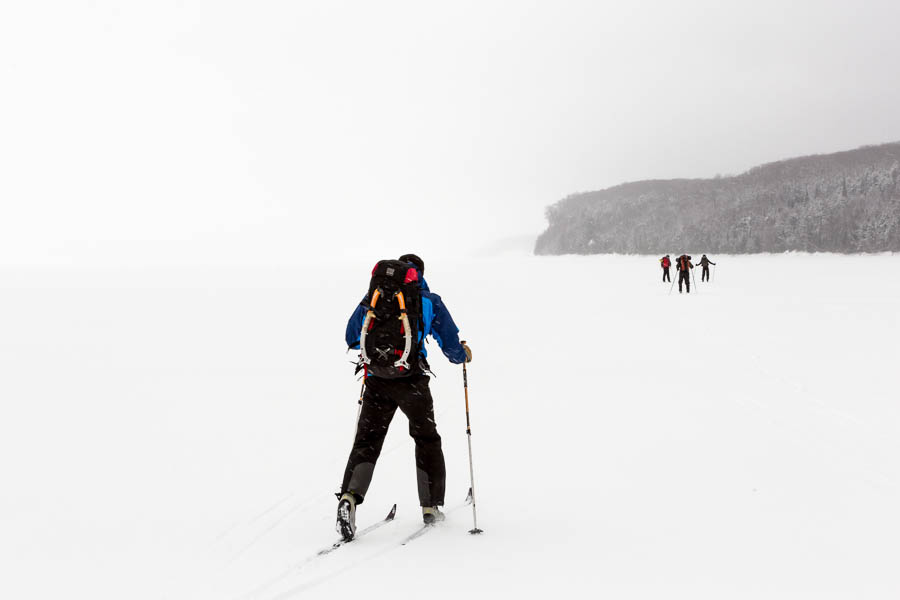
Skiing across Superior.

Spring is in the air in southern Wisconsin. Ice climbing season is over. Or is it?

We heard rumors that there was still climbable ice in Michigan's Upper Peninsula. Wanting to investigate, our group of four left Madison before dawn on a cold and dreary Friday. Drizzle turned to sleet as we headed north. A fifth climber joined us in Appleton, and we continued our journey. When we crossed into the UP, we were driving on icy roads, through a fog of fluffy snow. We had gone back in time, to a land still shrouded in winter.
Picture of Gokul.

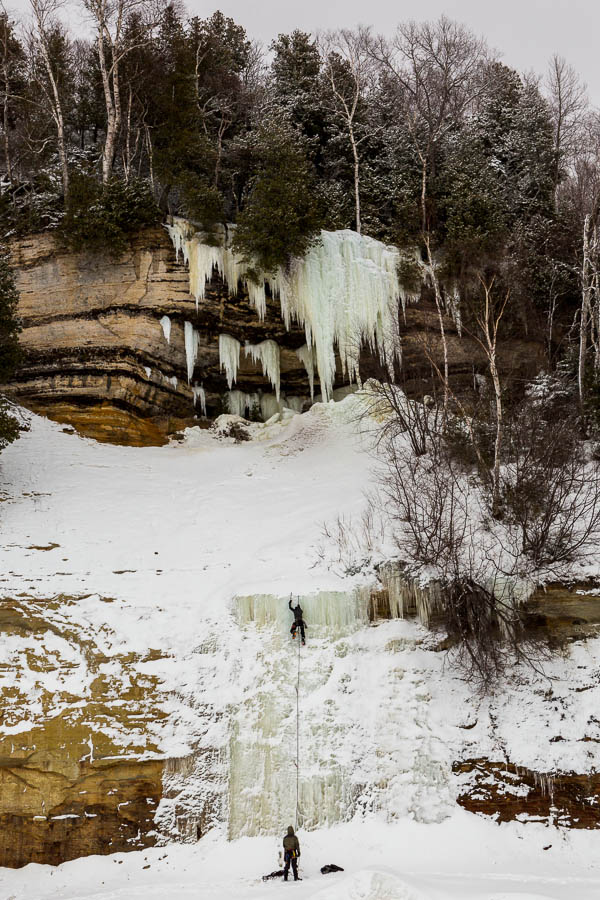
Gokul leading the first route of the weekend.

By the time we reached Munising, on Lake Superior's south shore, seven inches of fresh powder blanketed the land. The forecast called for seven more inches in the next twelve hours. A local gas station attendant thought we were crazy for driving north in an April blizzard. (She also said, “We only have two seasons here: shovelin' and swattin'.”) For us, coming to Munising was rational: this was our final chance to climb the best ice the Midwest has seen in decades.

Friday would be a short day of climbing, so we decided to stick with the ice along Superior's shoreline. Rather than hiking along the path, we chose to ski on the lake. We were concerned about the thickness of the lake ice, given that – even in Munising – there had been a few warm days in the last week. We stayed within view of one another as we skied into the wind next to the south shore's icy cliffs. Forty-five minutes into our journey, we spotted a wall of ice that looked climbable.

Gokul quickly led a route and set up an anchor. Meanwhile, Eric and Dunbar scouted “Midnight Rambler,” a column of fat ice nearby that required an approach up a steep hill. The wind soon was gusting at thirty miles per hour, pelting us with blowing snow. Grand Island, just a mile from the mainland, vanished in the storm. While rearranging my gear, the wind ripped a plastic bag from my hand and carried it into oblivion within seconds.

We got in a few climbs, then packed our stuff for the three-mile ski back to the car. Visibility continued to drop, until we were in a near-whiteout. My thirty-pound backpack (loaded with a BOSS sub, three days' food in a single sandwich) made me top-heavy and clumsier than usual; the wind nearly knocked me onto the ice on multiple occasions. We made it to the cars as darkness was setting in, cold and soaking, yet psyched for our big day ahead.
Picture of Katie on skis.

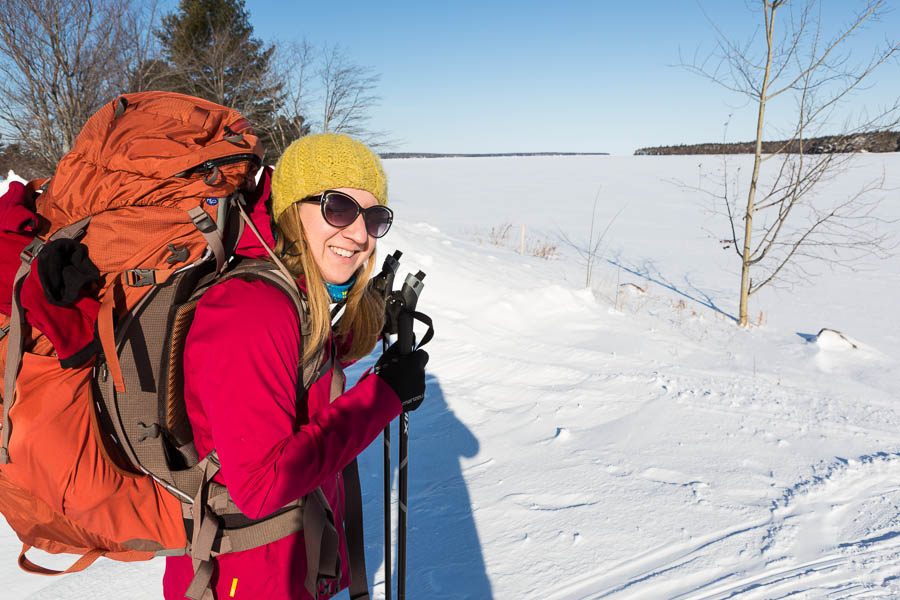
Ready for a long ski.

We got up from our “base camp” at dawn, dry and ready to go. Katie and Teresa had joined us in the middle of the night, declaring that the snow had stopped falling during their drive. The temperature had fallen to twenty degrees, perfect for outdoor winter fun. The previous day's blizzard was a distant memory – the air was calm and there was not a cloud in the sky. Our group of seven ate a large breakfast and packed for the long day ahead.

If the ice on Munising's shoreline is magnificent, then Grand Island's ice is world-class. Though the island is close to the mainland, the lake ice in the narrow channel that separates the two often isn't thick enough to walk on, even in the dead of winter. Because of its inaccessibility, no one in our group had climbed on Grand Island. Until today.

We parked in the lot used for ferry traffic in the summer and stepped onto the lake. All fears of thin ice were abated when we saw fresh snowmobile tracks leading toward the horizon. The ice we wanted to climb was about six miles from the parking lot, so it was going to be a long ski. Figuring this would be a good chance to brush up on my Mandarin (I'm moving to Beijing in July), I took out my MP3 player and started saying phrases such as “How many children do you have?” and “Where is the bathroom?” to the rhythm of my gliding skis.

Within an hour we spotted cliffs of ice, over 100 feet tall. If this had been anywhere else, we would've been happy to spend our day there. But this was Grand Island. We continued.
Picture of Dan.

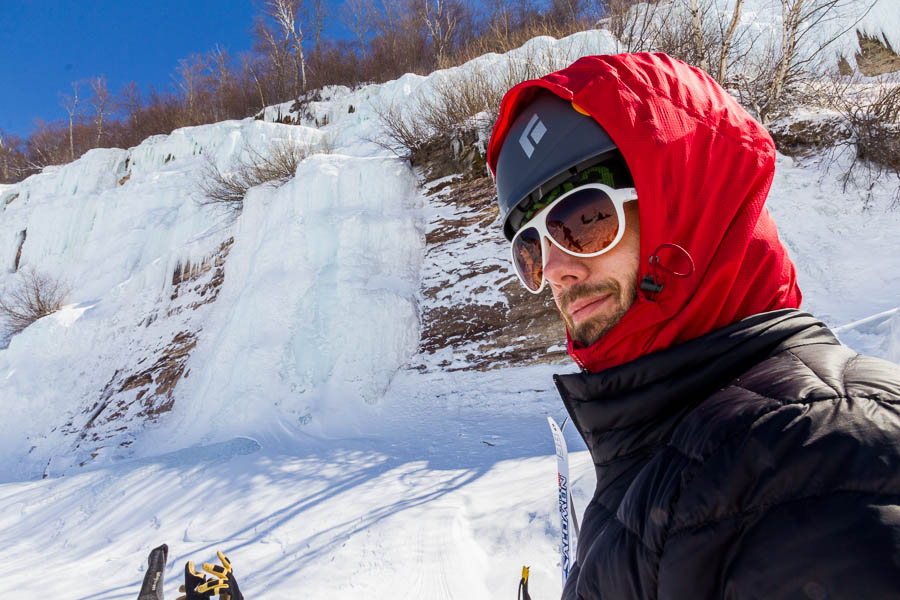
You see what we found?

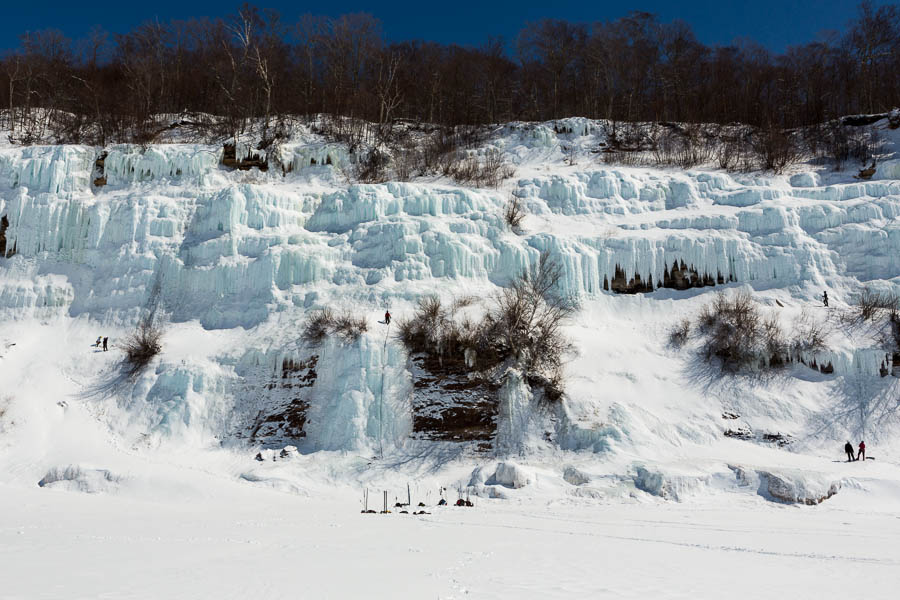
After two hours of skiing into the void of the world's largest lake, we stared in awe at what we had found: a quarter-mile stretch of continuous ice-covered cliffs, rising 150 feet above the shore. We had hit the jackpot, yet the formation didn't even have an official name in our guidebook. Even though Grand Island has a lifetime of ice to scale, it remains nearly untouched, year after year.

We changed into our climbing gear and got to work. Dunbar and Eric headed off to set up a route on the tallest cliff. Brett and I created an ice-screw anchor on a shorter line. Gokul, Teresa, and Katie went into multi-pitch mode. Soon we had three amazing routes within a stretch of a couple hundred yards. Our only regret was that we didn't have more ropes – or time – to climb with.
Picture of ice.

Three routes set up.

The temperature rose throughout the day, and by mid-afternoon it was in the forties. The lake became a snowy desert, reflecting the sun into our faces and desiccating our bodies. We shed layers, but with no shade, escape from the omnipresent rays proved impossible. Our skin soon sizzled.

The only other people on the lake were snowmobilers who, like us, were making their last rounds of the year. They tended to stop, snap a few pictures, and take off without talking to us. But while we were packing up, two men, who had been fishing a few miles further out, stopped to say 'hi.' Still curious about the safety of being on a frozen lake in April, I asked one of them how thick the ice was. He pointed to the three-foot-long spiral blade of his auger and said that it barely made it through the ice. Even so, with more warm weather in the forecast, the ice near the shore would soon be dangerously thin.

We said goodbye to the snowmobilers, finished packing, and began our ski back to the mainland. The setting sun illuminated the island's cliffs, enticing us not to leave. Too bad we weren't equipped to stay the night. I listened to another lesson in Mandarin and, exhausted, was barely able to dictate the phrases (one of which was “Please give me water”). We made it back to the cars in total darkness, with no reservations about skiing twelve miles to climb some ice.
Picture of Katie.

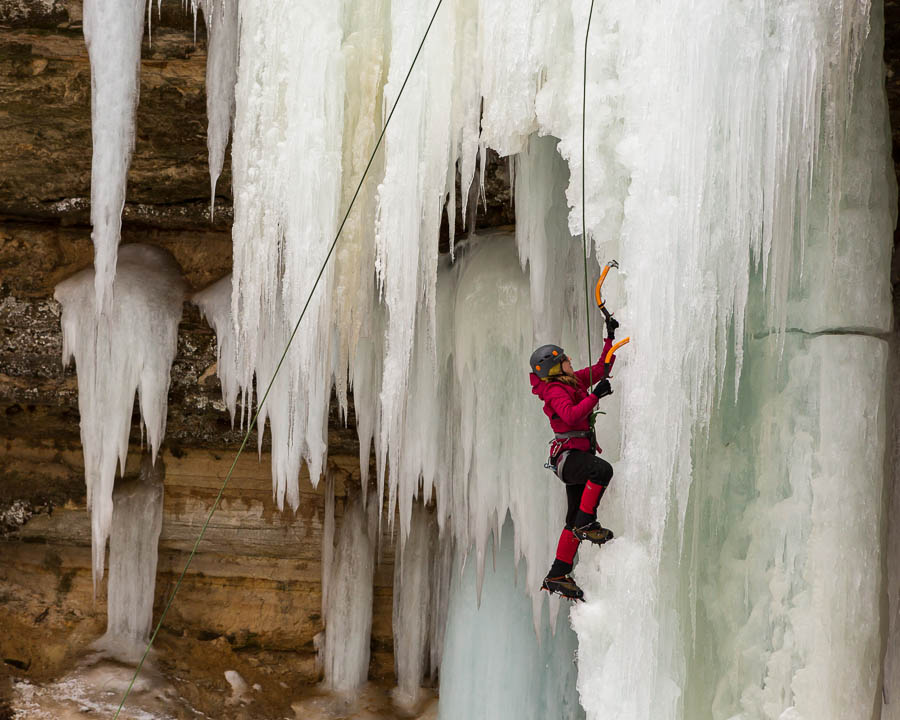
Katie climbing the Amphitheater.

With a half-day planned for Sunday, we decided to stick to climbs close to the parking lot. After a short walk we reached the “Amphitheater,” a narrow column surrounded by icy chandeliers. Conditions were rapidly deteriorating – the temperature had remained above freezing the previous night. Water dribbled down the ice and formed streams that trickled toward the lake. Birds of prey circled overhead, making us question why we were still here.

While some in our group debated whether The Amphitheater was still climbable (not only was it melting, but its main column had developed a horizontal crack), I found the “Dryer Hose” and began to set up two top-rope anchors. Katie, Gokul, and I climbed the Dryer Hose last December, in sub-zero conditions. More than three months later, the column was dissolving from the inside out, like a bleeding ulcer. Neither of our chosen climbs had much life left in them. We all took a few laps, carefully avoiding the hole in the Hose and the fissure in the Theater. Even though I got a cold shower while climbing the Amphitheater's column, it was still a fun route – the overhanging ice proved quite the challenge.

As we were getting ready to leave, with no significant injuries from falling ice, Nature threw one last stick at us. A waterlogged birch branch came hurling over the cliff and grazed Dunbar's arm before slamming into the ground, shattering into three pieces. Luckily, everyone walked away uninjured. You're never completely safe when climbing ice, even while standing thirty feet from the wall.

We were giddy during our drive back into spring – we had completed our last, grand hurrah of the best ice climbing season in memory.

More photos from the weekend

Chasing Summer: Down to the Ranch

Picture of Katie.

Katie climbing The Man in Black.

It was time to escape from a merciless Wisconsin winter. Late in March, with temperatures slightly above freezing in Madison, I drove with a group of six to the comparatively tropical climate of northern Arkansas. We had two goals: rock climbing and basking in warm sunshine.

We arrived at Horseshoe Canyon Ranch, famous for its sweeping sandstone escarpments, on a chilly Thursday night. While setting up our tents, we met a climber from Nebraska (yes, they actually exist) who informed us that it was going to rain throughout the night and all of the following day. The sky beyond the hills pulsated with lightning's glow. We were off to a bad start.

The rainstorm came fast and heavy, but by morning, it had stopped. The Nebraskan happily explained that the forecast had been upgraded – dry weather was expected until afternoon. The overcast sky looked ready to open up at any moment, so, despite being sleep-deprived, we got going as quickly as possible.

One huge advantage of climbing at Horseshoe Canyon Ranch is the short approach. The North 40 wall, the crag we intended to climb, was only a ten-minute walk from our campsite, passing through a barren forest. Another thing the ranch has going for it is a high concentration of beginner-friendly bolted routes. Soon, Katie and I had put up three routes and were teaching the beginners how to tie in and belay. Other groups gathered near us and climbed as much as possible while it remained dry. At 3PM our luck ran out and it started to drizzle. The rain continued for the rest of the day, soaking the cliffs and turning the ground to pure mud.

Picture of Ming.

Ming on The Controversy.

The fifty or so climbers at the ranch gathered under a shelter to make dinner. Katie's friend Daniel drove out to meet us late in the night. Since Katie last saw him in Germany four years ago, he had opened a brewery in nearby Fayetteville. He showed up with several growlers, instantly making him the most popular person at the ranch. Daniel explained that winter had been brutal in northern Arkansas – school had been canceled twenty-eight times this year. Kids were already making up for lost time on Saturdays, and they would continue to attend classes well into summer.

Picture of group.

Friday's pre-rain lunch.

On Saturday morning we ate breakfast under a clear sky, with temperatures approaching fifty. Because sunshine was already soaking the cliffs of the North 40, we decided to climb there again for the morning. Then, after eating lunch at our campsite, we walked to the Cliffs of Insanity, on the canyon's east side. Our first route was a classic called “Swamp Rat,” which was just entering the sunlight when we arrived. Soon it was in the seventies and I was covering myself with my jacket to avoid getting burned. We got in a few more climbs before heading back to camp at the end of a day of perfect weather. I no longer had any regrets of driving twenty hours to climb some rocks.

Picture of Guilhem.

Guilhem after climbing Swamp Rat.

With a short day planned for Sunday, we headed to the North 40 yet again. There are so many bolted routes on that side of the canyon, you could climb there for weeks without getting bored. After putting up an easy route called “Spam,” I got another chance to climb “Sonny Jim,” a 5.11a I climbed last year. It was just as fun this time, and the fact that it was in the seventies again made it all the more fulfilling.

We left the ranch feeling tired from climbing, yet totally relaxed from getting so much sun. On the way home, we had lunch at the Ozark Cafe in Jasper. They have the greatest breaded fried mushrooms I have ever tasted. It's almost worth driving ten hours from Wisconsin just for that food.

More climbing photos from Horseshoe Canyon Ranch

External Websites:
Hoofers Outing Club Website
Horseshoe Canyon Ranch Website
Apple Blossom Brewings Website