Author Archives: Dan Perry

About Dan Perry

Dan created this blog to document his South America trip, which covered every country on the continent and lasted over two years. He currently lives in Madison, WI.

The Future of The Facebook

facebook_question

Credit: flickr.com/birgerking

Have you noticed any changes on Facebook lately?

The world's most popular social network recently began to filter content in users' news feeds. The result is that when you create a new post, it only gets sent to a small percentage of your friends. If those friends engage with your post (i.e. they like, comment on, or share them), then it gets sent to more of your friends. Because of this, your news feed is no longer a chronological ordering of all new posts.

This may work fine for people who use Facebook to keep in touch with family and friends, but what about those of us who maintain public pages?

Is Facebook still useful as a promotional tool? Should we migrate to any other social networks?

Enter Catherine Ryan Howard

Irish author Catherine Ryan Howard is one of the top authorities on self-publishing today. Her delightfully quirky blog Catherine, Caffeinated is full of great advice. I used her book Self-Printed as a constant reference while publishing my own book, 1000 Days Between.

Catherine is releasing an update to Self-Printed today. It's actually a complete rewrite from the previous edition. The world of self-publishing is changing quickly, and this book promises to give authors the latest tools in the industry.

I recently asked Catherine the following:


Two years ago, when the second edition of Self-Printed came out, Facebook was easily the top social network for authors looking to reach new fans. Does that still hold true today? How about two years from now – do you foresee any other social networks taking Facebook's place?


Her response:

I do think Facebook is on the way out, especially for authors (as in, public pages). I blogged about it recently in some detail:

http://catherineryanhoward.com/2014/07/05/closing-the-facebook/

As for other networks taking its place, if there's any growing network out there at the moment, it's a visual one, i.e. Pinterest or Instagram. Now while I love using these, I don't think they're the best for authors. I think actually using them is kind of unnatural for authors, as in we have to bend and break in order to fit in there, seeing as we're not, say, graphic designers or bakers and can use images in a natural way to promote our work. So I'm sticking to what I know works and what I see continue to work in the near future: blogging and Twitter. Rather than trying to find ways to establish yourself on new sites, I'd say work on maximizing your use of those. You can't go too wrong then.


I think Catherine makes some good points. The thing I like about running a blog is that I own it. If I get booted from a social network, or if it goes belly-up, I could lose everything I've ever written on that site. But I get to control the future of my own blog. And for that reason, I'll continue to post the vast majority of new content here, and not on any external sites.

Here's where I stand with the social networks Catherine mentioned:

Twitter – I like the concept, though admittedly, I'm just getting started. I'll plan to tweet more in the future.

Pinterest and Tumblr – I have an account with both of them, but like Catherine said, they don't seem very useful in promoting books. I have used them both for posting photos, though.

Facebook – I have a personal account, as well as a page for this website. I don't think I'll update my page much in the future (not that I've ever really used it). It's not worth the effort. I certainly won't pay Facebook to “boost” my posts.

What social networks do you use? Have you found them useful for promoting products? Go ahead and leave a comment below.


More about Catherine Ryan Howard

Blank white book w/pathCatherine Ryan Howard is a writer, self-publisher and caffeine enthusiast from Cork, Ireland. SELF-PRINTED: THE SANE PERSON'S GUIDE TO SELF-PUBLISHING (3rd edition) is out now in paperback and e-book and available from Amazon. Follow the #selfprintedsplash on Twitter today (Friday 24th) and/or visit www.catherineryanhoward.com for chance to win an amazing prize that will get your self-publishing adventure started!

“SELF-PRINTED is my self-publishing bible. It taught me how to format, create and upload my e-books and print-on-demand paperbacks. It showed me practical things such as how to build a website/blog and how to promote my books. More importantly, it taught me how to compete with the professionals. Just look at the results - The Estate Series has sold nearly 100,000 copies and following that I got a traditional book deal with Thomas & Mercer too, so I’m now a hybrid author. Jam-packed full of hints and tips all in one place, I’m always referring back to it. In a word, it’s priceless.” – Mel Sherratt, author of The Estate Series and DS Allie Shenton Series  


* I should let you know that Catherine gave me a copy of the third edition of Self-Printed. Last year I purchased the second edition and found it extremely helpful. I'm looking forward to reading her latest insights.


P.S.

If you have a few extra minutes, you should check out these two videos by Veritasium. They go into great detail about Facebook's new algorithm for displaying posts, and why it's worse than useless to pay Facebook to “boost” posts:

Note: I don't make money when you watch these videos. I'm just a big fan of Veritasium's YouTube channel.

Moerdaoga: Tracing the Great Khan's Footsteps

Picture of Dan.

Gazing across Moerdaoga.

Sept. 29 - Oct. 2, 2014
Days 74 - 77
Northern Inner Mongolia Trip, Part II
(In case you missed it, here's Part I.)

According to legend, early in the thirteenth century a nomadic tribal leader went on a hunting expedition to a mountain at the eastern edge of the Eurasian Steppe. As he stood on the summit, the spectacular view of the surrounding grasslands and forests inspired him. The man suddenly realized his desire to unify all of the tribes in the region. He gazed at the golden sunrise and commanded to his tribesmen, “Moerdaoga!” – “Ride into the battle on your horses!” The man's name was Genghis Khan, and this land would soon fall under his rule.

Eight hundred years later, two bleary-eyed Americans stepped off a train in Moerdaoga, and the spectacular view of the surrounding forests and parking lot inspired them. They suddenly realized their desire to find a comfy bed. Gazing at the golden sunrise, they commanded to a group of taxi drivers standing before them, “Ungha ungha,” which roughly translates to “Drive us to a hotel in your car!” A mighty battle ensued amongst the great drivers of this land. In the end, one woman triumphed. The Americans hobbled into her car and she took them to her tribesman's humble inn, lit by candlepower in the long and cold nights. And they slept.

* * *

When Katie and I woke from our long nap, we went for a walk around town. There wasn't much to see – some Soviet-esque buildings, a Pegasus statue, a lumberjack monument – but our main goal was to stock up on supplies for the next few days. When I had told our taxi driver of our plans to camp at Moerdaoga National Forest Park, she had offered to drive us to the entrance the following morning. Two days later, she would return to pick us up.

We had no problem finding food in the village's small-but-vibrant market. The only issue was that we couldn't locate any fuel for cooking. My camp stove could run on anything from kerosene to gasoline, yet we had found it extremely difficult (maybe even impossible) to acquire any such fuels in China. (Trust me, I've spent many hours trying. Someday when my blood stops boiling, I'll write a blog entry about this frustrating experience.) Thanks to China's “safety” regulations, we wouldn't be able to cook with the same stove I had used hundreds of times in dozens of countries without blowing myself up (sorry, blood still boiling). Instead, we stocked up on bread, Chinese Spam, spicy tofu strips and a jar of locally-made blueberry jam. The latter would go well with the jar of peanut butter we had brought from Beijing.

It got dark and cold early in Moerdaoga, so Katie and I went to a restaurant for a bowl of warm soup. It was a romantic candlelit dinner – for reasons unclear, the electricity was off throughout the town. That was all right, though. It meant we would finally get a good night's rest.

The next morning our driver was at our hotel ten minutes early, with a big smile on her face. As we walked to her car, the owner of the hotel stopped us and took our picture. That's right, foreigners are a novelty in Moeradaoga, even to the local hotel owners.

Picture of highway.

The highway to Moerdaoga.

The highway took us straight through the forest, full of birch and pine trees, that had inspired Genghis Khan 800 years prior. We did a loop around the park and took several breaks to hike on boardwalk “trails.” The deep blue sky and natural beauty of the forest was stunning, especially after having spent the past few months in a big city. The best part of being there was that we could suck in long breaths of fresh air. The only downside was that we had arrived a bit too late to see the fall colors in full force.

During our drive through the park, we met some tourists from Hong Kong who spoke English. They were the first English-speakers we had met since leaving the train. We had been communicating with our driver using my limited Chinese, so we were relieved to have temporary translators. Our driver related to the Hong Kong folks that she was hesitant to drop us off in the forest for two days. What would we eat? How would we keep from freezing? Eventually we convinced her that we would be fine. After all, we were traveling with a large can of Chinese Spam and warm sleeping bags. What could possibly go wrong?

Picture of tent.

Our campsite.

After our driver left, we set up camp in the forest and went for a long walk along the highway. I listened to a podcast called “Wrath of the Khans” by Dan Carlin. It gave a detailed account of the life of Genghis and his descendents, their rise to power and the legacy of their empire. The Mongols were brutal (to put it lightly), and I could see why they terrified everyone they came into contact with. Nevertheless, I admired the Mongols' ability to live off of the land. They thrived in the face of near-daily life-threatening challenges. I, on the other hand, almost ran away when I spotted a fake moose.

Back at camp, we opened our Chinese Spam (not real Spam, please don't sue me). A thick, translucent layer covered it.

“Is that ice?” I asked. The air was getting cold with the coming night, but it was still above freezing.

“Nope. Just fat,” Katie said.

We scooped off the fat and reluctantly ate the “meat.” Luckily, a trash can was a short walk from our campsite. The half-eaten Chinese Spam and fat dollops probably made some critter's night.

* * *

Two days later our driver showed up fifteen minutes early, as we were finishing our spicy dried tofu breakfast. We wolfed down our food and broke camp. We had managed to stay warm during the cold nights, but the tent wasn't faring so well – it was sagging under the layer of accumulated ice.

Our driver convinced us that we should visit the Russian border. She took us along a bumpy road, through more birch and pine forests with cell towers disguised as trees (or were they trees disguised as cell towers?). Along the way we stopped to buy dried blueberries and mushrooms from a roadside stall. Eventually the forests gave way to grasslands and we entered Shiweizhen, where the signs were written in Chinese, Mongolian, Russian and English. A river ran next to the village; Russia was on the other side. Barking dogs and crowing roosters were barely audible. I couldn't tell what language they were speaking.

We walked around town and found several shops selling identical touristy stuff: Russian dolls, Russian vodka, Russian chocolate, Russian clothing. The only Russian attraction the village was missing was a bona fide Russian person.

Eventually we grew bored of shopping, so we did what came natural: we snuck across the border. Next to the river was a stage of sorts, with the flags of both countries in the backdrop and seating for around 100 people along the edges. Katie wondered what the stage was for. I speculated that it must have been located in “no man's land,” where there were no laws, and therefore, it was a cockfighting ring. Some college girls approached us for a picture, and one of them explained the less-sexy truth: This town was the setting for a popular TV show called “My Natasha,” in which a Chinese man falls in love with a Russian woman, but she's on the other side of the river. I still wasn't sure what the stage was for, though. Maybe there was a cockfighting scene in the show.

New friends.

Katie and I, with our driver in the middle.

Our driver was smiling when we came back to her car. She had gifts for us: “Twinkies,” filled with egg yolks instead of frosting. We couldn't get enough of those. Even though we spoke little Chinese and she didn't speak a word of English, we could tell our driver was a great person with a kind heart. We felt really lucky to have found her when we stumbled off of the train.

When we returned to Moerdaoga, we were delighted to see that not only was the power on, but our internet connection was surprisingly fast. Now that we were back on the grid, we turned our attention to our next destination in the land of the Khan...

What's next? How about reading Part III of this series.

More photos from Moerdaoga

External Link:
Hardcore History. For now, at least, “Wrath of the Khans” is still available for download. This is not a sponsored link. I don't get paid when you click on it. I'm just a fan.

Beijing Hutongs, Part II

Are you planning a trip to Beijing? If so, then make sure you include a visit to a hutong in your itinerary. These shared-housing neighborhoods offer a fantastic real-life glimpse at traditional Chinese culture. Unfortunately, many of Beijing's hutongs have been leveled in favor of apartment towers, but a few have received historical status, protecting them from demolition. Here are some pictures I took during a recent visit to the hutongs of Beijing's Lake District.

Picture of crowded street.

The Lake District is a traditional neighborhood in central Beijing.

Picture of Bell Tower.

In ancient times the Bell and Drum Towers were musical instruments and timekeeping devices. Today, they are historical landmarks.

Picture of men.

The locals regularly take strolls through their beloved hutongs.

Picture of mahjong.

Small fortunes are won and lost in games of Mahjong, often played in public parks.

Picture of courtyard.

Doorways leading to central courtyards are sometimes left open.

Picture of door.

Other doors are locked with chains and padlocks.

Picture of workers.

Sanitation workers ride through the hutongs on bicycles...

Picture of trash.

And emerge carrying full loads of trash and recyclables.

Picture of street vendor.

Street food is abundant in the hutongs...

Picture of rickshaw.

As are bicycle rickshaws...

Picture of smoking man.

And smokers...

Picture of performers.

And street performers.

Picture of rubble.

Unfortunately, some of the houses are crumbling...

Picture of construction.

And others are being demolished.

More photos from the Lake District

Riding the Rails to Moerdaoga

Picture of train.

The train to Hailar.

Sept. 27 - 28, 2014
Days 72 - 73
Northern Inner Mongolia Trip, Part I

We had been warned about Chinese national holidays. A few times per year, almost everyone in the country goes on vacation, all at once. The transportation infrastructure is overwhelmed, the hotels overcrowded. The message was clear: if you choose to travel during a Chinese holiday, you do so at your own peril.

Such a holiday fell during the last week of September, and Katie and I were ready to leave Beijing. But where could we go, knowing that a billion other people would also be traveling? We were hoping to see some fall colors. With a bit of research, we found one area that was far enough from any city that it might not be completely packed, yet close enough to Beijing to visit on a week-long trip. Nestled in the northernmost reaches of the country, close to the Russian border in the Inner Mongolia Autonomous Region, was Moerdaoga National Forest Park. Katie's guidebook for China didn't cover the park, and the articles we found online simply said that Moerdaoga was renowned for its fall colors. We decided to head to Hailar, the biggest city in the region, and wing it.

Hailar was a two-hour flight from Beijing, but it was also connected to the country's elaborate railway system. Give a choice between flying and taking a train, I'll almost always choose the train. How much can you see from 35,000 feet?

The trains going from Beijing to Hailar were slow and old. This particular trip would take thirty hours. That wouldn't be a big deal if we could get a sleeper cabin, but they were sold out. If we wanted to go to Hailar by train, we would have to do so in a “hard seat.” Reluctantly, Katie agreed to take the train with me, and she bought a plane ticket back to Beijing. I wanted to travel home overland, possibly making some stops along the way, so I decided not to buy a return ticket until I was ready.

Beijing's long-distance train station was huge. A massive pavilion was outside, and thousands of people with suitcases and backpacks were milling about. There was barely room to walk. Three men in camouflage uniforms stood guard at the edge of the crowd, assault rifles pointed downward, index fingers resting next to the triggers. Behind them was a van with blackened windows. Troublemakers wouldn't last long here.

There were about twenty lines, each thirty people deep. Nothing was written in English and we didn't see any other foreigners who might be able to help us make sense of this place. Luckily I had already scouted the station a few days prior, so I knew which line was the “will call,” where we could pick up our tickets. The shock of seeing so many people in such a small space dissipated, and we found that the lines were moving surprisingly fast. Within a few minutes, we were inside the station, ready to board our train.

Train loading was quite efficient, given how many people were waiting to board. Our “hard seats” had the same amount of padding as a Chinese bed (not much). We were lucky, though – many people were standing in the aisle. Katie and I sat next to each other, and a woman and her teenaged daughter faced us. This configuration gave us plenty of legroom, and several moments of awkward eye contact. Thirty hours is a long time to spend staring at someone three feet from you, especially when you don't share a common language.
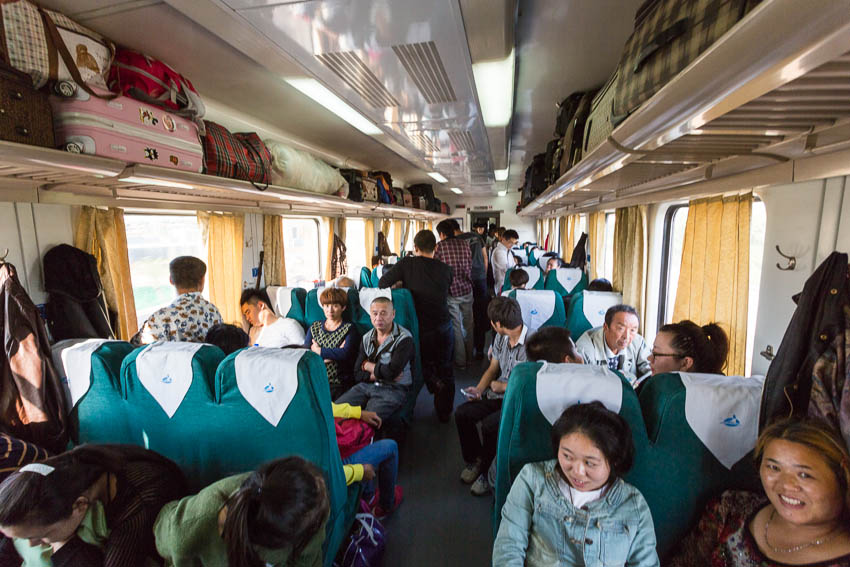
Picture of train.

Inside the train.

Our train left on time. At first we went south, across Beijing, and soon we were outside of the city center. But the population didn't cease. We passed multiple clusters of 8-12 identical apartment towers, each between 15 and 20 stories tall. How many people lived in these complexes? One thousand? Two thousand? For many of them, the answer was zero: they were still under construction. I was glad that at least some of the hutongs (traditional shared housing neighborhoods) had been saved from demolition. The towers had no personality. They were the same buildings, repeated ad nauseam.

When we crossed Sixth Ring Road, we were outside of the metropolitan area, heading east toward the coast. Small cornfields started popping up, but there were still clusters of apartment towers. Cornfields, towers, cornfields, towers. After two hours of this, we reached the city of Tianjin, and there were more towers. We turned north and continued through population centers that would be major cities in the US. Here, they were just names. Tanshang, Jinzhou, Shenyang, Changchun.

Now that we were settled in for our long journey, the people in our car got comfortable with one another. The girl across from us played with her mom's hair. On the other side of the aisle, a teenaged boy leaned forward, cupping his girlfriend's hands in his own. She leaned back, feigning disinterest. One by one, people walked to the small space between cars and lit cigarettes. The windows were closed, so the smoke drifted toward us and soon filled our car. This was not unusual – smoking was permitted almost everywhere in mainland China. I was still adjusting.

Between cities we continued to pass complexes of unfinished apartment towers. Counting them became a game. A thousand future residents. Two thousand more. Another thousand... How were they going to fill these places? How much longer could the construction keep going?

New noises constantly filled the train – salespeople hawking food, drinks, leather belts and plastic carps that “swam” in circles on the floor, glowing gold and playing loud music. People talked on phones and to one another. The train itself was also noisy, click-clacking along the tracks and blowing its whistle every few minutes. There was never a dull moment.

Four hours after we left Beijing, the cities finally gave way to huge cornfields. The landscape became hilly. We passed a few open-pit coal mines. Bullet trains occasionally flew past us in a white blur. We chugged along, never exceeding forty-five miles per hour.
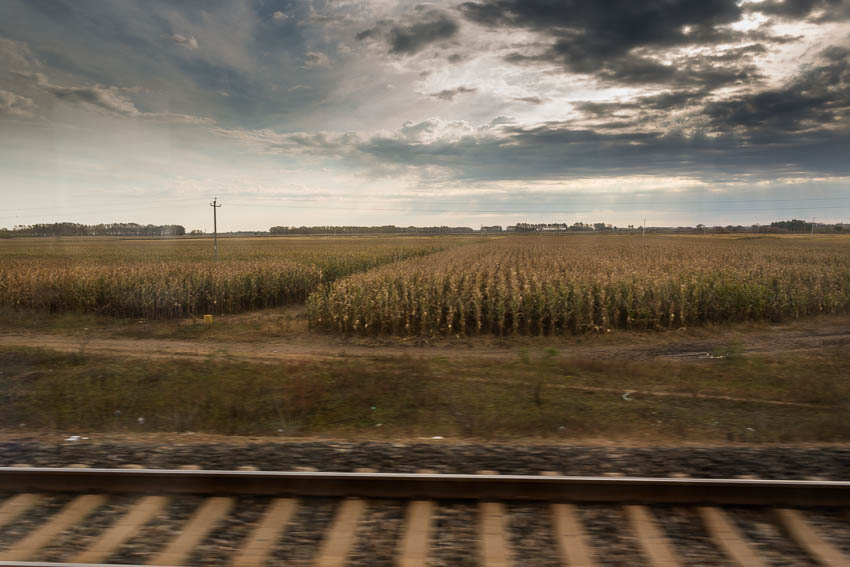
Picture of cornfields.

Northern Chinese cornfields.

At one point a train employee walked to the center of our car and gave a long sales pitch for a massager. When he was finished, he walked down the aisle and asked if anyone wanted a demonstration. He stopped at me. Before I knew it, he had stuck two electrodes to the back of my neck. Everyone sitting near us peered over their seats and watched. The salesman turned on the device and my shoulders shook uncontrollably. He changed the setting and my neck jerked back and forth. It was horribly uncomfortable. Finally I cried out, “I don't want it!” in Chinese. Laughter erupted all around us. I felt bad for making the salesman look like he was selling a shoddy product, but he laughed off the insult. After he was gone, Katie informed me that she had volunteered me for the demo when I wasn't looking. I wasn't mad – someday I would get my revenge.

The girlfriend sitting across from us got up and walked away. Her boyfriend finally leaned back in his seat and played with his phone instead of her hands. After she had been gone for a couple of hours, I assumed she had left the train, but eventually she returned to her seat. Her boyfriend feigned boredom, and now she was vying for his attention. They went back and forth like this all day.

I listened to podcasts, read a book and napped. At around 11 p.m., the lights went out. I leaned forward, placed my head on the table in front of us and fell asleep (it was like I was back in high school). Eventually I started burping and woke up. I tried sleeping while sitting upright, but my head bobbed uncontrollably and I woke up again. I leaned against Katie, but she could only handle it for so long before shoving me away. Then I repeated this trio of sleeping patterns. The other people near me appeared to do the same. I now understood the largest disadvantage of arranging the seats so that they faced one another: the seats didn't recline.

I woke at sunrise. My neck and back were sore and I was too tired to sleep. Luckily Katie and I had brought coffee and a French press with us. The train provided hot water, one of the best amenities commonly available in China. Besides our coffee, we indulged in bread and granola bars for breakfast. The other passengers ate buckets of ramen noodles, boiled eggs, sausages, cabbage and mushrooms.

We were now in the northernmost reaches of China, a world away from the cities we had seen the previous day. A fresh coat of September snow blanketed the ground. The villages we passed were small, even by American standards. Some of them looked abandoned (had their former residents moved into apartment towers?). Others were clearly mining towns – they were surrounded by quarries, and dump trucks full of coal drove through them. Many houses had gardens. Cabbage appeared to be the principal crop.

The salespeople worked their way up and down the aisle, selling the same food, drinks and gadgets. Every couple of hours, the train's seven conductors marched past us, impeccably dressed. After every stop, one of them entered our car and announced our next destination. Interestingly, these were the same employees as the previous day. Apparently, they were on a thirty-hour shift.

A girl who had been sitting near us got the nerve to approach us. She was studying at a university in a city near Beijing. Her English was good, yet she was clearly terrified of using it. I've heard this is common in Chinese culture, but I knew what she was going through. I constantly found myself thinking, I can't start a conversation in Chinese. I need to improve my Chinese first. Never mind that having such a conversation was exactly how I could improve my Chinese.
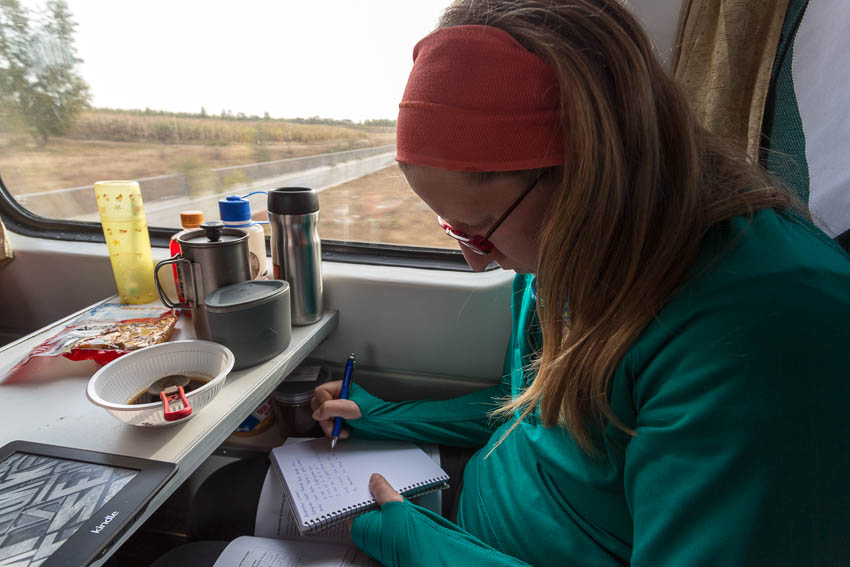
Picture of Katie.

Katie writes in her journal.

When the mother and daughter left our car for a while, a teenaged boy took a seat across from us, looking infatuated. Whenever I looked up from my book, I noticed that he was staring at me. Not in a creepy way; he just seemed curious. Once while I was reading, I heard the sound of a camera shutter. I looked up and saw that the boy had attempted to take a discreet photograph with his cellphone, but he had forgotten to turn off the fake shutter sound. The girl who had spoken to us in English was sitting next to him, and she looked mortified. I didn't mind, though – I take candid photographs all the time, so it was only fair. Now that the ice had been broken, we all got trigger happy with our cameras.

We reached Hailar a bit before sunset. It had been an amazing train ride. I loved witnessing the transition from metropolis to smaller cities to snowy hinterland. We said goodbye to the people we had befriended over the last thirty hours; they grabbed their luggage and vanished. Katie and I were exhausted after our night of fitful sleep, but we were still a long way from Moerdaoga.

After leaving the train, we went over our options for traveling the rest of the way to the park. We figured out that a train was due to leave for the village of Moerdaoga in a few hours. It would tack another twelve hours onto our trip, but we bought tickets anyway, with the thought that we could sleep the following day.

The train to Moerdaoga was significantly older than the one we had ridden to Hailar. The “hard seats” were wood benches. The paint was chipping. The bathrooms were filthy. At least it wasn't quite full.

Just like the last train, this one left on time. Say what you want about China, but it is a punctual culture. Between the plumes of cigarette smoke that immediately filled our car, we saw that our old friend, the infatuated kid, was on this train as well. He moved to the seat across from us and stared.

The guy sitting next to the infatuated kid smiled and offered us apples. We gladly accepted and gave him oranges. He upped the ante, handing me a vacuum-sealed package containing three hard-boiled eggs. The shells had been removed, and the “whites” were brown. I repeatedly told him that I didn't want the package, but he forced me to take it. I had yet to figure out how to gracefully turn down a gift in China. Not wanting to make the man “lose face,” I ripped open the package, bit into one of the vinegary eggs and acted like it hit the spot. The guy wouldn't stop, though. He forced us to take two moon cakes and some “Twinkies,” filled with egg yolks instead of frosting. We tried to give him a chocolate bar, but he wouldn't accept it. Instead, he continued to hand us food until he was out.

We had another night of little sleep. The generous man got up every half-hour to smoke between the cars, waking Katie and me in the process. Eventually he stopped getting up and chain-smoked from his seat. At least he didn't force us to take his cigarettes. I couldn't blame the generous man for smoking. It was probably his way of passing the time during our insomnia-inducing ride.

At last we arrived in the village of Moerdaoga at 9 a.m. Most of the leaves had already fallen from the trees, but I didn't mind. The sky was blue, the air was crisp and clean and the forest surrounding the village was still beautiful. Even before I exited the train, I knew I wouldn't regret coming here.

What's next? How about reading Part II of this series.

Or you can check out the full photo album from this entry.

Wangfujing Critter Market

Wangfujing is a popular shopping district in central Beijing. One day, Katie and I were walking along Wangfujing's main street with Brendan, a friend from home. We found an alley that turned out to be the famous “critter market.” This place looked like it was designed intentionally to gross people out with its strange foods and beverages for sale. It proved to be a fun experience.

Here are some photos:

Picture of crowd.

The main pedestrian avenue in Wangfujing is full of fast food restaurants and modern shopping malls. And of course, construction cranes.

Picture of crowd.

We found a crowded alley and shuffled forward.

Picture of critters.

Movement caught the corner of my eye. This man was completing a bouquet of seahorses and scorpions on sticks. The scorpions' legs and stingers twitched under the bright overhead lights.

Picture of scorpions.

The vendor was a showman. He allowed the scorpions to crawl on his hand. Katie was disgusted. From behind the lens, I was saddened.

Picture of Brendan.

“No way I'm eating live scorpions!” Brendan said.

Picture of crowd.

Eventually the showman convinced us to buy a stick. The scorpions were deep-fried. They tasted like bacon.

Picture of crowd.

I also bought some cicadas. Crunchy on the outside, squishy in the middle.

Picture of vendors.

There were many more vendors in the alley, selling all sorts of tasty meats.

Picture of cocktail.

Katie washed her meal down with a delicious dry-ice cocktail.

Picture of trio.

Brendan, me and Katie, going strong after our interesting dinner.

More photos from Wangfujing

No Guts, No Story

Picture of Katie.

Katie eats a dumpling.

“You hungry?” I asked my girlfriend Katie. It was Sunday afternoon, and I was starving.

“I could eat,” she said. “What did you have in mind?”

“Let's find a cheap local place. I'm sick of eating pizza and burgers.” Three weeks prior, we had moved from the US to a suburb of Beijing, China. Katie's new co-workers had introduced us to several Western restaurants. Their food was good, but expensive. I wanted to find a hole-in-the-wall Chinese restaurant, somewhere I could stop for a quick meal whenever I was hungry.

An idea popped into my head. “Let's get on bus twenty-six, see where it takes us.” There were no maps at the bus stops, and the routes were only printed in Chinese characters, which we couldn't read. The best way to figure out where the buses went was simply to hop aboard.

We walked to the bus stop, and bus 26 quickly arrived. It took us a few miles west, then stopped. Our driver said something in Mandarin that we didn't understand, and the other passengers stood up.

“Looks like this is the end of the line,” I said. We got off, along with everyone else, and the bus did a u-turn and headed back toward our neighborhood.

We were on a dusty road, near a major highway, and few people were walking around. Nevertheless, there were several small shops on the opposite side of the road. We ran across, dodging traffic, and peered into the windows. We found a restaurant and walked inside. The place was empty.

We took a seat and looked at the wall, where the menu, written entirely in Chinese characters, was posted. I had been in this situation once before. That time, I had pointed at a random item, and it had turned out to be a delicious noodle dish. But we wouldn't need to employ the “point-and-pray” technique this time: hanging on the wall next to the menu were four blurry, pixelated photographs of food.

The waitress came up to us and lingered while we decided what to order.

“That one looks good,” I said encouragingly, pointing at a photo of a plate of noodles and vegetables.

“No way,” Katie said. “I think those are chicken feet.” She pointed at the side of the bowl.

The photo was of such low quality, I hadn't noticed. I squinted and said, “Maybe they're pitchfork-shaped noodles. With claws.”

“I don't think so. Let's get something else.” Katie had been battling a stomach bug for the past few days. Chicken feet are a delicacy in China and we would try them eventually, but today we would have to opt for something bland.

While we were talking, two teenaged boys came in, sat down and got the waitress's attention. They quickly placed their order and the waitress went into the kitchen.

“All right, let's try that one,” I said. The photo I was looking at was of a bowl of soup. Something resembling chunks of meat were floating in it.

“Fine, but we should try this beef dish, too.”

When the waitress returned, we ordered both dishes and two bottles of beer. A few minutes later, the waitress brought our beers and a plate of cold roast beef, covered in cilantro. The portion was small, but delicious. We toasted our luck in finding such a delectable dish, in a country where we couldn't speak – or even read – the language. We were ready for more.

The soup came next. It contained several cloves of garlic and a few green beans, but it was mostly filled with shriveled lumps of...something.

“Are those mushrooms?” Katie asked.

“I don't think so.” The soup had a distinct odor that I couldn't quite place. I grabbed a “mushroom” with my chopsticks and put it into my mouth. It didn't have much flavor, but its chewy texture made me want to spit it out. I tried, unsuccessfully, to tear the “mushroom” with my teeth. I took a swig of beer and swallowed it whole.

Picture of lunch.

“Well? What is it?”

Finally I recalled eating menudo in Mexico, many years before. “Cow guts,” I said, matter-of-factly.

Katie pinched a clove of garlic in her chopsticks and ate it. Then she dug around the guts and came up with a green been. She didn't say anything about the elephant in the room.

The waitress brought out two bowls of noodles for the teenagers. I didn't see anything resembling intestines in their meals. I wondered why we hadn't simply asked for the same thing they were having. Maybe we weren't so travel-savvy, after all.

Returning to the task at hand, I popped an intestinal chunk into my mouth. I figured this dish was a delicacy in China and I didn't want to offend the wait staff. But there were at least thirty pieces left and I didn't think I could take much more. I took a big gulp of beer and forced the second piece down my throat. If I kept this up, soon there would be an undigested pile of guts flowing through my guts. “Aren't you going to try some?” I asked.

“I don't think so.”

“Come on, you have to help me. Eat your guts.”

Katie cringed. “All right, I'll try one.” She tentatively grabbed a piece and started chewing.

Our waitress sat at the table behind Katie and played with her cellphone.

I took out my phone and looked up the Chinese character for “intestine.” Sure enough, it matched one of the characters on the soup photo. Then I turned my attention to the menu. Most of the dishes cost 10-12 yuan. Now I saw that our tiny roast beef dish cost 40 yuan. Our intestine soup was 38 yuan.

The teenagers stood up and one of them threw a twenty-yuan note on the table. They snickered at the sight of Katie, grimacing as she chewed, and left.

Katie swallowed the rubbery chunk, then followed it with a long draught of beer. “Where's a stray dog when you need one?” she asked.

“Eat your guts,” I said.

“I can't handle more.”

“Look, we just ordered the two most expensive items on the menu. Let's get our money's worth.”

“That figures. We should've known they would only take photos of their specialties.”

I chewed another piece of intestine and tried to imagine it was a juicy steak. It didn't work. I was done.

Katie asked the waitress for the bill. Then she said to me, “Look on the bright side. You could write about this in your blog. We wouldn't have had this experience if we had ordered pizza.”

Over the past few days, she had encouraged me to blog about everything we had done. Apparently I hadn't been updating my website enough for her taste. This time, she was right. No guts, no story.

Beijing Hutongs, Part 1

Hutongs are northern China's traditional back alley neighborhoods. Their houses are small; their bathrooms are shared. They typically have communal central courtyards. Some hutongs date back to the Ming dynasty of the fifteenth century. In recent decades, many hutongs have been demolished to make way for highrise towers and wide avenues. Only a few have been protected from modern development.

One day while walking around central Beijing, I stumbled upon Jiaochangkou Hutong and got my first brief glimpse of Old China. About a week later, I walked through Wudaoying Hutong. Here are some photos from those experiences:

Picture of woman.

An elderly woman is pushed through an alley in Jiaochangkou Hutong.

Picture of vendor.

Fruit vendors abound on the quiet, narrow streets.

Picture of people.

The alleys form a maze in which it's easy to get lost.

Picture of card game.

An intense card game happens next to a fresh load of beer. The men will continue to slam their cards on the table and shout for hours to come.

Picture of old men on bikes.

Old men ride bikes past an ice cream vendor. Squeaky brakes are easily audible in the car-free streets.

Picture of crumbling house.

Many buildings are crumbling. Will they be restored, or will yet another office tower soon sit on this valuable piece of property?

Picture of hutong.

The hutong from above, surrounded by central Beijing.

Picture of people walking.

Wudaoying, located close to the famous Lama Temple, is a hip hutong, full of trendy cafes and bars.

Picture of table tennis.

Men play table tennis in a public park.

Picture of men.

A man sits outside, writing and drinking his second beer while others have long conversations indoors.

Picture of gate.

A large gate welcomes visitors to this restored neighborhood.

Beijing Pollution, Construction and Migration

Picture of street food.

Cactus for sale, central Beijing.

August 2 - 10, 2014
Days 15 - 23

Things were slow-going during Katie's and my first week in Beijing. One day we got cellphones. Another day we went to Ikea and bought some dishes, furniture and other odds and ends for our apartment. Another day we went to a government office and got health checks, which were required for our long-term visas. Some of the “tests” seemed superfluous (height and weight check) and others were downright ridiculous (an “eye” exam where we had to read some of the biggest letters on the chart and a “hearing” exam where they simply shined a flashlight into our ears), but I think those tests were only done to distract us from what the government actually cared about – the blood test. Apparently, foreigners with HIV, or any other infectious blood-borne diseases, are immediately deported. While standing in long lines for several hours in a dreary government building, it occurred to me that I really was in a communist country.

On our third day we took the subway into the city. It was only then that we realized just how far from downtown Houshayu is. The Beijing metropolitan area is arranged in six concentric circles, where Tienanmen Square and the Forbidden City are the “First Ring.” Just traveling from our apartment (near the Sixth Ring) to the Fifth Ring took an hour and a half. Getting to the center by train takes well over two hours. The last train of the day leaves at 10:50 p.m., so if we want to stay out later, we have to either take a taxi home, find somewhere to sleep in the city or wait until the trains start running again at 5 a.m. One good thing about the subway system is that it's constantly being expanded. By the end of the year, the line we live near will be extended by several stops, bringing the number of trains we have to take to get downtown from four to two. This should make our trips into the city much quicker.

It's amazing to think how quickly this city has grown. I met one woman who lived here in 1989. She told me that at the time, the Third Ring was the outskirts. Taxi drivers refused to go beyond it. Wolves were occasionally spotted in the nearby forests. Even Katie's Beijing guidebook, which was published nine years ago, shows the Fourth Ring as the edge of the city, and it only lists a couple of the central subway lines. Now, the Third Ring is downtown. Thirty-story highrises encompass it, and far beyond. The core of the city ends at the Fifth Ring, but a large population (including Katie and me) has spilled beyond even its reaches.

I'm likely witnessing the tail end of the largest rural-urban migration in human history. According to some estimates, since 1979 over 440 million people in China have left small villages, often where their families have lived for centuries, for a chance at the “good life” in the big cities. I say “tail end” because I don't think this migration can continue much longer. Beijing, at least, is becoming too expensive for unskilled laborers. To cut costs, factories are starting to move out of the city. On top of that, the government has finally started to recognize the pollution problem; it has forcibly moved some factories to less-populated areas. It would have been fascinating to see Beijing two decades ago and compare it with today, but I still think I'm here at an important period of rapid modernization. (Not that I'm an expert – this is just stuff I've been reading and hearing about since moving here.)

Picture of construction.

Beijing construction.

Beijing's extreme air pollution has come up in almost every conversation I have had here. During our first week the sky was constantly smoggy. Then one day it rained, and for the next few days, we experienced beautiful blue skies. Ever since then, I've always welcomed rain, knowing that it would give a respite of a day or two from the pollution. People often mention the Air Pollution Index, an official measurement of pollution levels. An index of 50 or lower is considered safe; 300 is hazardous – everyone is advised to stay indoors. Lately Beijing's index has hovered around 100, higher than I had ever experienced in Madison, WI, but still not particularly dangerous for healthy people. In theory, the scale maxes out at 500, but two winters ago, the air quality got so bad, it became impossible to accurately measure. Unofficially, the highest level recorded in Beijing was 755, on January 12, 2013. People who were living here at the time have told me that if you were sitting on a park bench, you could barely even see the other side of the bench. Not that anyone would willingly spend time outside in those conditions. That winter most teachers at Katie's school got bronchitis, and a few got pneumonia. Even though the index is relatively low right now, I've almost constantly had a cough since moving to Beijing. With the aforementioned relocation of some factories, maybe the pollution won't ever break the scale again, but I'm not getting my hopes up.

(The numbers I have quoted are based on the US government's measurements. The Chinese government uses a different methodology to measure pollution. The article I link to below has more info on this discrepancy.)

Construction is everywhere in Beijing, including right outside of my bedroom window. One day the dirt lawn in front of our apartment was sodded. Another day the workers brought in trees and shrubbery. The main courtyard was cemented, then bricked. The result looks really nice.

The construction workers on campus have been the subject of many discussions. It was difficult to sleep in our cozy, air-conditioned apartments, knowing that the workers were just outside, toiling from dawn till dusk, cooking eggs for dinner on an electric wok and sleeping under a tarp in August's extreme heat and humidity. One day, while Katie and I were walking home, the workers invited us to share their dinner, an act of generosity we couldn't possibly comprehend, let alone accept. We wanted to throw them a party, or do something to show our gratitude for their hard work, but we were told that this would go against Chinese culture, and could even be construed as insulting. These guys had a job to do, and they were doing it well. They didn't need anything from us, or so the logic went.

Picture of Rome Lake Restaurant.

A nice restaurant on Rome Lake, in Houshayu.

Pollution notwithstanding, I'm really enjoying my stay in Beijing. I love walking around this city – everything I see here fascinates me. I've got a few blog ideas about specific places, so stay tuned.

Houshayu may be far from the city center, but it still has everything I need for day-to-day existence. There are multiple fruit and vegetable stands within walking distance of the school. There's even a lake in our backyard, with several nice restaurants along the shore. There's also a Wu-Mart (Wal-Mart knockoff), McDonald's, Burger King and Starbucks for close-to-home comfort (although a small cup of regular coffee at Starbucks costs $3). The school has been challenging for Katie, but overall I think she's enjoying her new job. We picked a really great place to spend the next two years.

More photos from Beijing

External Resources:
University of Washington study on urban migration in China
Video about factories moving out of Beijing
Differences in pollution reporting: China vs USA

Adjusting to Beijing

Picture of Katie.

Katie sucks in some fresh Beijing air.

July 31 - Aug. 1, 2014
Days 13-14

I was confused. Our plane was only a few thousand feet above one of the world's largest cities, yet I barely saw any lights. Beijing's international airport is located far from downtown, but I still was expecting the city to look brighter from above. As we neared the ground, a thick haze blanketed us. Visibility was less than half a mile in all directions. We landed at 10 p.m. and the pilot announced that the temperature was 85 degrees Fahrenheit (29C).

Luckily, the airport was nearly empty. Katie and I loaded our luggage onto two carts and breezed through customs. Ryan, a teacher from BIBA, where Katie will be working, met us at the entrance and led us outside to a taxi. As soon as we left the confines of the air-conditioned building, I was drenched in sweat.

“What is that haze?” I asked Ryan, even though I was pretty sure I already knew the answer.

“Pollution,” he answered. “Some days are better than this, but others are far worse.”

I could still breath normally, but the immediate issue with the pollution was a mental one – not being able to see more than a few hundred feet made me feel constricted, like I was locked in a giant cage. It would take me a while to adjust.

But the pollution wasn't the only reason the city looked so dark. As we drove away from the airport and into our neighborhood of Houshayu, I noted that there were few street lights, and the buildings were dimly lit. It brought back memories of Latin America, where many large cities are equally dark at night.

Picture of buildings.

The streets have separate lanes for bikes, and all other traffic.

There was little traffic, so we made it to the gate of our new home within fifteen minutes. We loaded our luggage onto a flatbed scooter, which a security guard drove toward our apartment while we walked. Ryan shined his flashlight on the dark buildings and noted that one was the high school, and another was the elementary school. At this point, Katie and I suddenly realized that we would be living on her school's campus – we had been expecting to live several miles away. We also noticed that the ground was quite muddy, and at least a dozen people were doing construction work. Apparently, the school was still being built.

We were relieved to see that our apartment was spacious, and nice. It had two large bedrooms, and the bathroom had a flush toilet and a tub. The television, couch and beds were new, and there was central air conditioning. In fact the entire building had just been completed. Katie wasn't sure if having a two-minute walking commute would be a good thing, but otherwise we had lucked out.

We said goodnight to Ryan, unpacked a few things and went to bed. After having stayed awake for most of the flight, I figured I would have no problem sleeping until late the following morning.

I was wrong. At about 4 a.m., I was wide awake. I had never traveled so far from home in a single day. This was my first real experience with jet lag. I also noticed how firm the mattress was. My hips were already sore, as if I had been sleeping on a tile floor all night. I blew up my air mattress and lay on it, still wide awake. A thought popped into my head: at China's equivalent of REI, the “camping mattresses” must be sheets of plywood. I tried in vain to fall asleep and was reminded of Bill Murry, lying awake in his hotel room in Lost in Translation.

When the sun came up, Katie and I took a walk around campus. It was already hot and humid; my fresh change of clothes quickly became soaked in sweat. Showering in this heat was pointless. The high school was a new five-story building, and its courtyard was full of mud and bricks. The rest of the grounds were similarly under construction. There were now at least fifty workers laying bricks, mixing cement, welding girders and preparing sod. The noise of their machinery and shouts followed us wherever we walked. A tarp was hanging next to a plot of mud the size of a tennis court. Underneath the tarp, mosquito nets and sleeping bags were set up – the workers were sleeping here. The first day of school was two weeks away. It looked like the construction would come down to the wire.

Picture of biker.

Many people wear futuristic garb while driving their scooters.

We met a teacher named Peter at the school's gate. The street leading up to the school was lined with willow trees, all of which had trunks painted white and leaves cut to an identical length. The sound of cicadas screeching in the trees was overwhelming. We took a taxi to an upscale shopping area called Pinnacle Plaza and ate lunch at a Thai restaurant. (I found out there were no Chinese restaurants in the area. Go figure.) While walking out of the restaurant, a red Ferrari drove past us.

Next we went to the subway station and bought public transportation cards. The subway only costs thirty-three cents, and the bus is only seven cents. But even though transportation would be cheap, it wouldn't be fast. We learned that it takes over two hours to get downtown from our apartment. In fact, even though there are fifteen-story highrise apartments all over Houshayu, the neighborhood is still considered “the middle of nowhere.”

For our first supper in China, we returned to Pinnacle Plaza and met some of the other new teachers at a pizza restaurant. The teachers seemed like a really nice bunch, and I felt lucky to have gotten involved with such a cool community. It was a really long day, and I was exhausted by 10 p.m. I started to nod off during our taxi ride home.

I didn't experience any major culture shock on our first day. In fact, I found our neighborhood to be quiet and friendly. The biggest shock was that I made it through my first day in China without eating any Chinese food. Katie still had a lot of questions about the school, and with the construction, everything seemed up in the air. But after surviving our first day in the country, we figured everything would work itself out soon enough.

More photos from Houshayu

More photos from BIBA

One Last Stop

Picture of Rainier.

Nate's street had a great view of Rainier.

July 27-30
Days 9-12

In Seattle I stayed with Katie's friend Nate and his girlfriend Nadia. Katie flew to Seattle on my second night there. She and Nate have been friends for eighteen years, and they were excited to get caught up. Katie was giddy, having just taken third place in a national Ultimate Frisbee tournament. And we were about to fly to China.

Nate, Katie and I spent a day checking out the city. We crossed Puget Sound and went downtown, to the Pike Place Market. Hundreds of people were strolling about, shopping for fruit and seafood. I figured the large crowd would be a good preparation for China. We dined at Jack's Fish Spot, a famous seafood restaurant where I got a delicious fried trout. We also saw the Great Wheel, the bubble gum wall and some of Seattle's other quirky draws. It was a sunny day, and we caught several great views of the Olympic Mountains and Mount Rainier. On our last night we ate at Proletariat Pizza and foraged for blackberries for dessert. My last stop in the US was short, but sweet.

On the day of our departure, Katie and I took a shuttle to the airport and loaded two carts with our luggage. When I saw the immense pile, it finally sunk in that we really were moving to China. In deciding what to pack, my biggest concern was that I wouldn't find pants or shoes in my size. I ended up taking every pair I owned. We wheeled our luggage carts to the counter and checked in our five bags, each of which weighed nearly fifty pounds.

As we walked toward our terminal, we approached an escalator to a lower level. An older lady, draped in a colorful shawl, and her adult son were in front of us. They moved tentatively, and soon it became apparent that the lady was terrified of the moving staircase in front of her. She would put one foot on, then quickly retract it as her son clutched her elbow. The rest of their family waited for them at the bottom, cheering them on. Finally, she went for it, leaping onto the escalator and wobbling, only managing to remain upright because of her loyal son. It reminded me that some modern-world experiences that I take for granted are alien to others.

Our terminal afforded us one final look at Rainier, far in the distance. Every time I saw the mountain, I wished I was climbing it. When we boarded our plane, the sun was about an hour from setting. We took off and banked toward the sun, then turned northwest and flew over the Cascades. Many of the mountains were covered in snow, and it seemed as though we were only a few hundred feet above them. We flew around Vancouver, then continued over Alaska, where we saw an even bigger mountain range.

It stayed light outside as we flew toward the sun, suspended in the sky. Katie and I kept our window open, no only for the view, but to stay awake, attempting to minimize the effects of jet-lag. Soon we were over the Bering Strait, then Russia. It did eventually get dark, but not until we were flying south over China, ten hours into our flight. It was the most beautiful flight I had ever taken.

More Seattle photos

External Websites:
Jack's Fish Spot