Author Archives: Dan Perry

About Dan Perry

Dan created this blog to document his South America trip, which covered every country on the continent and lasted over two years. He currently lives in Madison, WI.

Climbing at Necedah and Ship Rock

Picture of Brett.

Bret working on Y-Crack (5.10c).

I recently went climbing with three friends in Necedah, WI. After a nice sport warmup on a 5.6 called Air, I went for my first ever trad lead. It was only a 5.4, which I could normally climb without even thinking about it, but having to place my own protection made it a mental challenge. I started to get worried when I got about three-quarters of the way to the top and was almost out of protection – I hadn't taken nearly enough with me. I ended up running out the last section, then spending about twenty minutes at the top of the climb trying to figure out how to build an anchor with the single nut and two cams I still had on my rack. Eventually I found a few good placements, built an anchor and enjoyed the panoramic view from the highest point in at least ten miles. Even though it was an easy lead, it was a great feeling to get it under my belt.

On the way home, our group stopped at Ship Rock. The easiest route to the top was low fifth class, but we didn't know exactly what that route was. We walked around the rock and scouted it, then made our way to the top to the delight of several onlookers who were having a picnic in the park below us. When we stood at the summit, we discovered that there was a bolt anchor, so we could rappel instead of attempting a sketchy down-climb. Ship Rock had the feel of an alpine route, right here in Wisconsin. Soon I would be off to do some actual alpine climbing out West...

More photos from the day

Madison Couch Crash

Madison, WI recently hosted its annual Couch Crash, where we invite members from CouchSurfing.org to come to our city for a weekend of festivities. It was an amazing weekend, with lots of interesting people in attendance and many amazing events to partake in.

Here's a little video I put together which summarizes the weekend:


Here are some photos from the crash.

External Websites:
The Melon Heads' Website
CouchSurfing.org Official Website
Madison's Couch Crash Website

Colorado Kayaking, Part II

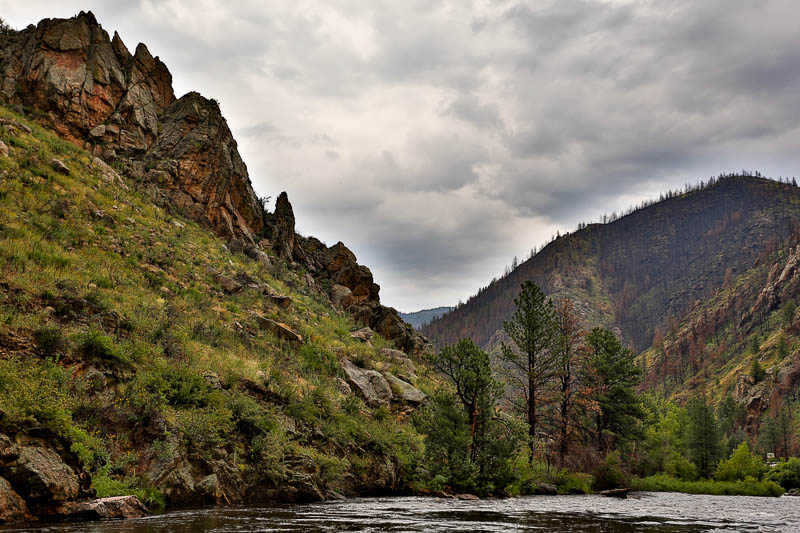
Picture of Poudre River.

The fire damage is apparent along the Poudre River.

“A group of twelve, huh?” asked Smokey. He was past retirement age and seemed like a nice enough man to have as a campground host.

“Yes,” Ted said. “Is there enough space for us for two nights?” We were still in his car and had just pulled into the campground when Smokey stopped us.

“Well, you'll need two sites for your group. I have two open sites for tonight, but only one for tomorrow. They cost nineteen bucks each. This is a real nice place. Lots of good fishing here.”

“I think we should keep looking,” I said to Ted, loud enough for Smokey to hear. “I don't want to have to move tomorrow.”

“Don't bother,” Smokey said. “Every campground upstream of here is already full.”

We had just entered the Poudre Canyon west of Fort Collins after driving through the afternoon and into the night. The four cars in our group had gotten spread out during our drive. There were several other campgrounds on the Cache La Poudre River, where we planned to spend our final days in Colorado, but we had agreed to meet at this one first.

Ted and I discussed the situation and he convinced me that we should stay put – even if Smokey was wrong about the other campgrounds being full, we wouldn't be able to communicate with the other cars if we left because there was no cellphone reception within the canyon.

But something about Smokey's demeanor seemed out of place.

“Did a car with boats on its roof stop by here tonight?” I asked, helpfully pointing up to the four kayaks that were on top of Ted's car. Ken's car should have arrived at least a few minutes ahead of ours.

“Nope, I just kicked two kids out for trying to poach, but that's it. Nobody's come through here with boats all night.”

“All right,” Ted said. “I'll pay for both campsites for tonight.”

“Great, I'm sure you'll love it here. You need to fill out this form,” Smokey said, producing a clipboard and a piece of paper. “But I can do it for you.”

Ted paid Smokey cash for our sites and we started to set up our tents. A few minutes later, Christophe's car showed up, so only two of our cars were still missing. Just as I finished blowing up my air mattress and laying out my sleeping bag, Ken's car showed up. There was a problem, though – Michelle was in the car, but Dave was missing.

The six of us who were setting up camp listened closely as Michelle explained their story. It turned out that Ken's car had arrived first and they had already talked with Smokey. Knowing that they had some time before the rest of us showed up, they decided to keep looking at the campgrounds that were further into the canyon. They found two empty sites a few miles up the road and paid for two nights, leaving Dave behind to flag down the other cars in our group as they passed. Then Ken and Michelle returned to tell us the good news.

“But we already paid for our sites here,” I said.

“Didn't Smokey tell you guys to wait for us to come back?” Michelle asked. “I told him you were just a few minutes behind us.”

“No, he told us he hadn't seen anyone else with kayaks all night.”

It all started to click now – Smokey was going to pocket our money! Because we paid cash and hadn't made a reservation, there would be no paper trail. Smokey's generous offer to “fill out the form” on Ted's behalf was further evidence. It was 10:00 PM and we were in a remote campground – nobody would notice if the host, instead of the state government, suddenly became $38 richer. It was the perfect crime.

But Smokey had gotten greedy. By not telling us that our friends were already looking for a site, he risked having us find out about his little side business. Because Ted and Michelle were the two who had talked with Smokey, they went to his trailer to demand their money back. Smokey was conspicuously missing, but his wife was there. She apologized for the mix-up and returned the money. That was the final proof we needed – if Smokey had slid our money through the slot of the locked payment box like he was supposed to, he wouldn't have been able to return it to us.

Lesson learned: Get a receipt when you pay for camping or your money might conveniently disappear.

Dan's car showed up a few minutes later, so we were all together. We drove a few miles up the road and set up camp on a section of the Cache La Poudre River called The Narrows. The river near our site was full of Class IV's and V's and therefore too burly for our group. Instead, we decided to kayak an easier section that was a little further upstream.
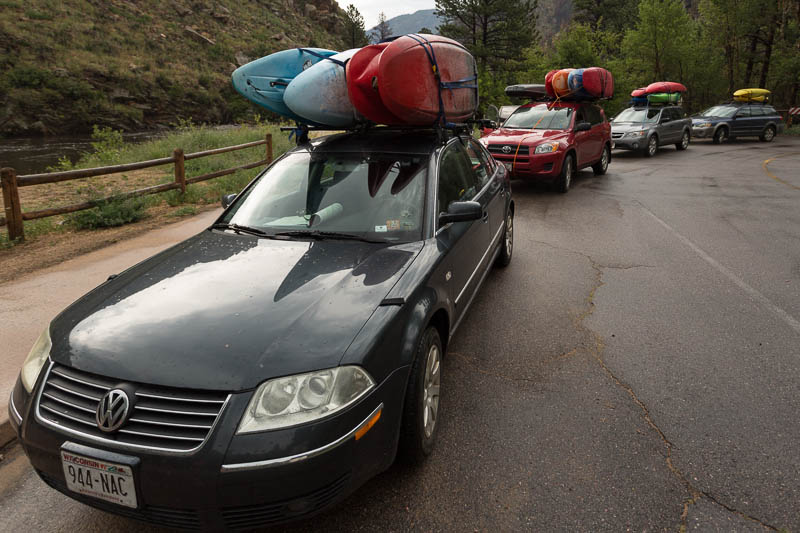
Picture of cars.

Our cars are loaded up after a short day on the river.

As soon as we got into our kayaks the next morning, we saw that the Poudre was different from the Arkansas because the river was so rocky. It looked like a more difficult version of the Wolf River in Wisconsin at low water. With the twelve of us ping-ponging off of the rocks and taking multiple lines for each rapid, it soon became apparent that our group was too big for its own good. We decided to split into two groups of six and I went in the first group with Christophe leading the way. We navigated around a few long stretches of Class II water, then hit a bigger Class III that led us through a tight S-shaped turn like a water slide around some boulders and dropped us into a large pool.

The river downstream of us was mostly obscured by a couple of boulders, so Christophe decided to get out and take a look. I soon followed and scrambled up the forest hill and onto the highway. It started to rain as we walked about 100 yards down the road, staring at the river. The rocks and whitewater below us created a maze of navigation with no places to rest. Then we spotted a drop with a hole that looked sticky. It would be easy to avoid if we picked a good line, but we wouldn't be able to see it from our kayaks.

If the rapid had ended there, it wouldn't have been so bad, but looking further downstream, the whitewater continued for a few hundred more yards before the river rounded a bend and left our view. The sheer length of this rapid made it a risky proposition for our group. If one of us swam, there would be a long and difficult cleanup effort, and with a group of our size and limited experience, someone was going to swim.

When our other leaders got out and saw that this was what our entire run would likely look like, they had a conference and decided to call it off before someone got seriously injured. As it continued to rain, we went through the arduous process of hauling all of the kayaks up the hill to the road with ropes, then someone ran back to a car so we could start packing our gear. I was disappointed to end the run so early, but we were clearly in over our heads. Unfortunately, river conditions can change from day to day, so you often don't know how difficult a section of whitewater will be until you get on it.

It was early in the afternoon, so maybe we'd still have time for a short run, but the river was giving us “bad juju.” With the thunderstorm now beating down on us, we decided to call it a day and head to the New Belgium brewery in nearby Ft. Collins. As our group drove out of the canyon, we hit some muddy debris in the ground, then our lead car came back toward us, flashing its lights. The thunderstorm had triggered a mudslide and left the road covered in four feet of mud. Our bad juju had turned worse – our only realistic way out had been blocked. Luckily there was a gas station in the canyon, so we bought some New Belgium beer and spent the afternoon at our campsite, lest the river gods strike us down for good.

For our final day in Colorado, we got packed and headed downstream to another section of the Poudre. The rain was gone and the road had been cleared. Our final run was fun and short, taking us only two hours to complete. The only incident our group had was a broken paddle, but even that was due to years of wear, not from a single collision with a rock. It was just the run we needed to end the trip.

I probably encountered more rapids in a week than I had in my whole life of kayaking in Wisconsin. This accelerated my skills in both reading rivers and running rapids. Many thanks go out to Dan and the other river leaders who made this trip happen. They could have taken a small group of experienced paddlers and easily run these sections, so I was thrilled to have the opportunity to join in. And I was especially happy that despite our setbacks, we all made it back home with no major injuries.

More Colorado photos (in case you missed them last time)


External Websites:
New Belgium Brewery Website
Poudre Canyon Wikipedia page

Colorado Kayaking, Part I

Picture of Dan.

Catching a wave in Salida, Colorado.

After coming home from my fishing trip, I traveled with a group of twelve Hoofers to the Arkansas River in southern Colorado for a week of whitewater kayaking. Five people from the group were advanced kayakers who had already run far more challenging rivers. The other seven (including me) were intermediate and hadn't run anything on this scale.

We made our base camp on BLM land next to the river at about 8000 feet above sea level. The forested hills and snowy fourteeners that surrounded us showed little indication of the recent wildfires that devastated much of the area and put a campfire ban into effect. The river had been running low, but the rainstorm we got during our first night probably raised the level a bit and helped to mitigate the fire risk.

Our first run was down a section called Brown's Canyon. Having never kayaked anything bigger than the little rivers in Wisconsin, I was nervous when I first popped on my spray skirt and launched into the current. Soon, however, the jitters went away and I was able to enjoy the river and scenery as I got swept downstream – the Arkansas was just bigger and pushier water than the rivers I was used to. Our biggest challenge of the day wasn't even the river but attempting to dodge the multitude of rubber rafts that were running it, often in groups of ten or more. They were a lot bigger than our little kayaks and moved faster than our group because we stopped and played at the smaller waves. Their guides and customers were friendly, though, and we were able to avoid them and didn't have any major incidents all day. The takeout for the run was at our campsite, so despite having kayaked a long run of about thirteen miles, it was a short day.

The next day we ran a section called The Fractions. Dan, our group's leader, thought it would be an easier run than the previous day, and I was glad he was wrong. This turned out to be the funnest day of our trip with lots of great play waves and few dangerous rocks. The section ended at a play park in the town of Buena Vista, so a few people from our group stayed on the river a bit longer and practiced their moves. Afterward, we rewarded ourselves by bathing at the famous Mt. Princeton hot springs, which has multiple pools set at various temperatures from cold to scalding. By the time we rolled back into camp, we were relaxed and ready for a bigger challenge.

Picture of Buena Vista.

Packing up at the end of the day.

We got what we wished for. The next day we drove ninety minutes to the famous Royal Gorge. Kayakers, rafters, and tubers alike go to the gorge to take in the beauty of its thousand-foot cliffs and the Royal Gorge Bridge, which spans the Arkansas River from 955 feet above and until recently was the tallest suspension bridge in the world.

The first rapid on our run was a Class III called El Primero. We couldn't see the whole thing from the top, but decided it would be tame enough to “read and run” rather than getting out of our boats and scouting. Our strongest kayakers went first and raised their paddles straight into the air as a signal to continue.

I went next. The first part of the rapid was a wave train, a series of tall, but harmless waves that smacked me in the face and blocked my vision temporarily. As I was barreling along, a rock suddenly appeared right in front of me. If the water were a bit higher, I could have safely gone over the top of it, a bit lower and I would have seen it with plenty of time to react. But the water was just obscuring the rock enough that I didn't see it until I was a second or two from crashing into it. If I hit the rock sideways, the force of the rushing water could pin me against it. If I got thrown upside-down while pinned, I might get trapped inside my kayak. I swerved left, the bottom and right edges of my boat scraped the side of the rock, and the strong sideways current flipped me. I felt a sharp crack as my helmet hit the river's floor. I tried to roll but only got partway up as the current sucked me into a hole and slammed my head again on the way down. I nailed my second roll and got right-side up just before going over the rapid's final drop. I was shaken, but uninjured.

The next person in our group didn't fare so well. She also ran into the hidden rock and flipped, but scraped her way to the bottom upside-down before ejecting from her boat. Before letting anyone else continue, the other Dan walked to the top of the rapid to tell the others about the rock and the easiest line to take. Everyone else made it down unscathed, but it portended a long, challenging day on the river.

Picture of Dan Y.

Dan surfs a wave at Salida's play park.

As we continued downstream, we hit a few more Class III's with only a couple of swims and appeared to be getting into somewhat of a rhythm as a group. Then we were presented with our first big challenge of the week when we came upon a Class IV called Sunshine. We walked on a path around the rapid to scout it and found one big problem: After a few smaller drops, there was a large hole that looked sticky – the water going over the drop got recirculated and had enough power to hold onto a boat or a human for a long time. At the right side of the hole was a “tongue” of water that flowed freely over the rapid without being recirculated, but it was only about a foot wide. It would take a set of technical, precise moves to hit the tongue. I decided not to run it and carried my kayak around it along with the other weaker kayakers.

The first few people who ran Sunshine hit the tongue and made it to the bottom without issues. Then Ted came along, hit one of the higher drops a bit off course and drifted to the left with his boat pointed upstream. He was barely able to turn his boat around before going over the drop, but it didn't help. Despite a tenacious effort, he got sucked back into the hole and was soon upside-down and getting jolted as if riding a bull under the water. Somehow he managed to roll, but was quickly flipped again and was stuck. He loosened his grip on his paddle in preparation to wet-exit and it got yanked out of his hands and thrown downstream. Then he popped his skirt and got sucked to the bottom, where he hit the downstream current and got flushed out of the hole. We threw two ropes at him, but he didn't see them as he passed beneath them. When he finally popped back up, he was near the bottom of the rapid.

Ted needed a long time to recover his energy, but he was OK. We portaged the rest of our boats around Sunshine and continued downstream. We were now entering the main part of the gorge and the walls closed us in, narrowing our focus and committing us to the river. The only man-made objects inside the gorge were an out-of-commission water pipe that was suspended above the water to our right and a railroad track about twenty feet above the water to our left. The large rapids continued with few quiet pools in which to rest.

Soon we hit a rapid called The Narrows, a long Class III with some technical maneuvering required. Our leaders took a long time to scout a clean line, then sent us down one by one. As the name suggested, the river got narrow at this point and was only about 30 feet wide by the time we hit the eddy at the bottom of the rapid. About 100 yards downstream was Wall Slammer a long Class IV rapid. A train full of gawking tourists pulled up next to us and stopped just as Caitlyn was running The Narrows. She got flipped and had to swim half of the rapid to the pleasure and horror of the onlookers, most of whom had their cameras rolling. One guy offered her whiskey as she was climbing into her boat and she waved her hands in victory. Her run is probably all over YouTube and FaceBook now.

Wall Slammer turned out to be another big challenge, with one Class IV hole in the middle surrounded by several III's upstream and down. Our first few boaters ran it and waited at the bottom. Virginia got flipped in a hole and tried to roll, but the current was slamming her against a wall that was most likely undercut and she got thrown back down and wet-exited. She was fine, but all of expert boaters had to run over several more drops in their efforts to rescue her and her boat. They couldn't paddle back up the river because the current was too strong and there was a twenty-foot, forty-five-degree retaining wall leading up to the railroad tracks that would present a difficult climb in neoprene boating shoes. The ledge that was just above the water normally would be perfect for walking back upstream, but a six-foot section of it had broken off, so there was no way to traverse it safely. I used my climbing skills to give Christophe a hip belay, bracing myself against the only thing available: a train track. Then we got his boat into position and I lowered Virginia and her boat back to the water using the same technique. (This Flickr photo courtesy of Dan Y shows it well.)

By the time we got on our way, we had just a few hours of daylight left, but over five miles of river to run. I looked up at the rocky cliffs that surrounded us. Posted signs threatened us with jail time for walking on the railroad tracks. We had already used the tracks during our portaging adventure, but even if there were a nice path next to the tracks, walking five miles to the cars would be very difficult while carrying our boats. We had started our run at a reasonable hour, but because we were moving so slowly, we now faced an overnight bivouac next to the river if we didn't reach our cars before dark.

Luckily, the canyon walls got lower until they were only ten feet above us. We ran the last of the named rapids, but still had to navigate through miles of Class II's, or what they call “flat water” out West. I watched the sun dip beneath the trees behind me and wondered how much further we still had to go. We all breathed a sigh of relief when we saw our cars with about half an hour of daylight left. After loading our boats, we made the long drive back to our campsite in complete darkness.

Despite a very challenging run, we made it with no major injuries. Our group was worn out, though, so we decided to take it easy for our last day on the river and spent most of the day in the town of Salida. Signs of kayaking were everywhere in town, from the line of old boats against the wall to the mural of a guy kayaking a PBR can in a river of PBR. At the edge of town was a nice play park, so we still got a few hours in our boats. Late in the afternoon we packed up and began our drive across the state to our next challenge: the Cache La Poudre River.

More Colorado kayaking photos

External Websites:
Wikipedia page for the Royal Gorge Bridge
Mt. Princeton Hot Springs Website

The One That Didn't Get Away

Picture of Dan with fish.

Me with my walleye.

For the forth of July, Katie invited me to visit her family in Northern Wisconsin. They rent a beautiful north woods cottage every year on Big Sand Lake near Phelps. Everything's so relaxed there, I took three naps on my first afternoon; it was the perfect location for a lazy vacation.

An hour before sunset on my first night, Katie and I went fishing with her parents, brother Greg, and friend Ryan on a pontoon boat called the Gill Getter. I don't fish often, so I was excited to catch my dinner.

We drove across the lake past some nesting eagles, swimming loons, and other fishing boats, and dropped anchor. Over the next hour, we caught a variety of species, including bluegills, perch, crappies, bass, and northern. Everyone was laughing and having a great time.

Except me – I had yet to catch a thing and wondered how it was possible to be bad at fishing. At one point I got a nibble, but then felt nothing. When I reeled in my line, my minnow was missing. I hooked some fresh bait, cast, and crossed my legs in the traditional fisherman's position, hoping it would help me catch a bluegill.

I felt a tap, then another and yanked my rod upward to set the hook. From the size of the bite, I figured I had something small, but then the fish fled and almost broke my pole. Greg got excited and reached over to set the drag on the reel, declaring that I had hooked something big. He guided me on how to let the fish run out, then reel him in when he got tired. My heart started pounding and I focused and fought a long battle. Eventually I got him close enough to the boat for Greg to scoop with the net.

I couldn't believe what I was looking at. This was a walleye, and it was huge! I was so excited, I didn't even notice that after I set him on the floor, he started to chew through the net and got his fangs within inches of my toes. I jumped back and helped to hoist him into the live well, which was too small for his massive body. We joked that the next time we opened the lid, the other fish would be sitting in my walleye's belly.

We tried to keep fishing, but it was pointless – everyone wanted to know exactly how big the walleye was. We called it an early night and drove back to the cottage, where the tape measure and scale waited. The fish's dimensions were confirmed at 28.5 inches, 6.5 pounds. It was by far the nicest fish I had ever caught, probably a once-in-a-lifetime score. We had a celebratory beer and went out to the pub, where I became a local legend.

I didn't get any other keepers all week, but that didn't matter. I caught the one that didn't get away.

More photos from the lake

Kayak rescue training and how not to run a whitewater river

Picture of Seth.

Seth begins his swim across the Wolf River.

I spent the weekend brushing up on my kayak rescue skills in northern Wisconsin with the Hoofers Outing Club. Our instructor for the day was Scott, who works at the Bear Paw Outdoor Adventure Resort on the Wolf River. We spent Saturday morning going over the basics in the classroom, then headed to a rapid called Gilmore's Mistake for some “on-the-job training.”

First, we practiced rope throwing (both the giving and receiving ends), which is important to know because you wouldn't want to go over a waterfall or a nasty rapid after self-ejecting from your boat. Swimming across rapids is also an important skill, so we each took turns crossing the river in moving current. We also practiced wading to the middle of the river, which is a lot harder than it looks. Scott spent the rest of the afternoon giving us various challenges on the river, and we managed to have some fun along the way. After a long day of training, we tipped back a few beers and ate some delicious pizza at Bear Paw's pub.

Scott is a great instructor who has the rare combination of tremendous technical skills and lots of patience that one needs in his position. I took this same lesson two years ago and was glad to have had the opportunity to brush up on my rescue skills, not that I hope to ever have to use them.

Picture of Varun.

Varun braves the last drop of Monastery Falls.

The Wolf River was running a bit low, so we decided to head south to the Red River, which is dam-fed and almost always runnable. The rapids on the Red are pool drops, meaning that there is a large pool of flat water below each rapid – if you have to wet exit from your kayak, you probably won't get pinned against rocks. Our run went smoothly through the first few drops, although we were competing with about fifty locals who were running the river in inflatable tubes and pool chairs.

There is one class III rapid on the Red called Monastery Falls, and the water was high enough that the top hole was very sticky, meaning that if you are unable to clear it, the recirculating water will suck you back in and hold onto you. The sneak route was a viable option, however, so a few from my group chose to run it and hope to remain right-side up before the final rocky slide, which would not feel good on your head if you happened to get flipped at the top of it.

The first group of tubers were wisely skipping Monastery Falls, which I was glad to see because none of them (other than the little kids) were wearing life jackets or helmets, and most had been drinking all afternoon. But then one brave (or dumb) soul went over the falls and got sucked under. He popped up, but lost his glasses and came dangerously close to slamming his head into a rock. Others followed, all of whom got ejected from their tubes but somehow managed to avoid catastrophe. The fact that they weren't wearing life jackets probably saved them from getting sucked back into the rapids because as they plunged to the bottom of the river, they hit the downstream current and didn't surface until they were clear.

Four people have drowned on the Wolf River in the last two years, and though each instance had its own unique circumstances that led to disaster, these guys weren't doing anyone favors by risking their lives. A few people in our group were ready with the throw ropes, but we didn't want to have to use them. It's important to have the skills to rescue yourself and others from potentially deadly situations, but it's even more important not to put yourself into those situations in the first place.

More photos from the weekend.

External Websites:
Hoofers Outing Club
Bear Paw

Biking to Blue Mounds

Picture of John and Katie.

John discusses the geological history of the region with Katie.

Ever since our bicycle excursion to Devil's Lake last month, my girlfriend Katie and I have been talking about other places we could bike to. We got our chance last weekend when we took a sixty-mile round-trip ride to Blue Mounds State Park with some friends from the Hoofers Outing Club.

We were supposed to leave on Friday morning, but a forecast of all-day thunderstorms caused us to postpone the trip by a day. It was still drizzling when Katie, John, Genya, and I met on Saturday morning, but the rain was a far cry from the torrential downpour that had hit while we were supposed to be on the trail. After navigating through Madison's extensive paved trail network, we left the city and joined the gravel Military Ridge State Trail, which crosses much of southwestern Wisconsin.

By late morning it stopped raining and we were able to shed some layers. Katie and I were covered in mud, which taught us the importance of fenders on bicycles. By the time we got to Mount Horeb, the mud had dried in to a dust that could easily be brushed away.

Starving after having biked twenty miles, we stopped at the Grumpy Troll, a brew pub with an assortment of delicious burgers. Another Dan joined our group at the pub, and we made sure our stomachs were as oiled as our bike chains before leaving.

We had a few more miles to go, but there was a problem: The previous day's storms had felled several large trees across the trail. On at least two occasions, the foliage was large enough to block our entire view of the trail which lay ahead. Glad to have postponed our trip, we blazed new routes through the blockage.

Picture of bike.

My fender-less bike gets a muddy beating.

All of the normal campsites at Blue Mounds State Park were reserved, but they had several sites cordoned as first-come, first-served for walk-ins and cycle tourists (an oft-overlooked advantage of not driving) and most were still free. We set up camp, had a quick nap, and went for a swim in the park's pool (Cost: $2) before returning to camp to cook our dehydrated pasta dinner.

While cooking, it became apparent that we were about to get hit with another thunderstorm, so we retreated to a shelter built by the Boy Scouts near our campsite (Thanks, Boy Scouts!). The rain continued unabated for most of the night, and in lieu of sitting around a campfire, we resorted to entertaining ourselves with silly stories and John's signature Tang-quila Sunrises.

The next morning was sunny, so we dried our gear before packing up and biking to the park's two towers, which overlook large portions of southern Wisconsin. Afterward, we had a fun ride down the large hill back to the park's entrance which brought back memories of the Death Road in Bolivia, though scaled down by about 1000 times.

“Let's have a contest to see how far we can go without pedaling,” the other Dan said to us before we went down the final hill out of the park.

“Sure,” we all agreed. It started innocently enough, with each of us building our speeds up to about 35 MPH as we neared an intersection before slowing down to a sane velocity. I took the corner onto the Military Ridge Trail as fast as I could without wiping out and rolled another 400 yards before stopping.

I won the contest and waited for Dan, but he didn't show up. Turned out he had blown a tire and was in the process of changing it. With painstaking attention to detail, he squeezed his spare tube underneath the tire, but as he blew it up with his fancy CO2 cartridge, the presta valve broke off and the tire deflated with a hiss. The original tube was so pockmarked, patching it did no good, so he rode the last few miles to Mount Horeb on his rim, which was oblong to begin with and likely the source of the flat tire. It happened to be the perfect opportunity for Dan to invite his parents to dinner and drive him home, so all was well.

Despite the inclement weather and flat tires, this was another fun weekend of cycling. My next longish trip might be to Governor Dodge State Park, which is another fourteen miles past Blue Mounds, in a combination biking/climbing weekend. Biking gives you low-impact exercise and it's fast enough to not be boring, yet slow enough that you actually take in your environment during your journey. If you haven't tried it yet, what's stopping you?

More photos from the weekend

Devil's Lake Day of Instruction

Picture of canoers.

Carl teaching a canoe lesson.

A couple of times per year, the Hoofers Outing Club holds a Day of Instruction (DOI), where they teach new members basic skills in canoeing and kayaking. Because of the construction at the Memorial Union, this summer's DOI was moved to Devil's Lake State Park. It's the most scenic park in Wisconsin, so this wasn't a bad trade-off.

Club members drove sea kayaks, whitewater kayaks, and canoes to the lake and lessons were given all day. I was recruited for my awesome boat driving skills, so I had lots of free time to walk around the trails. I climb at Devil's Lake all the time, but it had been so long since I had seen the Balanced Rock and Devil's Doorway, I had forgotten how amazing they were. I also finally got a closer look at the blue herons that nest next to the CCC parking lot, and there was family of birds living next to a light fixture in the shelter we used for the day.

At the end of the day, we grilled out and got in some extra relaxation. Fun times!

More photos from Day of Instruction

Twin Cities Couch Fest

Picture of couchsurfers.

Group shot at the sculpture gardens.

Last weekend was time for another Twin Cities Couch Fest, an annual gathering of friends old and new in the fabulous Twin Cities of Minneapolis and St. Paul.

On Friday, we headed up to Interstate State Park, which spans the St. Croix River between Wisconsin and Minnesota. We got to check out some of the hundreds of potholes in the park, which formed about 10,000 years ago during the last glacial period. The area was created by lava flows millions of years ago, leaving behind hardened basalt rocks mixed with some granite. Taylor's Falls was just upstream of the park's entrance, which made me wish I had brought my kayak. There were also boulders all around the park, which made me wish I had brought my rock shoes. Oh well, you can't do everything.

We dined on grass-fed buffalo burgers and gouda cheese at Eichten's Cafe, then spent the rest of our afternoon exploring the Franconia sculpture park. There were exhibits ranging from 80's pop to playgrounds, and I even finally got to live my lifelong dream of shooting Bambi. It was interesting seeing the artists at work on their next pieces; this place reminded me of a more diversified version of Dr. Evermor's Forevertron.

There were a bunch of options for Saturday afternoon, and Katie and I decided to ride our bikes from the Stone Arch Bridge to Minnehaha Falls in central Minneapolis. I was unaware that Minneapolis had so many bike trails, so this was a great option. I still wish the city had more bike lanes, though. They would make riding on the streets less scary, which would encourage more people to bike instead of driving, which would help to alleviate traffic issues, a win-win for all.

Picture of alien craft.

One of the stranger exhibits at the sculpture gardens.

Saturday night we went to Northern Spark, a free live art show in downtown St. Paul that went from dusk till dawn. This was my favorite event of the weekend because it had exhibits everywhere you looked and several live music acts. I didn't take my camera with me (too busy discoing it up), so check out the website link for photos. At 2:00 a.m., the main event happened when they burned down a replica of a historical house. Bloodlust was in the crowd as they chanted “Burn it down!” until it finally went up in a ball of flames. About 500 people recorded the event on their cellphones, which they held above their heads.

This was a really fun weekend where I got to meet old friends and make some new ones. I was especially glad they had more events this year in St. Paul – the evil twin normally doesn't get much love. Lots of other big cities have annual couch crashes now, which are organized through Couch Surfing, though the events are put together by the local couch surfers.

By the way, Madison's Couch Crash is coming up August 1-4. We're planning lots of fun stuff around town, so this will be a another great way for you to get to know the city and make friends. Here's our official website (it still has to be updated with this year's schedule).

More photos from the Twin Cities Couch Fest


External Websites:
Twin Cities Couch Fest
Interstate State Park
Franconia Sculpture Garden
Northern Spark
Couch Surfing

How To Set a Top-Rope Anchor

Picture of anchor setters.

Time to set some top-rope anchors.

I spent a day at Devil's Lake to learn how to set top-rope climbing anchors from several leaders in the Hoofers Mountaineering Club. After introductions, the leaders taught our group the basics of setting anchors:

– Tying knots in cordelette and webbing
– The attributes of all safe anchors – Secure, Equalized, REdundant, No Extension (SERENE)
– Advantages and disadvantages of passive protection (stoppers, hexes)
– Advantages and disadvantages of active protection (tricams, cams)
– Techniques for equalization
– How to sling boulders and trees

Next, we went over some example placements on the crag, which gave us a visual of what good and bad placements look like.

Picture of JJ.

JJ demonstrates a water knot.

Finally, we split into smaller groups and got to set up real anchors and receive constructive criticism from the instructors. I built four separate anchors and was feeling good about my judgment in placements by the end of the day. On top of that, I was feeling a lot better about standing near the edge of a cliff while building an anchor. Climbing has helped a lot in overcoming my fear of heights.

Thanks to all of the instructors who took time out of their busy days to teach us!

The club puts on this formal anchor-setting clinic at least annually. They also also teach clinics on other skills such as lead climbing and mountaineering. If you are interested in any form of climbing, the Mountaineering Club is a great resource for skill development and connecting with other climbers. I'm really glad to have such a great resource available in Madison.

More anchor-setting photos