Author Archives: Dan Perry

About Dan Perry

Dan created this blog to document his South America trip, which covered every country on the continent and lasted over two years. He currently lives in Madison, WI.

Bobbing and Weaving the Price Gougers

February 28-29, 2008
Day 883-884

I took yet another bus to the town of Arenal, which sat on the Arenal Lagoon with a view of, you guessed it, the Arenal Volcano. It was a pretty area, but there wasn't a lot to do because the roads were set up for motor traffic only, and the consequently the lagoon wasn't very accessible by foot. Still I had to stop there for a night because there weren't any more buses that could take me through this region to the place I wanted to go.

The next day I took two more buses to get to Santa Elena. It looked close to Arenal on the map, but I still wasn't able to get there until late afternoon. That didn't much matter, though, because it was probably the biggest tourist trap I had seen in Central America so far. Basic necessities like restaurants and the Internet were three times more expensive than anywhere else I had been in Costa Rica, and even the grocery store did its best to gouge the tourists.

I was sure this place wasn't for me I met an English girl who said she had just gotten back from walking through the forest. She went without a guide, so I figured the experience would be cheap, or possibly even free. But when she showed me her entrance ticket for $15, I decided to leave the first chance I got. I could somewhat understand it when people paid $75 for a full-day guided tour, but $15 just to walk through a forest on your own for a few hours? Absolutely ridiculous. I calmed my nerves, called it an early night, and planned to leave tomorrow before my mildly good impression of the country turned really bad.

Where Your Mouthwash Comes From

February 26-27, 2008
Days 881-882

Picture of Mary.

Mary and her mom waiting for the bus.

A few days ago, I met a girl named Mary on one of my bus rides. She was studying computer science at a university on the Caribbean coast, and through a scheduling miracle of sorts, managed to take off for a few weekdays to visit her family. She invited me to visit her family in San Rafael de Guatuso, and soon I was introduced to her mom, brother, adopted brother, and a bunch of extended family members. They were a jovial bunch, and we had a good time exchanging the stories of our cultures that first night.

The next day, we took a four-wheel-drive truck up a long, unpaved hill to the Rio Celeste. On the way, we stopped at the Arbol de la Paz, which was probably the biggest tree I had ever seen. The river got its name from its mouthwash color, which was a result of the natural mixing of various minerals from the mountains. During our long hike, we stopped at hot springs, a lookout point, a swimming hole, and of course, a waterfall. It was a beautiful place and still largely a secret kept only by the locals.

My visit with Mary and her family changed my opinion of the Costa Rican people. I had thought they were a bit jaded from all of the tourism, which resulted in them being treated like servants by thousands of Americans per year, but Mary's family was very nice and just happy to meet a foreigner, despite having already met thousands before. The people of Guatuso were every bit as hospitable as those whom I had met elsewhere on my travels.

The photo album for this entry is here.

A Volcanic Culture

February 25, 2008
Day 880

Picture of town.

The town of La Fortuna, with Arenal in the background.

I got out of the big city today and took a bus to La Fortuna. It was a nice little town with a quaint church and a flowery plaza, but the highlight was clearly the nearby 1633 meter Arenal Volcano. Every businesses in town had a volcanic theme to it, including at least three hotels called "Hotel Volcano." I would have liked to have climbed Arenal, but it was illegal because some tourist got killed by lava and ruined it for everyone, so I had to settle for viewing it from afar.

The photo album for this entry is here.

The Psychological Analysis Of San Jose

February 21-24, 2008
Day 876-879
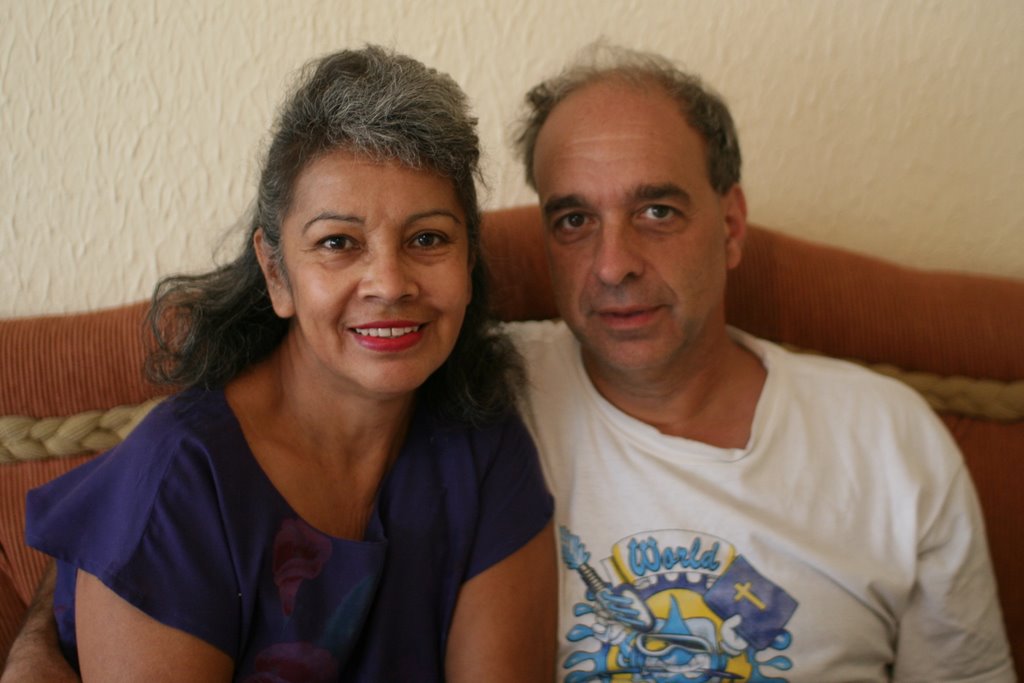
Picture of people.

Steve and Miriam at their home.

It was a long bus ride to San Jose. Despite the small size and good roads of Central American countries, it still takes a full day to go halfway across the country because of frequent bathroom breaks, multiple flat tires, and engine breakdowns in the middle of a busy urban highway. It was still dark when I left the jungle this morning and almost dark again by the time I got to the capital.

I had told myself that I wouldn't visit any of the capitals in Central America due to a lack of interesting stuff to do, but when I was in Boquete and a fellow hostel-goer named Steve invited me to visit him, I couldn't pass it up. Steve was a psychologist from Chicago married to Miriam, a Tica (a Costa Rican woman) from San Jose. They were living in San Francisco for over a decade, but a few years ago they retired and moved back to her hometown.

I think the psychologist in Steve constantly had him playing mind tricks on me. He assured me that he was brilliant, and when I informed him that every brilliant person I had ever met didn't feel the need to inform others of their brilliancy, he told me that he was, in fact, so brilliant that he had no need to be humble. We spent a lot of time in coffee shops talking about travel, and Miriam spent most of her time rolling her eyes at Steve's highly intelligent remarks.

We also got to meet some of the most upstanding members of Costa Rica's ex-patriot community. Steve's friends (actually, he referred to them as 'acquaintances') were mostly single American men in their sixties with a surprising lack of American women at their sides. Steve told me that virtually all of the Americans living in Costa Rica were societal outcasts, whether running from the authorities or their ex-wives, or simply being unable to handle the pressures of a "normal" life back home. Steve, however, assured me that unlike the rest of them, his closet was free of skeletons.
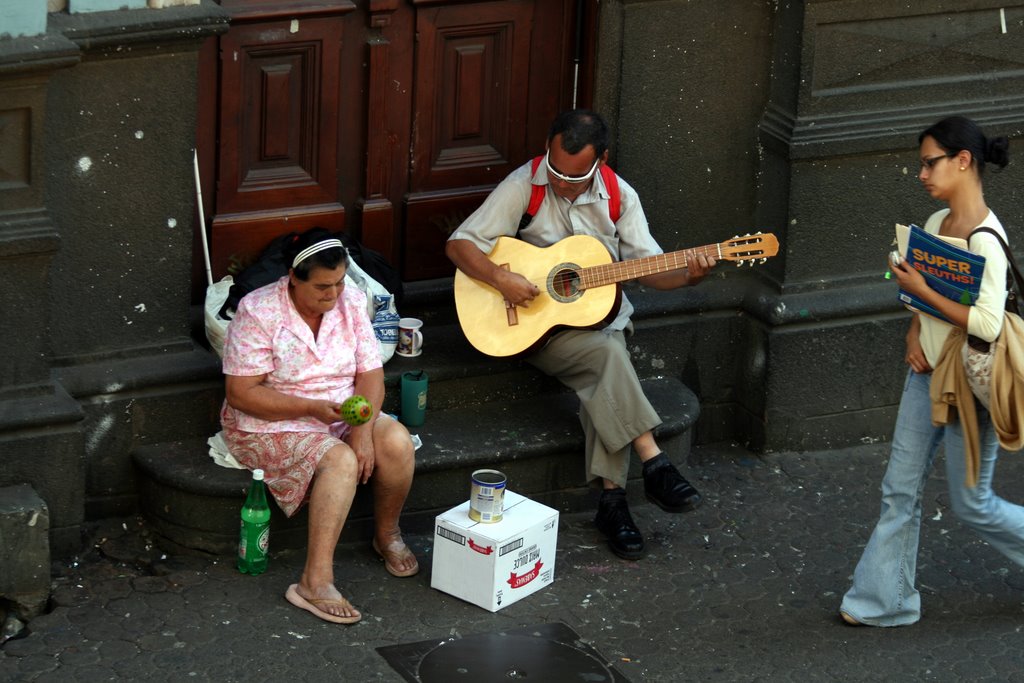
Picture of performers.

Street performers.

Besides the Americans living in San Jose, who were easily distinguishable because they hung out in the same haunts every afternoon, there were a lot of normal tourists meandering the city as part of their week-long vacations. I wondered why they chose Costa Rica when there were so many other places in Latin America with equal, if not better, sights and amenities, and lower prices. Steve explained that when people researched Costa Rica as a possible vacation destination, they only read about the good stuff. The country abolished its military back in 1949 after a civil war left the government in shambles. There are rain forests, volcanoes, and beaches withing easy reach of the capital. There is a large middle class and generally a high standard of living, including a free social health care system. At first glance, Costa Rica looks like a gem surround by other Latin American countries that are marred with problems.

However, the level of violent crime in San Jose was as high as anywhere I had seen. Reading the local newspaper, I discovered that a few days ago, two immigrant engineers working outside got robbed at gunpoint of thousands of dollars worth of equipment by several men. The police caught the assailants but they were inexplicably released after a night in prison. That sparked a wave of vigilante justice, in which scores of frustrated citizens pummeled a man who was known as a thief, yet who had nothing to do with the robbery, nearly to death. The message was clear: The police won't protect us, so we'll take the law into our own hands. Steve also told me several stories of people and businesses, including a jewelry store just last week, being robbed in broad daylight in the supposedly safe downtown area with hundreds of people around. Of course, the robbers never got caught in those stories. He also warned me of the increasing problem with street gangs with nothing to lose in Honduras and El Salvador. I missed the days of traveling through South America when all I had to worry about was high altitude, hungry jaguars, and drug cartels.

The photo album for this entry is here.

Back To Town

February 19-20, 2008
Day 874-875

Corcovado National Park Trek Day 3

Picture of Richard.

Richard at a waterfall in the Corcovado.

This morning we walked with Martin and Helen, a German and British couple who recently had been spending most of their time living and working tourism and nature conservation in various parts of Central America. The walk out of the park had a few more knee-deep river crossings, but otherwise was uneventful. We eventually ended up on a road and took the opportunity to get a ride the rest of the way back to Puerto Jimenez. The weather was cooler but with constant rain, and I needed a whole day just to clean and dry out all of my stuff.

For me, Corcovado National Park was unspoiled and full of wildlife, but it still was lacking something intangible. I think if I had chosen to travel through Central America at the beginning of my trip instead of the end, I would have viewed it differently. After all, how could a tapir in Corcovado get my heart pounding after coming face to face with a puma in Noel Kempff Mercado in Bolivia and a jaguar near Blanche Marie Falls in Suriname? How could the antenna-laden view atop the 3475 meter Baru Volcano in Panama be awe-inspiring when I had already reached the 6000 meter summits of the Cordillera Real in Bolivia? How could seeing some coral and a single stingray while diving at Bocas del Toro, Panama dazzle my eyes when I had already swum with dozens of sea lions and fifty eagle rays in the Galapagos? And how could Panama City's ten-minute parade of an excuse for Carnaval quench my thirst when I had witnessed the massive acts of hedonism in Brazil and Argentina in previous years? One of the downsides of travel is that it becomes increasingly difficult to be impressed the more places you go.

Through the Jungle

February 18, 2008
Day 873

Corcovado National Park Trek Day 2

Picture of spider.

Charlotte's web.

Richard and I left camp as soon as it was light enough to see. We were heading northbound, away from the ocean, and as the sound of the waves faded away, the rain forest came alive. Howler monkeys were making their horrible dinosaur-like roars all around us and a few white-faced and spider monkeys jumped around the trees near us to let us know they were there. Then the sighting of the day happened when a tapir crossed the path about ten meters in front of us. Being a shy creature, it only looked at us for a second before running into the forest and remaining hidden. This all happened withing the first thirty minutes of walking.

In the middle of the day, a group of fourteen gap year kids, mainly from Britain, passed us in the other direction. They talked to Richard in strange dialects of their hometowns ending in names like "hampton" "-shire," and "-ford," and were about to sit down for a cup of tea, but I reminded Richard that we were, in fact, walking through the jungle and not the English country side, and we moved on. Soon thereafter, we passed a young, fully-clothed guy walking with his parents who were wearing nothing but sandals and skimpy European bathing suits. The mosquitoes and sand flies must have had a field day with them, biting them in legendary places of bug lore.

The jungle was thicker and seemed more authentic by midday, and we stopped for lots of breaks near some of the dozens of river crossings on the path to listen to the multitude of sounds of the wildlife. The howler monkeys especially never seemed to leave our sides, and there were also lots of macaws , smaller parrots, and woodpeckers to keep us company. After hearing the horror stories yesterday of how difficult today's walk was going to be, I was surprised to arrive at the Los Patos ranger station after only six hours, including abundant breaks. Then I remembered that the people who had warned us had been in their offices in Boston only a few days earlier.

Today's camp was much more tranquil as we were joined by only four others and had a large grassy area in which to put our tents. Yesterday's ranger was in a state of perpetual anger from having to deal with too many campers, but today's ranger was going crazy with boredom as he ran around the camp with his arms flailing out at his sides while obnoxiously singing Spanish love songs. The rest of us exchanged a few stories of our other travels and enjoyed an early bedtime in the peaceful night.

How Much For the Little Girl?

February 17, 2008
Day 872

Corcovado National Park Trek Day 1

Picture of beach.

The beach path.

Richard and I were ready before dawn and were joined by a few others for our ride into the park in the back of a truck. Along the way we passed a bunch of oceanside mansions owned by rich Americans. A construction worker got off at one of the works-in-progress, explaining that rich people were his favorite to work for. A few hours later, we were in Carate and were officially in the park.

The trek started with a short walk along the beach. It seemed as though we were walking at the beginning of our own movie, with the waves gently crashing to the shore and the thick rain forest awaiting our arrival at our side.

Soon there was a sign for La Leona, the first ranger station of the park. We left the beach to find a location that was far more luxurious than we had expected, with private cabins surrounding the main building and a group of patrons having a large breakfast, polishing their huge camera lenses for birdwatching, and relaxing on their beach side hammocks. We sat near them and began cooking porridge on my stove, but soon an employee told us to leave. I protested, stating that I had obtained permission to enter the park, but the employee explained that this was the La Leona resort, not the La Leona ranger station. So they gave their place the same name as the ranger station and were not at all sympathetic when I pointed out how confusing that was. I think we were just too grungy for the other patrons, who were staring at us like that scene in The Blues Brothers where they try to recruit their maitre d' friend. Apparently being boated into this luxury hotel for a few days was actually some peoples' idea of going into the jungle.

We found the much-more-rustic La Leona ranger station a few minutes down the beach and checked in with the real rangers. They sent us on our way as the path went slightly into the jungle, but still within earshot of the ocean. We got poured on in the middle of the day, but it was actually a relief from the heat. The path was moderately interesting, and we saw lots of crabs and a raccoon-like coati, but it was still too close to the ocean to achieve that "out there" feeling. Just before reaching our camp, we had to wade through a knee-deep river, thus ruining my hopes of keeping my shoes dry.

La Sirena ranger station was filled with commotion. It had a landing strip, so most people's "jungle experiences" consisted of flying in, looking at birds from the rangers station for two days, and flying back home. We were forced to camp under a shelter packed in tightly with a dozen other people because of the threat of creepy crawlies outside. Most people were doing the same trek in the opposite direction and warned us of the long, arduous journey in store for us tomorrow. It was nice to have a little camaraderie with the other campers, but most of them had no idea what a real adventure was.

The photo album for this entry is here.

An Easy Crossing

February 15-16, 2008
Day 870-871

Boquette was cool and drizzly as usual when I left, but the heat knocked me back like an ocean wave as I neared David. Soon I was in Paso Canoas, where I had my easiest border crossing since going between Chile and Argentina two years ago. Within half an hour, I was in Costa Rica and on my way to the small port town of Golfito.

From Golfito I took a short boat trip to Puerto Jimenez on the Osa Peninsula, still very close to the border with Panama. My reason for going there was the Corcovado National Park, which the Lonely Planet and several travelers I had met recommended as an off-the-beaten-track jungle adventure. Just as in Panama, I found Puerto Jimenez full of tourists, but the locals were nonchalant and even accepting when they were expected to speak English in their own country. The best part of the town was that scarlet macaws were living in harmony with the people, and their loud squawks could be heard wherever I walked.

As I was walking around the town, I met a Brit from Birmingham named Richard who was in the country doing research on climate change and was up for a jungle trek. Getting information on the park was easy and seemed more organized than other countries, but unfortunately that meant the best camping place was almost always full so we could only stay there one night. After a day of planning and buying supplies, we were ready for our Central American jungle experience.

To the Top Of Panama.

February 10-14, 2008
Day 865-869

Picture of me.

Me at the highest point in Panama, 3475 meters.

After leaving the Bocas archipelago, I took a bus across the country, from the Caribbean to the Pacific, to David, the second-largest city in Panama. From there I got to ride in my first school bus to the small highland town of Boquete. Three people sat in each seat, but it wasn't nearly as jammed as I had been expecting based on what other people had told me, and I found it quite the nostalgic experience as I recalled riding to school in my youth.

At 1000 meters above sea level, Boquete had a far more pleasant climate than the coast. The only problem was that it rained the entire first day I was there, and supposedly this was dry season. The really bizarre thing was that even though it was raining, the sun was constantly out. I didn't realize it was possible to have so much sun and rain simultaneously.

The main attraction of the area was the extinct Baru Volcano, which at 3475 meters above sea level was the highest point in the country. I decided to hike up to the top one day, then come down the next. The 2000 meters uphill climb was uneventful though exhausting, but I had plenty of energy due to the perfectly cool temperature. I met a few of the guys working on the antennae on top, and noted how clearly their soap opera came in on their portable television set. They situated me with a room to sleep in so I didn't need to bring my tent. The pitch black and solitary night made me somewhat regretful of my chosen reading material of Interview with the Vampire.

I got up early and made the short walk to the very top where there was -- of course -- a cross. The previous afternoon had been cloudy, but the sky was fairly clear for the sunrise. I had the beautiful view all to myself for a few minutes before five others joined me on top. One of them was a Canadian guy who had recently befriended a yacht owner looking for crew, and they were preparing to sail around the world for the next two years.

On a clear day, you could see both oceans at once, but there were too many clouds to see the Caribbean this morning. The Pacific, however, was easily visible, and looking over the edge showed even more detail than my guidebook's map of the region. It was a long trip, but that view made it worthwhile.

I made the long walk back to Boquete to find the whole town up in arms. Pancho (the owner of my hostel)'s mother had inherited the house next door many years ago, but never got the chance to move in because a prostitute was already there and claimed squatter's rights. Pancho tried for years to kick her out, but the prostitute always had excuses, such as having her children in the house, who had themselves become prostitutes. But I got to witness history in the making as the police finally showed up to kick her out, despite the fact that she claimed she was too sick to leave.

This whole story was related to me by a man of about sixty from Tennessee who smoked pot "morning, noon, and night" and who had been coming to Boquete for the last three years to escape the US winter. He gained most of his gossip from sitting on the porch all day, but unfortunately he left carrying his rugby ball and dressed in his uniform to "get some exercise" before he could fill me in on all of the juicy details. I don't know which was stranger, the squatter or the old man whose hobbies were those of a teenager.

The photo album for this entry is here.

Taking the Bull By the Mouths

February 7-9, 2008
Days 862-864

Picture of Bocas.

A restaurant at Bocas del Toro.

I arrived near the Costa Rican border to the archipelago of Bocas del Toro before dawn. I took a quick boat taxi from the mainland to Colon Island, where I based myself for the weekend. I was amazed when I looked into the sky and saw the Southern Cross, which I hadn't seen in months and didn't realize could even be seen this far north. The island culture was laid back and the beaches were nice, but the place was filled with the most annoying type of tourist: The loud ones, the ones who think they invented travel by the simple fact that they've managed to set foot on foreign soil.

After a day of getting situated, I went scuba diving with a couple of Dutch girls named Sybrenne and Tara. They were a psychologist and a psychiatrist respectively, so I tried not to tell them anything incriminating. After watching the jumping dolphins in a tranquil bay, we submerged ourselves and saw lots of colorful coral, a few schools of fish, several lobsters, a few eels, and one stingray. Between dives, we went to a small island with one restaurant where the first item on the menu was lobster for $15. It saddened me that the creatures I was just admiring in their natural habitat were being served for lunch, but luckily I brought my own PB&J, one of those delicacies not available in places with fewer tourists. Another great thing about the archipelago was that the water was so warm, it was like being in a bathtub. Unlike Colombia, I could stay in the ocean for hours without getting cold.

The photo album for this entry is here.