Author Archives: Dan Perry

About Dan Perry

Dan created this blog to document his South America trip, which covered every country on the continent and lasted over two years. He currently lives in Madison, WI.

Getting Info for Roraima

November 14, 2006
Day 412

We took a bus overnight last night to Boa Vista, in the far north of Brazil. From there, we caught another bus to the Venezuelan border and walked across. The border control station on the Venezuelan side was the nicest I had ever seen. It was new, clean, had air conditioning, and everyone was professionally dressed. There was no waiting in line, so getting my entry stamp in my passport was a piece of cake. Craig had some trouble getting into Brazil because he only had a Peruvian card proving that he had been vaccinated against yellow fever, but here they exchanged his card for an international one, so there shouldn't be any more problems in the future.

From the border in Venezuela, we caught a taxi to Santa Elena de Uraina, a small town with loads of tourists planning treks in the area. We got as much info about the Roraima trek as possible, but still will need to obtain more. Tours from town are expensive, and we have all of our own gear anyway, so going on one wouldn't make much sense. However, it's not clear whether we need to get a guide for the trek, and it appears that there isn't any public transportation to the park. Maybe we'll be able to go with a tour group but carry all of our own stuff, or maybe we'll find some other independent trekkers to go with us. We'll have to get more info tomorrow.

Bimbo Bus Attendants

November 13, 2006
Day 411

Today I wanted to see the Meeting of the Waters, at the confluence of the Rio Negro and the Amazon. When the dark waters of the Negro collide with the brown waters of the Amazon, the differences in velocity and volume create a dramatic natural border in which the rivers don't mix completely for several miles. While I was walking through the garbage and mud near the port looking for a boat to take me out, I was greeted by a huge downpour that wouldn't let up. In the Amazon, the rain could continue for days, so I decided that the Meeting of the Waters wasn't that important to see after all and planned to leave the city.

Craig and I packed up our stuff and got on a city bus in the middle of the rain to go to the bus station. The way the buses work here is that you get in the back door, pay the bus attendant, and walk to the front. We paid our attendant, who was a young bleach blond girl with painted nails and jewelery everywhere, and told her we wanted to go to the bus station. She seemed to understand, but as the bus moved on, she proceeded to talk on her cell phone, chew her gum, put on more makeup, and adjust her hair. I reminded her once again of our destination just to be sure, and she nodded at me indicating that she hadn't forgotten us. After around twenty minutes, she gave us an embarrassed look. Somehow, she had forgotten to tell the driver to stop for us! We had to drive all the way around the entire city and wait for the bus to pass the bus station yet again. After spending forever riding in the rickety old bus with no shocks, we finally stopped at the bus station. Well, we actually stopped 200 meters beyond it, but close enough.

Everything's Closed

November 12, 2006
Day 410

We arrived in Manaus late last night, but saw no point in leaving the ship just to find a hotel room and go to bed. Instead, we slept one last night on board and headed out this morning. Charlie desperately needed a shower, so he used our facilities and left around noon to catch his flight. Today he's on the Amazon, tomorrow he'll be at work in Seattle.

Craig and I tried to get organized for our upcoming Roraima excursion, but everything in town was closed because it was a Sunday. There's probably a boat up to Boa Vista, in the north of Brazil, from here, but it looks like it might take two weeks to get there, so it's probably not a great idea. Luckily, Manaus is the biggest city on the Amazon, so it actually has road access. Taking a couple overnight buses looks like our best bet, but we'll have to wait at least another day when the port and information centers open to know for sure.

The city of Manaus doesn't impress me much. It has a beautiful opera house built in 1896 that's surrounded by other architecture left over from the rubber boom of the late 1800's, but most of the city appears to be falling apart. There are crumbling buildings and garbage everywhere. I thought Brazil might be cleaner than Peru because people on the boat didn't throw any garbage into the river (in Peru, the Amazon is one big garbage can), but that's not the case here. I couldn't even sit down to eat some food without being overwhelmed by the smell of beer and urine. On top of that, the 40 degree temperature (over 100 F) was too much for me. Hopefully I'll be able to leave here soon.

Tabatinga to Manaus River Trip

November 8-11, 2006
Day 406-409
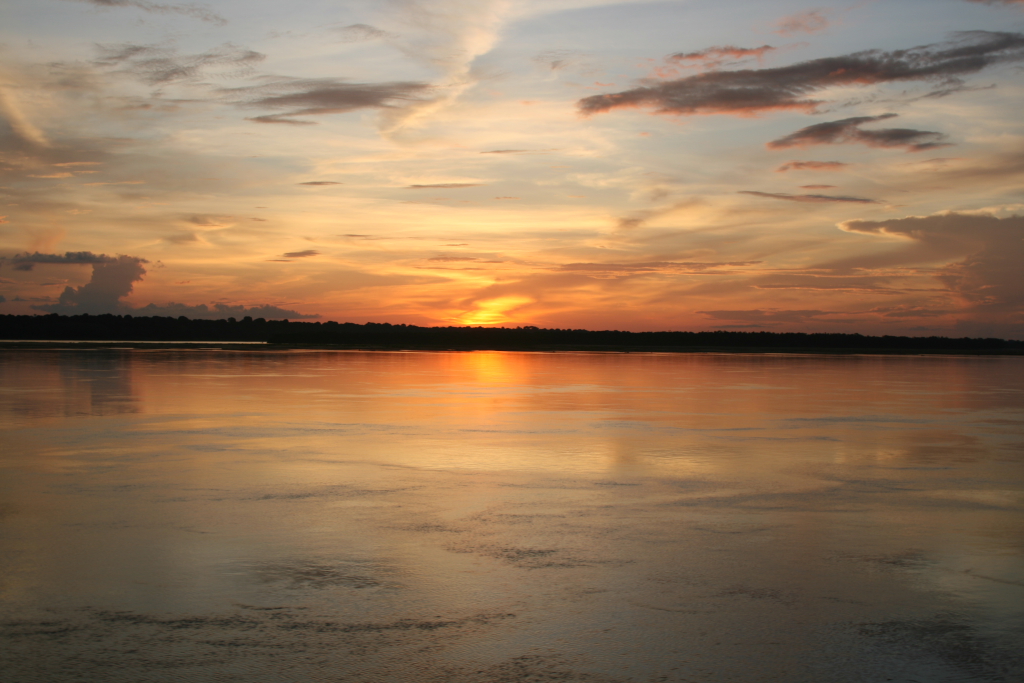
Picture of sunset.

An Amazon sunset.

The journey from Tabatinga to Manaus was a long one, 1200 KM to be exact. For me, it involved riding down the Amazon for four days in a large boat in hammock class. This boat was much more crowded than the one from Iquitos to Santa Rosa. Not only was there very little room on the sides of our hammocks, which often created a human-sized Newton's Cradle when someone got bumped, but in several cases, there wasn't any room left, and people had to start stacking their hammocks on top of each other.

This boat was a lot nicer than the last one I took, though. The top floor had a bar with plenty of cold beer, a television, tables for playing cards, and a large open deck for watching the river. There were rooms with real beds, private bathrooms, air conditioners, and television sets, but I couldn't justify paying the extra price, considering that it would've cost less to fly. There were actual bathrooms with flushing toilets, and they were separated for men and women. I found that out the hard way. The bathrooms were marked "WC ELE" and "WC ELA." WC is a standard symbol for bathroom, but I didn't know what ELE and ELA meant. In fact, I didn't even realize they were different words until I tried walking into the "ELA" bathroom and got yelled at by a woman nearby. I guess they translate to "his" and "hers." That naming convention must confuse many travelers.
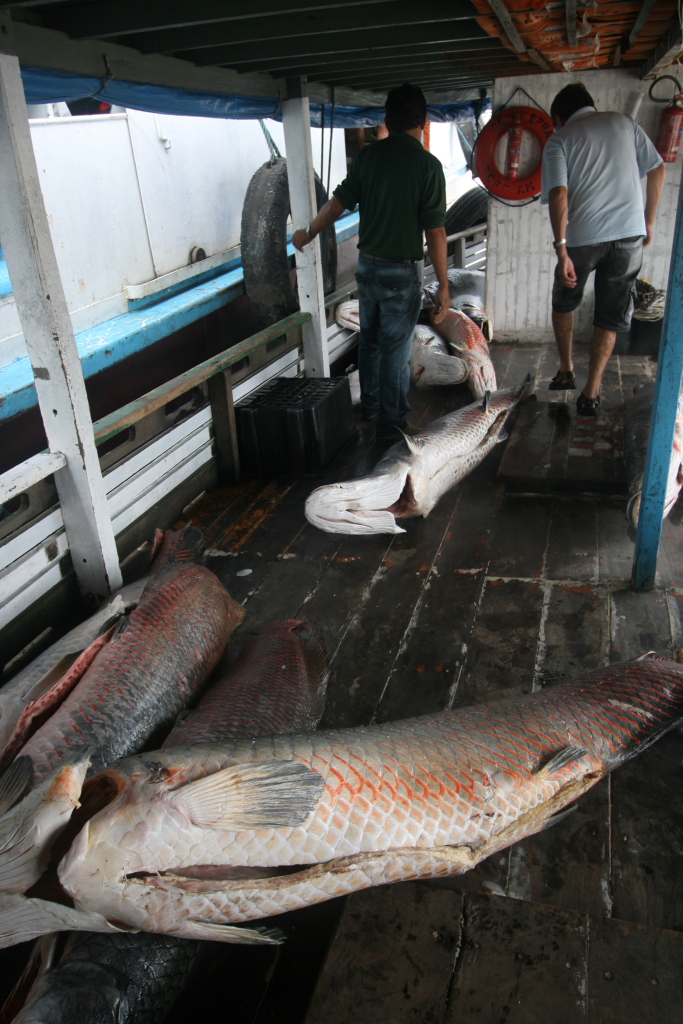
Picture of fish.

The pirarucu is one of the largest fish in the Amazon.

The weather was cool and comfortable for most of the trip. We had a couple rainstorms, but water didn't enter the ship this time because the tarps that served as walls were more waterproof on this boat. A few times it got ridiculously hot, but then it was easy to take a long nap in my hammock.

Food was included in the price of admission, but it was bland and repetitive. Every morning we got woken up at 6:00 for breakfast when one of the employees ran past everyone ringing a bell. Breakfast consisted of a bread and cup of sugar with a little bit of coffee, lunch and dinner generally contained chicken, rice, beans, and noodles. Fruits and vegetables were unheard of on board, and I was dreaming of coconuts and watermelons by the second night.

There were a lot of other travelers on the boat besides Craig and myself. Charlie, the Polish-Canadian-American immigrant who was on my last boat, accompanied us this time as well. His constant stories about finding good food, spending as little money as possible, and especially finding good food as cheaply as possible provided us with plentiful comic relief. Also joining us were Aldo, an Italian whose story about losing everything but his life in the Tsunami in Sri Lanka two years ago ranks amongst the greatest survival stories I've ever heard, a couple of Israelis, and an Aussie guy whose arm you'd have to twist to get him to open up about the minutest detail of his travels. We spent a lot of time playing cards, chess, and Scrabble on the board Craig made since last time I saw him. I always thought of Scrabble as a kid's game, but some of the arguments we had about what was and wasn't a word would even make most hardened adults shudder in disbelief.

Along the way, we stopped many times in towns and cities to load and unload cargo and people. The towns seemed to be a lot better off financially than those of Peru. Instead of having to set up the gangplank to walk on and off the ship, there were actual ports to make things easier. More people drove cars and motorcycles, and very few people gathered 'round the ship to watch all of the action. Everything was a lot more organized than in Peru, too. The ship left right on time, instead of paying the captain before getting off, we had to buy official-looking tickets before getting on, and the boat always rang its horn fifteen minutes before leaving a port to warn everybody. There was a walk-in freezer in the cargo hold for transporting chicken, beef, and fish from the size of small piranha to pirarucu, which was longer and heavier than me. The ship also constantly had to be restocked with beer and other food supplies for the passengers.

The first night on the ship, I decided to get away from the hordes of people and sleep on the top deck on my inflatable mattress. About midnight, we got stopped by the drug police. They instantly singled me out and looked at my passport and all of my luggage. When they were finally done, I went back to bed for about an hour when they woke me up again. This time, they were inspecting all passengers' luggage, so they had to look through my backpack again. They were never rude, but the search took hours and kept everybody up half the night. At least they started searching us at midnight rather than making us wait until dawn like the Peruvian police.

For the most part, it was a long, boring trip. The river was so wide, it felt more like traveling across a really long lake. Wildlife was unseen because we were always so far from shore. There were so many young women with babies, often all breastfeeding at once, that it felt like I was in the middle of a nursery rather than on an adventure down the Amazon. At least the locals didn't stare at us as much as in other countries. A lot of them even appeared to be Brazilian tourists because they carried cameras and spent a lot of time with us watching the scenery pass us by. Overall it was a nice trip, although I think a few more days on the ship would've gotten too boring for me. 1200 KM may seem like a long distance, but that's actually only one-fifth the length of the entire river.

The photo album for this entry is here.

Small Town Guyana

I've been hanging out in small Amerindian villages with no electricity in Guyana the last few days. Don't even ask how I'm able to write this now because I don't know. Everything is going well and I should be able to update this blog within a few weeks.

At Long Last, I'm Going to Brazil!

November 7, 2006
Day 405

It was pouring rain when I got up this morning. Craig and I had to walk to the Brazilian consulate to attempt to get visas, so I threw on my waterproof pants to stay dry. Craig didn't like my sense of fashion and tried to talk me out of it, but I insisted that as long as I had them, I might as well use them. He wore a pair of shorts in stark contrast.
When we got to the consulate, Craig wasn't even allowed inside because he was wearing shorts. It hits 40 C (104 F) nearly every day here, yet you're not allowed to enter the building without pants. If I had worn my shorts, we would've been turned back immediately.

The first thing I noticed when I walked inside was that nobody spoke anything but Portuguese. I would think that since it's an official government building, somebody there would know English, or at least Spanish, considering that the building is located in a Spanish speaking country, but that wasn't the case. Instead, I had to wave my hands all around to communicate.

I learned a lot of bad news from my pantomiming. In my numerous attempts to get the visa from Buenos Aires earlier this year, I learned that it would cost $100, and I could only pay in US dollars. A few days ago, I withdrew $100 from an ATM exactly for that purpose. However, today I learned that I would need 300,000 Colombian pesos, which is worth $136, and no other currency would suffice. So nobody in the consulate speaks the language of the country they're in, yet they don't use any form of currency other than the one from the country they're in. Besides that, the price went up dramatically since last time I checked. I've never heard of anyone having to pay $136 just to enter a country as a tourist and spend their money there. I was also informed that my visa would only be good for one year, whereas previously I was told that it would be good for five. On top of that, I learned that my photos that I got specifically for purchasing visas, which are official passport and visa size, weren't big enough for the Brazilians. The only good news was that if I got everything in order, I'd get a visa today or tomorrow. I left the consulate with a lot of work to do.

I must point out that the only reason the Brazilian government is being such a pain in the ass is that the US government does the same thing to Brazilian citizens. For them it's even worse, though. They have to pay money just to apply for a visa, and they might not even get it. They also get the pleasure of being fingerprinted when they enter the country. I still think the US government should have to pay for my visa, but of course that will never happen.

Back in town, we found an instant photo place and got our pictures taken. Then we went to a money changer, where I tried to change my US dollars into Colombian pesos to pay for the visa. The guy wouldn't even take half my money, though, because the bills had a few marks on them. I got them from a bank's ATM only a few days ago, and now they were worthless! I ended up having to borrow some money from Craig to get enough pesos. After we had our money, we picked up our photos, Craig threw on some pants, and we went back to the consulate.

This time around, they actually accepted our applications. A few hours later, we had our visas!

We wanted to be ready to go tomorrow, so we went over to the airport and got stamped out of Colombia. Next we took a bus into Brazil. The border is completely open in this area, so the city never really ends, and the only way you know you've entered a new country is that you start seeing green and yellow everywhere. We found the immigration station in Tabatinga and got stamped into Brazil. Next, we found the port, went to the boat, and took a look around. It's more expensive than the Peruvian boat, but also a lot nicer. With confirmation that the ship will leave tomorrow afternoon, we were all set to head to Manaus in hammocks.

The Search for Shakira Continues

November 6, 2006
Day 404

For our last moments in Peru, Craig, Charlie, and I had breakfast at a restaurant across from our hotel. The owner had a pet macaw, apparently as a ploy to attract more customers. After the macaw finished its yucca, the owner talked me into getting it to fly onto my shoulder for a photo. That seemed like a great idea, but as soon as it landed on me, it started biting my hair and clawing my skin, which was quite painful. Craig was waiting with the camera for the macaw to pose for a shot like you see in pirate movies, but instead of looking forward, it decided that a human ear would make a much better breakfast than a piece of yucca. The searing pain went right through me as its beak latched on and wouldn't let go. Still screaming in pain, I ran over to the owner and got him to take his pet back. When I reached up to feel my ear, I thought part of it would be missing, Mike Tyson-style, but luckily it was all there and was only sore for a few hours afterward. The owner was laughing so hard, I'm pretty sure he trained the bird to bite all tourists as a sick form of entertainment.

After breakfast we took a boat to Leticia, Colombia on the other side of the river. It's a nice little place with lots of motorcycles, but not nearly as loud as a lot of the other cities I've been to lately. On the other side of the city is Tabatinga, Brazil, which is where we need to go to get on a boat to Manaus, Brazil, which leaves in two days. The problem is that Craig and I both need visas to enter Brazil. I tried for a week to get one from Buenos Aires, but to no avail because of their strict rules regarding tickets into and out of the country. Today's problem is that it's a holiday of some sort, so the Brazilian Consulate is closed. We'll have to try tomorrow.

This afternoon we took a ride out to the airport in Leticia where the immigration office is to get an entry stamp on our passports. I don't know if the Brazilian officials will care whether I'm officially in Colombia, but I'd rather not risk it. If I don't have a visa in two days to catch the boat, the next boat doesn't leave for five days, and I don't want to sit here that long.

We also ran into an Italian guy who Craig met in Iquitos. Assuming all goes well with the visas, I think he'll be on the same boat as us, so there will be at least four tourists to make the journey through the Brazilian Amazon.

Many Delays

November 5, 2006
Day 403

Picture of house.

Laundry drying at an Amazonian house.

I woke up around midnight in the middle of a rainstorm. I had been sleeping on the floor with my sleeping bag and mattress, so I got soaked fairly quickly. The ceiling was waterproof, but there were no walls, only loosely hanging tarps, and the wind got so bad that the rain blew right in. We pulled over to the side of the river, but the storm was still powerful enough to soak everything. I scrambled to put my gear under my waterproof cover, then I climbed into my hammock, the only thing that didn't get wet, and waited for the storm to blow over. Apparently it rains frequently and heavily on the Amazon, but the storms pass quickly, which was indeed the case this time around.

Picture of kids.

Picture of kids.

We arrived at a town with a military post at 2:00 AM, but we couldn't leave until the entire boat was searched for drugs, and the officials refused to start searching until dawn. Finally they meticulously checked every single piece of cargo for several hours. When they finally got to where our backpacks were sitting, they saw that we were tourists and didn't bother searching us. We didn't get moving again until 9:00 AM.

It was another hot day where we took in our surroundings in the Amazon. We stopped at a lot more towns and constantly picked up and dropped off cargo. In the middle of the day, the engine cut out. We were out of gas. Luckily we had spare fuel tanks on board, and we were soon on our way again.

We got to Santa Rosa late in the afternoon. It's the easternmost point in Peru, and is joined by the border town of Leticia in Colombia and Tabatinga in Brazil. Santa Rosa is just a little settlement with a few hundred people, but tonight there was a party for all three border towns, so it was livelier than normal. Tomorrow we will head across the river to the Colombian side and finally obtain the coveted Brazilian visa.

Amazonian Life

November 4, 2006
Day 402

Picture of boat.

Our boat.

The entire day was spent going down the Amazon today in one of the many slow boats that go up and down the river. I spent most of my time in a hammock watching the jungle go by. At this point, the river is at least a mile wide and moves with very little current. It will only get bigger as tributaries continue joining with the main river.

The Amazon is much more populated than the tributaries I went down in Bolivia. It seems like there are constantly a few houses in view. Most of them have thatched roofs and are on stilts to prevent flooding. Almost none of the houses have electricity. However, everyone seems to have a canoe.

Picture of town.

Unloading the boat in a bigger port.

We stopped frequently at small towns and one bigger city called Pevas to load and unload cargo. At times it seemed like we were just constantly crossing the river. Every few hours there were a few new faces amongst the hammocks on the boat.

It was a very hot day, probably over 100 degrees Fahrenheit, but we did get some relief from a rainstorm late in the afternoon. The heat was so intense for most of the day that all we could do was lay in our hammocks, read, sleep, and play a few games of chess. This is definitely not the type of trip you can comfortably do on a short holiday. Charlie is only in South America for a month, and he's been running around the boat wondering when we'll get there all day.

The photo album for this entry is here.

A Flight to Iquitos

November 3, 2006
Day 401

I spent last night on a bus heading to Lima. I paid extra for the luxury bus this time, and was rewarded with a good night's sleep.

My flight to Iquitos was set to leave at 4:00 this afternoon, so there would be no sight seeing in Lima. Actually, that's how I prefer it. I saw enough of Lima when I started my trip. I grabbed a cab to the airport and waited a few hours for my flight time to approach.

Normally I don't fly much within my trips, but I didn't have much of a choice this time. With 400,000 inhabitants, Iquitos is the largest city in the world with no road access. It also is an important port on the Amazon River.

The small airport didn't have any hangers, so we had to walk directly to the runway from the airplane. As soon as I walked off the plane, I could feel a wave of heat and humidity hit me. I caught a three-wheeled motorcycle taxi into town, all the while listening to and smelling the thousands of identical taxis all around me. The abundance of motorcycles and lack of cars seems to be the norm for all jungle towns in South America.

I met up with Craig, my travel companion from Bolivia and Paraguay, at his guesthouse. Since I last saw him, he has spent most of his time in Peru, including riding a balsa raft down the Rio Urubamba, surfing in the north, and taking a dugout canoe through a remote national park.

We didn't have much time to spare because the boat was to leave the port at 9:00 for Leticia, on the border of Peru, Brazil, and Colombia. On board the Manuel, I met Charlie, a Polish-Canadian-American who had been staying at Craig's guesthouse. I set up my newly-purchased hammock amoungst about a dozen others on the third floor of the ship and made myself at home. The ship left late, but that was no worry. This is the slow boat, and its relaxed pace reflects life itself in the Amazon.