Author Archives: Dan Perry

About Dan Perry

Dan created this blog to document his South America trip, which covered every country on the continent and lasted over two years. He currently lives in Madison, WI.

Another Day, Another Continent

Picture of Melbourne, Australia.

Central Melbourne.

Dec. 18, 2014
Day 154

The sound of suitcases rolling past my head woke me. My flight had landed in Melbourne, Australia in the middle of the night. After clearing customs, I walked outside to get my bearings, then I quickly scampered back into the airport. I had flashbacks of my night in the airport in Miami, which I wrote about in 1000 Days Between. Unlike in Miami, I found a few other backpackers, sleeping in a quiet hallway. I blew up my air mattress, crawled into my sleep sheet and joined the others in their quiet slumber.

By 5 a.m., I couldn't take it anymore. The “quiet hallway” turned out to be one of the main corridors that led through security. It just happened to be closed when I first had seen it. But now it was open, and there was a constant chatter of over-caffinated travelers, dragging their luggage across the floor.

I packed my stuff, put on my backpack and got a cup of coffee. While walking through the airport, I felt something digging into my shoulder. When I took off my backpack, I saw that the metal frame had snapped. I had owned that pack for about five years and I had put it through the ringer, so I wasn't surprised that it had broken. Still, I wished it wouldn't have happened at the start of a two-month “vacation.” I took the frame out, shoved the broken end into my empty coffee cup to prevent it from ripping anything and added it to the front of my now-flimsy backpack.

When I stepped outside, the warm air confused my body. Jet-lag wasn't the issue – Melbourne is only three hours ahead of Beijing. But I was going into a sort of “seasonal jet-lag,” the result of traveling from winter to summer. This was actually a disappointment, considering how much I loved ice climbing. There would be none of that in the Australian summer.

I walked up to a curb, searching for the bus stop. Something so unusual happened, it took a few seconds to register: a car stopped and allowed me to cross. No car had ever yielded to me during my five months in China. Other strange things were happening. I had already practiced my English on the locals in the airport. Then when I got to the subway station, I saw people lining up on the left side of an escalator so others could pass. And when I wanted to exit the train, people waited outside until I was off. In China, everyone pushes their way aboard, so you have to force yourself through the crowd to exit. Compared with traveling through China, Australia really was going to be a vacation.

When I reached downtown Melbourne, I walked along the Yarra River, which passes through the center of town. People were sitting at riverside restaurants, having a beer and a laugh. Next I found Flinders Street, walked past the iconic Flinders Street Station and Saint Paul's Cathedral and ended up in the Treasury Gardens. It was only about one square block, but it had a green lawn, and eucalyptus trees provided plenty of shade. Last time I had seen such a nice park was in Shanghai, and when I had taken a nap on the grass there, a cop had woken me and kicked me out. But in this park, people were napping and picnicing all around me. A few guys were even playing a friendly game of cricket, Australia's national sport. I fell asleep for about an hour, and was not disturbed by the police, nor anyone else.

Across the street from the Treasury Gardens was Fitzroy Park. It was bigger, and in its center was a conservatory, full of flowers, fountains and ferns. Nearby was a miniature village that was a gift from the citizens of Lambeth, England, who sent food to Melbourne during the second world war. I also saw the “fairies' tree,” which took Ola Cohn four years to carve in the 1930s. Later I walked past a graduation ceremony for Melbourne University and took a stroll through the world-class Melbourne Museum.

At the end of the day, I met a local couple whom Katie had known from her time teaching in Berlin. We had a nice chat and called it an early night at their home in the suburbs. It wasn't the most exciting first day one can imagine spending in a new continent, but the blue sky and warm weather were just what I needed to reset my body after having spent so much time in Beijing. And bigger adventures were just around the corner.

More photos from Melbourne

Observations From Five Months in Beijing, China

Dec. 17, 2014
Day 153

You can't visit a new continent (let alone two new continents) every year. This year is special for me, my only multiple-new-continent year. After spending nearly five months in China, I'm due for a break. I'm heading to Australia.

Friends back home are always asking what I think of Beijing. To be honest, even after living there for nearly half a year, I still don't know how to respond. I've written about many amazing experiences in China (the best so far being my trip to Inner Mongolia). In fact, there are many more facets of China that I love and have yet to write about. But almost every day, I find myself in a situation that makes absolutely no sense to my Western eyes and ears.

I could go on and on about China, but for now, I'll give you 10 observations from my limited experience in the country:

1. The stereotypes about bathrooms, spitting and toilet-training are all true.

Picture of janitor.

Public bathrooms in Beijing.

Squat toilets are common. Bathrooms stink. People spit with no reservations. Toddlers wear crotchless pants and do their business on sidewalks, or wherever.

A lot of Westerners freak out when they see this stuff, but honestly, it hasn't been an issue for me. I'm not sure why it hasn't affected me as much as others, but I do know this: you're not going to change Chinese culture. If you plan to travel to China, you'll need to get used to this stuff quickly, or it'll be all you ever talk about.

2. The people are genuine and not aggressive.

Picture of smiling person.

Friends in Beijing.

Whenever I go for a walk, people say “hello” to me. I live in a suburb with a large expat community, and even there, many people get excited when they see foreigners. The language barrier is a real issue, but even if we can only communicate non-verbally, it always brightens my day to talk with the locals. And I have almost never been verbally harassed, which is very different from my experiences in Latin American cities, and even in bigger cities in the US. China has only recently opened its doors to the rest of the world, and the excitement is in the air. Meeting the locals has been one of my favorite things to do in China so far.

3. The websites you use every day won't work in China.

facebook_question

Credit: flickr.com/birgerking

Before I came to China, I knew that Facebook and Twitter were blocked. That wasn't a huge deal to me because I didn't use those websites very often. The thing I didn't realize was that Google is blocked. That's right, no Google Search, no Google Maps, no Google Drive, no Gmail! My own humble website isn't blocked, but because it uses some code that accesses a font from Google, it is painfully slow in China. The Android phone I bought in China doesn't even have the Google App Store, so I can't download any useful English-language apps. Google is like oxygen: you have no idea how important it is until it's gone.

The internet in China reminds me of a Ned Flanders quote about his cable television. “[I have] over 230 channels, locked out!”

4. The street food is amazing. International food is available at a price.

Picture of street food.

Dumplings (饺子) and steamed buns (包子) are my favorites. Beijing also has many nice restaurants that cater to those with international culinary preferences. They tend to cost a bit less than equivalent restaurants in the States. I go out to eat a lot in Beijing, and it's always an interesting experience. Even when I accidentally order intestines.

5. People smoke like it's the 1950s.

Picture of smoking man.

You can smoke just about anywhere, and cigarettes cost less than $2 per pack. This is a terrible place to live if you want to quit.

6. The beds are really hard.

Picture of tiles.

Softer than a Chinese bed.

If you laid sheet of plywood on top of a typical Chinese bed, it would become about 10% softer. This isn't a problem for everyone. If you sleep on your back, a hard bed probably is a good thing. If you sleep on your side and have plenty of “padding” on your hips, you'll still get a good night's sleep on a Chinese bed. But if, like me, you sleep on your side and you have bony hips, hard beds make you very, very ornery. After a couple days of waking up feeling like someone had hit me with a baseball bat across both hips, I broke down and started sleeping on my air mattress. People think I'm weird for bringing my own “bed” to a hotel room, but I consider it a necessity in China.

7. The pollution can be nonexistent or terrible on any given day.

Picture of pollution.

Air pollution.

Sometimes I wake up to a perfect blue sky. I can see the distant hills to Beijing's north and west. Other days, I can't even see the next building. There are so many factors at play – rain, wind, government mandated factory closings, and I'm sure many more – that it's impossible to guess tomorrow's pollution level. I don't know much about the long-term risks of living in such a polluted place, but if you're visiting Beijing for a short time, keep in mind that, depending on your luck, you might go home thinking I don't see what the big deal is, or I better make an appointment for a lung cancer screening.

8. The driving seems horrible, but there is a method to their madness.

Picture of traffic.

Beijing traffic.

Your biggest danger – by far – in China is getting hit by a car. I'm not the kind of person who blindly walks across the street, assuming that cars will stop. Even in the US, I look both ways before crossing. But in China, that's not good enough.

People do tend to stop at red lights, but stop signs, crosswalks and “green walking man” signs are meaningless. Cars are allowed to turn right on red, but they're not allowed to slow down and check if anyone's coming. There are so many more rules here, if you try to understand them all, you'll quickly start pulling your hair out. Instead, I've boiled the rules of the road down to their lowest common denominator.

Just for you, free of charge, I present my guide to driving and walking in China:

If you're on foot, here's when you have the right-of-way:

If you're on a bicycle, here's when you have the right-of-way:
When you're up against someone who's on foot.

If you're on a motorcycle, here's when you have the right-of-way:
When you're up against someone who's on foot or on a bicycle.

If you're in a car, here's when you have the right-of-way:
When you're up against someone who's on foot, on a bicycle or on a motorcycle.

If you're in a bus, here's when you have the right-of-way:
When you're up against someone who's on foot, on a bicycle, on a motorcycle or in a car.

If you're in a truck, here's when you have the right-of-way:
Always.

9. The public transportation is dirt cheap. The subway is easy to use, but buses are a huge challenge.

Picture of Dan in subway.

In Beijing, the subway costs thirty-three US cents per ride. There is plenty of English signage, so it's easy to figure out. Trains come every few minutes, so you never have to wait for long. My only issues with the subway are the long transfers (sometimes you have to walk through underground tunnels for fifteen minutes just to change trains) and the fact that the trains stop running at 11 p.m.

Buses in Beijing cost as little as seven US cents per ride, but they can be extremely difficult for foreigners to use. There is almost never a map, or anything written in English, at the bus stops. I have yet to meet a bus driver who speaks English, so if you get on a bus without a local who can translate for you, chances are you'll have no idea where you're going. Of course, this can be a fun adventure in itself.

10. There are tall people in Beijing. Seriously.

Overall, Beijing has been a great experience. I'm sure 2015 will bring more of the same. And in case you were wondering, here's when I first visited each new continent:

1. North America – 1978
2. Europe – 2001
3. South America – 2005
4. Antarctica – 2006
5. Asia – 2014
6. Australia – 2014
7. Africa – ???

Beijing Hutongs, Part III

On a crisp autumn afternoon, I went for another walk around Beijing's hutongs, this time near the Drum and Bell Towers. I really enjoy walking through these neighborhoods because they give a glimpse into traditional daily life in the modern capital city.

Here are some photos I took during my walk:

Picture of Drum Tower.

The original Drum Tower dates back to 1272, during Kublai Khan's reign. The current incarnation was built in 1420.

Picture of people.

Today people carry their own time-keeping devices.

Picture of man.

A man guards the Drum Tower's gate. The building is under construction.

Picture of soldier.

When I pointed my camera at this fake soldier, he pointed his fake gun at me.

Picture of bird man.

The man on the left trains birds. The man on the right is just curious.

Picture of bird.

One of the birds, attached to a nail by its breast.

Picture of electric meters.

Electricity is a welcome achievement in the hutongs.

Picture of ducks.

Roasting ducks, possibly for Peking duck, a local specialty.

Picture of biker.

A motorcycle delivery man.

Picture of rickshaw drivers.

These rickshaw drivers will show you around the neighborhood for a modest fee.

Picture of sign.

Happy officers give a Chinese warning.

Picture of bright houses.

New and old.

Picture of Hello Kitty.

The Hello Kitty car.

Picture of crumbling wall.

A crumbling facade.

Picture of rickshaw driver.

Another rickshaw driver.

Picture of janitor.

Those infamous public bathrooms don't clean themselves.

Picture of tiles.

Future roof tiles.

Picture of friends.

Friends taking a stroll through the neighborhood.

Picture of wheelchair.

The elderly are revered in China.

Picture of newspaper.

Time for a newspaper break.

Picture of sign.

“Must wear defence mask” is always sound advise.

Picture of sign.

Beer bottles stacked on a window sill.

Here's the complete photo set.

Happy Memories

Back in April, my friend Amy organized a flash mob in Madison, Wisconsin for her birthday. At noon on a warm and sunny Saturday, “Happy” by Pharrell Williams spontaneously blared from an outdoor speaker. The crowd dispersed from the street to make room for a group of boisterous dancers. I had a camera set up on a tripod to record the performance, and of course, many in the crowd recorded the event as well. I made the following video by splicing five feeds together.

Ah, the memories. I'd say the performers did a great job, in a style that is uniquely Madison. What do you think?

Manzhouli's Cabbage Bazaar

Oct. 9, 2014
Day 84
Northern Inner Mongolia Trip, Part VI

* In cased you missed the earlier parts, here they are:
Part I
Part II
Part III
Part IV
Part V

One day while walking through Manzhouli, I stumbled upon an outdoor bazaar. Like most markets in China, this was a vibrant place, with a wide variety of fruits and vegetables for sale. It was also crowded, with hordes of people and vehicles jockeying for position in the street. I love walking through bazaars; they give me a sense of day-to-day existence in faraway places. Cultural differences can put up barriers between me and the local people, but markets also help me connect me with others in this shared journey through life.

Here are a few photos I took in the Mazhouli market. Do they give you a sense of daily life in Inner Mongolia? Do you see any similarities to your hometown?

Picture of street.

Manzhouli is a small city, near the tripartite border between Mongolia, Russia and China.

Picture of field.

Nearby are the vast grasslands of the Eurasian steppe.

Picture of market.

In the city, there is a bustling market.

Picture of motorcycle.

Some motorcycle owners sell their wares directly from their vehicles.

Picture of band.

Others try to force their vehicles through the large crowd.

Picture of oranges.

Even this far north, oranges are aplenty.

Picture of band.

And there are a wide variety of vegetables.

Picture of chickens.

You can even buy live animals, like chickens...

Picture of bunnies.

...or bunnies.

Picture of meat.

And of course there are plenty of dead animals for sale.

Picture of chestnuts.

One man sells chestnuts.

Picture of walnuts.

Nearby, another man sells walnuts.

Picture of cabbage.

But in the fall, the biggest item at the market is cabbage.

Picture of cabbage.

Piles of cabbage.

Picture of leaves.

Sometimes the leaves are sold individually.

Picture of cabbage.

But usually the heads are kept whole and laid out to dry.

Picture of people.

It's cold this time of year. Scarves and winter coats are coming out.

Picture of man.

But as long as the goods get sold...

Picture of man.

...and the money comes in, everybody's happy.

More photos from the Manzhouli market

Blood Moon Train to Beijing

Picture of train.

The train to Beijing.

Oct. 8 - 9, 2014
Days 83 - 84
Northern Inner Mongolia Trip, Part V

* In cased you missed the earlier parts, here they are:
Part I
Part II
Part III
Part IV

I walked for the last time through Manzhouli, China, simultaneously bombarded by a Russian ad in my left ear and a Chinese ad in my right. A giant footbridge led me over at least ten sets of train tracks, with many trains waiting to transport goods to nearby Russia. On the other side of the tracks, a lady was selling lunch from her bicycle rickshaw. She had recorded the name of her dish and set it to loop from a bullhorn. She sat on her bicycle, listening to her own voice repeat the announcement every three seconds. She seemed fine with this arrangement, but I had to scurry past her to avoid instant insanity at the repetition.

The train left on time. It was only half full, and I had two seats to myself. I knew this comfortable situation was temporary – I wouldn't step outside the confines of this train until it reached Beijing, thirty-two hours hence.

After leaving the city, we passed sprawling fields with grazing cattle and a few little towns of identical five-story apartment towers. In one of these towns, there was a Russian onion-domed building, under construction, of course. This was the land I had become accustomed to over the last two weeks. How strange it would be to return to a city of 21 million.

At our first stop, a fellow passenger greeted me by waving his ticket in my face, obviously disgruntled that I was in his seat. I've come to accept in these situations that I'm probably in the wrong. I can't read, write or speak Chinese, so I'm basically a four-year-old without any parental supervision. I apologized, grabbed my backpack and soon learned that I actually was in the right seat, but the wrong car. My ticket was for an aisle seat, so I wouldn't even be able to sleep leaning forward with my head on a table. This was a significant downgrade. Five people already occupied my new seating area. Luckily, the guys sitting across from me were friendly. We communicated using hand gestures for the rest of the trip.

Picture of people.

My seat-mates.

After the sun had set, I tried to explain a special event that was about to take place: a total lunar eclipse, where the sun's rays would be refracted upon hitting the Earth, turning the moon red. I took out my phone and showed my new friends the Chinese character for “eclipse.” Then I showed them the character for “blood,” since this type of eclipse is known as a “blood moon” in English. One of the men immediately understood and explained it to his friends. Some people sitting near us overheard the discussion and started making comments about the eclipse. Soon everyone in our car was looking for the blood moon.

It was a cloudy night, so I was afraid we would miss the show. Then the clouds began to dissipate. A woman sitting across the aisle from me grabbed my attention, looking excited. I gazed out of her window and saw the moon, mid-eclipse. Strangely, it was streaking across the sky, as if time had accelerated. At this rate, the night would last about twenty seconds. Then I figured out the illusion: we must have been banking at angle that was shallow enough for me not to notice. In this dark and remote corner of the planet, only the moon betrayed our gradual turn.

I wanted to take a high-quality photograph of the moon during the eclipse, but now I realized that this would not be possible. It was too dark and the train was too bumpy. Instead, I joined the others in the shared experience of admiring the moon. With the unpolluted sky and the train's huge windows, this was an excellent venue for viewing the eclipse, photos or not. For the next hour, the blood moon danced back and forth across the sky, much to our amusement.

Picture of moon.

The blood moon.

When the eclipse ended, I jotted some notes from my trip in my notebook. Many people leered over my shoulder to watch me write. I figured they were doubly curious – not only was I writing in English, but I was using my left hand. Their curiosity surprised me because I see English all the time in China. Many road signs have English words under the Chinese characters, and every sign in the subway system is written in both languages. Many people even wear shirts with English words. I have yet to see a Chinese person with an English word tattooed across his bicep, though.

At around 11 p.m., a group of men boarded my car and sat a few seats in front of me. They took out a deck of cards, popped the tops off of their beer cans (yes, they still have pop-tops here), and lit cigarettes. They shouted, drank, smoked and slammed their cards on the table for hours on end. I sat up straight in my seat, trying unsuccessfully to sleep. Eventually one of the guys in my section crawled onto the floor and went to sleep underneath the seats. I splayed my legs across three seats and finally fell into a fitful sleep, coughing every few minutes from smoke inhalation. About an hour later my friend got up from the floor and took back his seat. I did what came natural – I slithered onto the floor and passed out.

When I woke, I saw that one guy had been sitting with his knees bent, feet pressed against his butt so he wouldn't have to put them on my hip. I was grateful. I climbed back into my seat, trying to shake the fog from my head, and noticed that the outside world was foggy as well. Soon I realized that even though we were in the middle of nowhere, hundreds of miles from Beijing, the “fog” was actually a thick cloud of pollution.

For breakfast, one of my new friends opened a package of three green boiled eggs. The guy next to him pulled out a vacuum-sealed chicken foot. He opened it and peeled its wrapping like a stick of beef jerky, then bit into the claws. He chewed it and spat the cartilage onto the floor (yes, the very floor I had been sleeping on a few minutes earlier). I was just happy he didn't offer me any. Instead, I ate a bucket of ramen noodles the size of a tub of movie theater popcorn. The chicken foot was almost certainly a healthier breakfast.

By the afternoon, we were back in “civilization.” At least once per hour, we went through a megalopolis, full of unfinished apartment towers, thirty stories tall, twenty at a time. At one point a salesman with about twenty leather belts hung over his arm walked into our car and gave a long spiel about his product. After a good ten minutes of talking, he handed one end of a belt to a potential customer. He twisted it into a helix, then played tug-of-war with the customer to demonstrate how strong this belt was. Finally, he announced the price: 10 rmb, less than $2. This indeed did look like a nice belt and I would have bought one if I didn't already have one. All told, he was in our car for about twenty minutes. He only sold a couple of belts before moving to the next car. I wondered how he could possibly make ends meet.

Later in the afternoon, an interesting character walked aboard and sat across the aisle from me. He was wearing a matching Adidas sweatshirt and sweatpants, a hat pulled low over his eyes, large-gauge earrings, a stylish watch and multiple necklaces. But most interestingly, he was carrying a Canon 70-200mm f2.8 lens, one of the most conspicuous lenses in that company's lineup. In a country where most people dressed plainly (standing out can be dangerous here), this guy was ultra-stylish. I asked him about the lens and he said that he shot sports. He seemed like a friendly guy, but I did get annoyed with him after a while – he was constantly on his phone, and whenever he got a text, our whole car had to listen to the sound of two silenced gunshots, followed by the cartridges clanging against the ground.

When the sun set for the second time of this train ride, I knew we were getting close to Beijing. Finally, the city's highrises, along with some hutongs, came into view. At least that's what I assumed I was looking at. The Air Quality Index was over 400 (extremely hazardous), so visibility was quite low.

The train stopped in central Beijing, I said goodbye to my companions and mixed into the throngs of people walking toward the subway. The locals didn't stare at me, and one person even said, “Excuse me” in English. Hearing that confirmed it: after spending the last two weeks in rural China, I was back in the big city.

What's next? How about reading Part VI of this series.

Hangzhou Ultimate

Nov. 9, 2014
Day 115

Last weekend my girlfriend Katie and I traveled to Hangzhou, China for an ultimate frisbee tournament. OK, to set the record straight, she played and I came to watch. This was a “hat tournament,” where teams are chosen somewhat randomly, although they make sure every team has a few experienced players and some beginners to balance it out. It was a fun tournament with lots of competitive play. I broke out my telephoto lens to photograph one of Katie's games. Here are the highlights:

(There is a link to the full photo set at the end of this post.)

Picture of biters.

Hangzhou is a city of 8.8 million (21 million in the metropolitan area).

Picture of biters.

Katie's team for the hat tournament was called “The Biters.”

Picture of ultimate.

The Other Guys.

Picture of Jared. Picture of Katie. Picture of ultimate. Picture of ultimate. Picture of ultimate. Picture of ultimate. Picture of ultimate. Picture of ultimate. Picture of ultimate. Picture of basketball players.

The basketball players stopped their game to check out the ultimate game.

Picture of Jared. Picture of ultimate. Picture of Panda. Picture of team. Picture of circle.

The post-game “spirit circle.”

Picture of biters.

The Biters.

Picture of ultimate

The Other Guys.

Click here for the full photo set.

End of the World

Whenever I travel to a new city, I like to check out the local music scene. Luckily, in Beijing this was an easy task. End of the World, a local ska/punk band is made almost entirely of BIBA teachers. They mostly play original music, and they are a ton of fun to watch. I have gone to two of their shows, one at the 798 Live House in Wanjing, and one at the Temple Bar in Dongcheng. If you're in Beijing, you should check out one of their frequent shows.

Here are some photos of End of the World:

Picture of band.

End of the World, playing at the Temple Bar in central Beijing.

Picture of Jeph.

Lead vocalist and guitarist Jeph Marquardt.

Picture of Jeph. Picture of Jeph. Picture of crowd.

The exuberant crowd.

Picture of Peter.

Peter on trumpet.

Picture of Peter. Picture of Rick.

Rick “Gramps” Freeman on sax.

Picture of band. Picture of crowd. Picture of Ryan.

Ryan Ihle on bass and vocals.

Picture of fan. Picture of crowd. Picture of Kevin.

Percussionist/vocalist Kevin Kasal.

Picture of Kevin. Picture of band. Picture of band.

More photos from the band's Live House performance
More photos from the band's Temple Bar performance

Manzhouli: Land of Matryoshka Dreams

Picture of Manzhouli.

The moon rises over Manzhouli.

Oct. 5 - 7, 2014
Days 80 – 82
Northern Inner Mongolia Trip, Part IV

* In cased you missed the earlier parts, here they are:
Part I
Part II
Part III

Tripartite borders, where accessible, are fascinating places to visit. In their vicinity, people speak multiple languages and vendors accept multiple currencies. The people who live near tripartite borders often have mixed racial and cultural backgrounds. Sometimes the borders are open, and goods flow freely back and forth. Many tripartite borders, however, are remote and inaccessible to all but the most intrepid travelers.

Officially, I've been to three tripartite borders, though I've traveled in the vicinity of many more. Near the Brazil-Argentina-Paraguay border sits one of the world's most awe-inspiring waterfalls (Iguazu) and the world's second-largest power plant (Itaipu Dam). Peru, Colombia and Brazil all converge on the Amazon River, hundreds of miles from the nearest town with road access. And perhaps the strangest and most spectacular border I have ever been to is on top of Mount Roraima, where Venezuela, Brazil and Guyana all meet at an unmanned obelisk. My trip to Inner Mongolia put me within spitting distance of yet another tripartite border, that of Russia, China and Mongolia.

It was already dark when the bus dropped me off in Manzhouli, China. I walked a few blocks and found a cheap hotel, marked with a plain door and a red neon sign. I walked inside and saw what I had learned was typical of Chinese apartment buildings: dim lighting, scuffed walls, filthy floors, no decorations. My kind of place.

The hotel's front desk was on the third floor. The manager, a middle-aged man with a comb-over and a leather jacket, held a cigarette between the index and middle fingers of his right hand while clicking his ancient computer's mouse. He was playing solitaire. When he saw me walk up with my huge backpack, he took one last drag from his cigarette and stubbed it out in an ashtray, next to its brethren. To my relief, he told me that there were vacancies, and rooms were only 50 rmb. I had been prepared to spend many times that amount on this holiday weekend.

The man plugged an ancient scanner into his computer and turned it on. (Hotels are required to scan foreigners' passports in China.) I handed him my passport, then he set it on the scanner, pushed a button and watched the green wand do its magical wave. An image popped up on his screen, showing half of my picture. It was upside down. The man moved my passport a couple of inches to the left and rescanned it. The resulting image showed only the lower-right corner of my passport. It was still upside down. He repeated the move-rescan process a few more times, each time not even coming close to scanning all of my vital information. Looking confused, he lit another cigarette and started to bend my most important document backwards, as if that would fix it. I yanked my passport from him – it has to last nine more years, after all – and removed it from its RFID-blocking sheath. He scanned it a couple more times, then seemed satisfied when half of my picture and all of my name were displayed, even though the image was still upside down.

The man led me upstairs to my room, carrying a ring of keys in his left hand and a cigarette in his right. The room was small. It was also the kind of place where you don't want to touch anything. The bathroom had a toilet that actually worked, and it had a bathtub, but no running water. Whatever, at least it was cheap.

I dropped off my backpack and went for a walk around Manzhouli. The city was full of thirty-story hotels with bright, blinking lights covering their facades. I walked down the main pedestrian street, which featured a few creepy statues and dozens of shops. Outdoor speakers pulverized my ears with advertisements, half in Chinese, half in Russian. I didn't understand the announcements, but I could tell they were succinct – they looped and replayed every ten seconds, sometimes even more frequently. Large Russian babushkas darted between shops, clutching full shopping bags. But mostly the streets were filled with Chinese people, heavily bundled in the frigid nighttime air.

Eventually I found a set of train tracks and followed them to the train station. Luckily, there was a ticket booth, so I was able to buy a ticket back to Beijing from a real, live person, just like in the old days. Unfortunately, all of the sleeper cabins were sold out, so I would have to spend another thirty-two hours in a “hard seat.”

Train ticket in hand, I returned to my hotel for some peace and quiet. When I reached the third floor, the front-desk manager got my attention. He wanted to see my passport again. Reluctantly, I took it out of its sheath and handed it to him. Just like before, he scanned an upside-down image. He rotated my passport 180 degrees, shifted it to the left, then rotated it 180 degrees. The resulting image was upside down. The man jerked his head backwards and a look of astonishment crossed his eyes. He repeated the same process of rotating my passport 180 degrees – twice – and again couldn't believe that the image was still upside down. He said, “Huh?” lit a cigarette and started to bend my passport again. I grabbed it from his hands and put it on the scanner myself. This time the image was right-side up, but it was still off-center.

The man shouted for a teenaged boy who was sitting in the hallway to help him. The two of them scanned my passport over and over, moving it a millimeter at a time. At one point, they had it almost perfect, but they decided to shift it a tiny bit and accidentally moved it the wrong way. The next few scans got progressively worse, until they pulled my passport from the machine and examined it, effectively starting over. I suggested that they just take a picture of my passport with one of their cellphones, but they refused. Getting a perfect scan had become a quest.

I sat in a chair next to the desk and put my head in my hands. I had spent most of the day on buses, and all I wanted was a good night's rest. Thirty minutes and fifty scans later, they were back to a near-perfect image. The manager finally handed back my passport and said, “We'll try again tomorrow.”

* * *
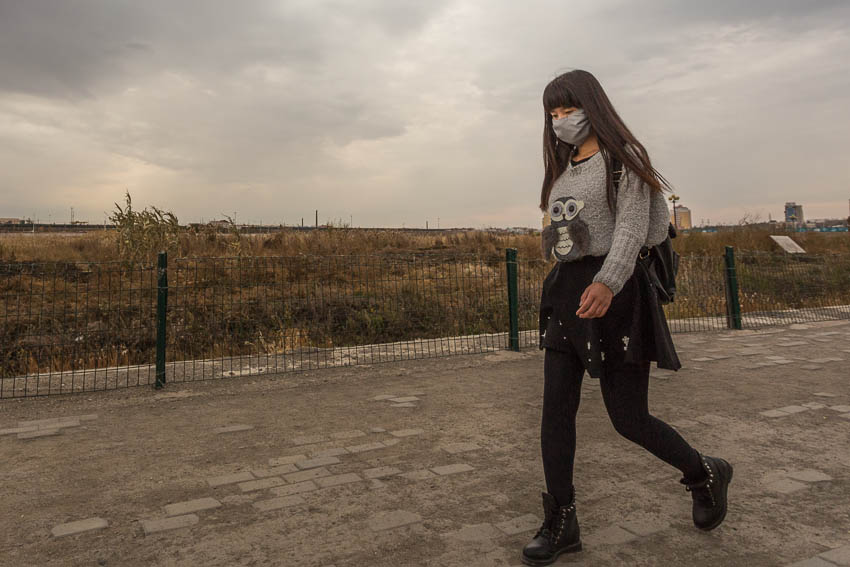
Picture of girl.

Walking with an owl sweater. And a mask.

The next morning, there was a giant thermos of boiling water waiting at my door, which I figured was for bathing. I filled a plastic wash basin with cold water from a communal sink, then mixed it with hot water in my bathtub and gave myself a sponge bath. On my way out of the hotel, I ran past the front desk, hoping the manager wouldn't remember to ask for my passport again. Luckily, someone else was working.

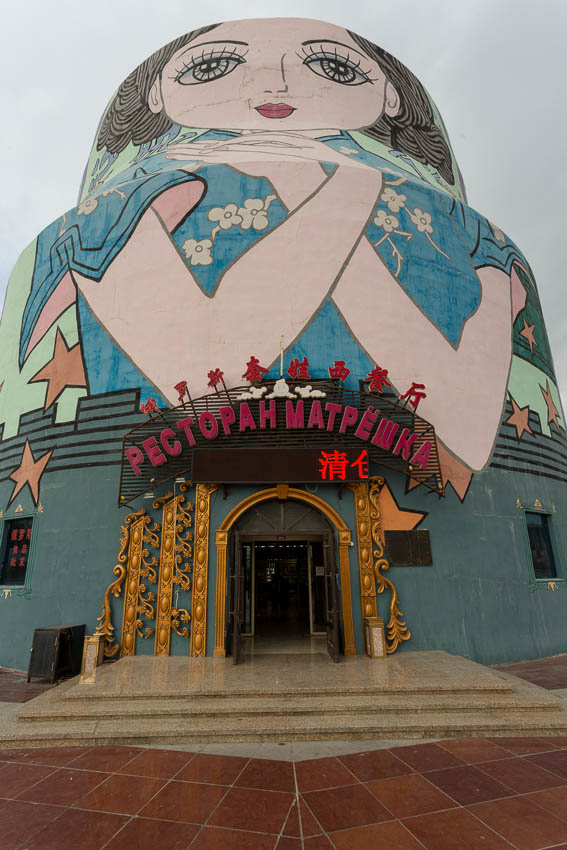
I decided to walk to the Russian border, several miles to the north. Before long, I was outside of central Manzhouli, walking past smaller houses with rows of cabbage drying outside. Soon I was passing a large empty field next to the road. A giant shopping mall was on the outskirts of the city. Nearby was an empty stadium. Looking toward the border, I noticed something strange in the distance. It looked like a giant matryoshka doll.
Picture of 23362.

The world's largest Russian doll.

My eyes weren't playing tricks on me. I was actually looking at a five-story Russian doll, surrounded by smaller dolls. The plaza's circular perimeter was sprinkled with dolls about eight feet tall, painted with various world leaders, famous athletes and pop-culture characters. The place looked decades old and poorly maintained. The paint was chipping from the dolls, parts of the walkway had been ripped apart and weeds were growing between the cracks. Yet while I was there several buses pulled up and dropped off loads of tourists to walk around and take pictures.

* I later learned that this is the largest Russian matryoshka doll in the world, and it was built just eight years ago. Go figure.

As if the plaza itself weren't strange enough, giant buildings were under construction all around it. When these buildings are finished, they'll dwarf the original five-story doll. Maybe they'll compensate by building an even bigger doll over the top of it?

Next to the doll plaza was a garden of bronze sculptures, featuring Russian literary figures such as Tolstoy, and various Soviet political leaders. There was also a tribute to Russian laborers, featuring a man and a woman holding a hammer and sickle. Unfortunately and perhaps ironically, one of the facade's tiles had fallen off and broken. The sculpture garden was in an even worse state of disrepair than the doll plaza, and no one except me was walking through it.

I walked the rest of the way to the border, but there wasn't much to see. Just a gate that I wasn't allowed to cross, with a small – and probably equally garish – city on the other side. The Mongolian border was a few miles to the west, but I didn't see any gates or cities or monuments or people. Just rolling hills, covered in grass.

Picture of 23351.

Sunset behind Manzhouli.

At the end of the day I returned to Manzhouli. I wanted to buy some dried blueberries to take back to Beijing, so I poked my head into a few shops. They all sold large bags that were filled with serving-size bags of blueberries. I've noticed that in China, food manufacturers love wrapping little items inside of bigger ones. Sometimes you have to open a package four times before it's actually open. I just wanted one big bag of blueberries that I would only have to open once, so I kept looking.

Finally, I hit the jackpot: a shop with several piles of dried blueberries, and no excess packaging. I told the owner to give me 50 rmb of his best stuff. As he was scooping the blueberries, he asked where I was from. I told him I was American and he said something I didn't understand. He tried saying it a different way but I still didn't understand. Then he took out his phone, brought up a video and asked something like, “Is this what America is really like?” The video was of a local Chinese newscast where they sent a reporter to the Mississippi River basin. They showed the reporter traveling on a river in a motorboat, and soon hundreds of fish started jumping out of the water, crisscrossing the camera's path. Several fish landed in the boat and flopped around. The whole time they were explaining what was happening in Chinese. They interviewed an overweight American man wearing a muscle shirt and a camouflage baseball hat. He explained, in a thick Southern accent, how these were invasive Asian carp and they had taken over the river system. Then he said, “You have to be careful 'round here, one of them suckers gave me a black eye.”

Even though I knew invasive species were a serious problem, I couldn't contain my laughter. The blueberry salesman put his phone away and gave me a look of concern for my safety. I answered his previous question by saying, “Yes, in America this is normal.”

(I couldn't find the exact video he showed me, which is a shame because the fact that it was told from a Chinese perspective made it really interesting. However, this video captures the essence of the situation.)

While walking home, I stopped at a few of Manzhouli's well-lit plazas to photograph the nearly-full moon rising. It dawned on me that other than Las Vegas, this was the gaudiest city I had ever visited. Normally that would be a major turn-off, yet for some reason, I actually enjoyed Manzhouli. Maybe the buildings that were far too tall, bright and concentrated for a city of this size were what did it for me. Miles of empty land surround Manzhouli, yet city planners had chosen to go vertical anyway. It was as if everyone in Manzhouli wanted to be in the middle of the action, so they crammed as much eye-popping stuff into as small an area as possible.

When I entered my hotel, my old friend the chain-smoking, passport-scanning man was working at the desk. I ran past him and he didn't say anything. Only one train and thirty-two hours now separated me from Beijing.

What's next? How about reading Part V of this series.

More photos from Manzhouli

The Greatest Pleasures of Travel

Picture of cabin.

A cabin heated by wood, televised by satellite.

Oct. 3 - 4, 2014
Days 78 – 79
Northern Inner Mongolia Trip, Part III

* In cased you missed parts I and II, here they are:
Part I
Part II

Katie and I left the village of Moerdoaga early in the morning, on a bus bound for the small city of Erguna. Soon after we left, the Moerdaoga National Forest petered out and gave way to the vast Hulunbuir Grassland. The population of this land was sparse – we only passed a few farming communities of identical tiny houses.

When we reached Erguna, the bus dropped us off in the center of town. Vendors sold fruits and vegetables along the sidewalks. Clothing shops and restaurants blasted advertisements from outdoor speakers, competing for our business. Salesmen selling street food from rickshaws shouted their wares into bullhorns. All of the noise and bustle made the city seem much bigger than it actually was.

We bought tickets to Enhe, our destination for the day. There was just enough time before our bus left for us to run across the street for lunch. We walked into a restaurant and saw that nothing was written in English. We “ordered” by pointing at some other patrons' dishes and saying, “I'll have that.” Luckily, our bowl of soup didn't contain any intestines this time. As we ate, a foreign man walked into the restaurant. We exchanged awkward glances of “What are you doing here?” Then Katie and I ran back to the bus station and found our bus, just before it left. One of the greatest pleasures of travel is figuring out how to get from point A to point B, in a foreign country where you can't speak, read or write the language, under the pressure of time. Of course, another great travel pleasure is spending all day doing nothing at all.

The ride started on a bumpy gravel road. When we made it to a paved road, it became inexplicably bumpier. There were few cross streets – we were in the middle of nowhere, and this road went to the border of Russian Siberia. We arrived in Enhe at about 3 p.m.

We only knew two things about Enhe: it had been populated with Russian immigrants, and it had a youth hostel. In fact, the previous night while I had had a decent internet connection, I had searched for all hostels in the region. The one in Enhe was the only result. That alone was enough to make us want to go there.

We gathered our backpacks and walked toward the hostel, passing log cabins built along a river. A Russian Orthodox church was in the center of town, as were little shops selling Russian souvenirs. A bakery exuded the smell of fresh bread. Pigs and cows freely roamed the streets.

Picture of hostel.

Our hostel in Enhe.

The hostel was a nice place at the edge of town. There was a large common area with big windows, where guests could admire the sprawling grasslands. This room was heated with a wood stove, which made me feel like I was “up north” in a cozy cabin.

Katie's flight from Hailar to Beijing was the following night, so we figured we could go for a bike ride or a long walk before heading out of town. Unfortunately, the last bus of the day left at 9:30 a.m. Katie may have had to leave this remote village a mere thirty hours after arriving, but I was under no such time constraints. What would I do next?

It was unlikely that I would visit this part of Inner Mongolia again, so I wanted to see a few more places before heading home. The problem was buying train tickets. I had discovered on this trip that you can't just show up and expect to get a ticket for a long distance train. If you don't want to stand for thirty hours straight, you need to book your tickets online, days or weeks in advance. During my South America trip (2005-2008), I never once used the internet to book a bus or train ticket. Things have changed a lot over the last six years.

The hostel was packed with Chinese tourists. As I was browsing for train tickets, a kid sat next to Katie and me and started asking questions. We were happy to talk with him at first, but he kept asking more and more questions. “Where are you from?” “Do you have children?” “How much money do you make?”. Then he said, “I like to talk about uncomfortable subjects, like euthanasia and freedom of speech.” Katie and I changed the subject, but he kept talking. Finally I ignored him and went back to looking for train tickets. The English ticket-purchasing website wasn't working, though, possibly because it was a holiday weekend. I would have to improvise my way to my next destination, without any idea of how to get there, or what I might do once I arrived.

Ah yes, one of the greatest pleasures of travel...

* * *
Picture of workers.

Workers in Enhe.

The next morning Katie left town by bus. She would be back in Beijing later that day. I was actually a bit jealous – at least she knew where she was going. I decided to stay behind for a day and think things through.

I rented a bike from the hostel and pedaled along the road to the Russian border, past vast farm fields and open landscapes. I continued to listen to “Wrath of the Kahns” and learned more of the legacy of Ghengis Kahn's empire. When his son Ogedei died, he didn't leave an obvious successor. For five years, the various factions of Ghengis' grandchildren squabbled. During this interim period from 1242 to 1246, Ogedei's widow took over as leader of the entire Mongol Empire. She ruled over more land than any female before her, and possibly since. Yet few people in the modern world have heard of her. Her name was Töregene Khatun.

I biked across the steppe, conjuring images of Mongolians, riding their horses across this dusty land to conquer new territory, pillaging, raping and slaughtering all who got in their way. I pedaled to the next village, another farming community. The people living there looked Mongolian – direct descendents of Genghis, perhaps?

The next morning I left Enhe with a plan: I would ride buses a couple hundred miles southwest to Manzhouli, on the Russian border. From there, I would find the train station and attempt to buy a ticket home, from a real human being. This may have been a bad idea: it was the end of a holiday weekend, and the only info I could find about lodging in Manzhouli was from a guy who said the cheapest room in town was 400 rmb and didn't have electricity or running water (by comparison, my bed in Enhe was 70 rmb and had both). I had a tent with me, though, so I could always walk to the edge of town and set up camp.

When I got to Erguna, I bought a ticket for the next bus to Manzhouli, which didn't leave for three hours. Luckily, I met a French couple outside of the bus station who were on their way to a park, so I tagged along. The park was at the top of the hill at the edge of town. It afforded us even more great views of the surrounding wetlands and grasslands. While we walked through the park's boardwalks, at least six Chinese tourists stopped us for a picture. The French couple informed me that the Chinese equivalent of saying “cheese” when getting your picture taken is “1, 2, 3, eggplant.”

Picture of sign.

A sign in the park.

The road to Manzhouli was long and lonely. The landscape was so flat, the highway so straight, you could see the road all the way to the horizon. The only time it changed direction was when it made an abrupt ninety-degree bend with no other roads intersecting it. Wired fences and flags lined the sides. We passed clusters of yurts and a band of wild horses. The only time we stopped was to let a herd of cattle cross the road.

After a four-hour ride, we saw onion domes and thirty-story buildings emerge from the horizon. If I didn't know any better, I would guess that this was Novosibirsk or maybe Las Vegas. But it was neither. We had arrived in Manzhouli, and it was to be the most interesting destination of my Inner Mongolia trip.

What's next? How about reading Part IV of this series.

Photos from Enhe
Photos from the park in Erguna

External Websites:
Hardcore History Includes “Wrath of the Khans.” Not a sponsored link.