Author Archives: Dan Perry

About Dan Perry

Dan created this blog to document his South America trip, which covered every country on the continent and lasted over two years. He currently lives in Madison, WI.

One Last Stop

August 9, 2006
Day 315

Today I took the last bus of my trip from Mancora, Peru to Guayaquil, Ecuador. The trip lasted over eight hours, so I got over halfway through my new book, Prey by Michael Crichton, a scary look at nanotechnology gone bad. I was happy when I scored it at a book exchange, but I was hoping it would last me all the way home. Now it looks like I'll be looking for a new book in a day or two.

Guayaquil is the largest city in Ecuador, but luckily the bus station and airport are within a few blocks of each other. I checked into the only hotel close to them both. I didn't have a lot of time for sightseeing, but Ecuador seems a lot more modern than Peru. I'm back in the land of shopping malls, fast food, and people driving nice cars. I'm also getting used to using dollars a day early. I'm not entirely sure why the official currency of Ecuador is the US dollar, but I've gotten severely conflicting stories from the various people I've asked. I'll have to get the real story from the Internet, the only source that never lies.

A Relaxing End To My Trip

August 6-8, 2006
Day 312-314

Fransisco, Robyn, and I took a bus to Piura and had a look around. The Lonely Planet says that it's a small colonial city centered around a plaza with a large church, but most of the old architecture was destroyed in an earthquake. Gee, that could describe just about any city in Peru. We only stayed for breakfast and decided to try and find a nice place to chill out for a few days.

We ended up going to Mancora, a small beach town along the northern coastline. Right away, I loved it. Everyday the weather was hot but not too hot without a cloud in the sky. There were lots of tourists, but not too many gringos, and the locals were friendly. Right away, I noticed a thriving community of hippies who sell jewelry for a few hours a day and hang out on the beach the rest of the time. It was impossible to be in a bad mood because nobody in town had a care in the world.

I ended up sticking around Mancora for three days. There were no great adventures, but I made a lot of friends and generally had a good time. With my trip coming to a close, my motivation to do spectacular things was gone. But really, given my time constraints, my only choices were to stay in Mancora or go to Guayaquil for a few days. That decision was a no-brainer.

NAFTA Takes Trujillo

August 5, 2006
Day 311

Picture of dog.

A hairless dog coming out of the water.

This morning, Robyn, Fransisco, and I met up to go on a tour of the ruins near Trujillo. A bus first took us to a few Huacas, which were ancient temples and living quarters. Most of the architecture was original, including the painting. The fact that painted adobe could last thousands of years made the trip interesting.

Everywhere we stopped, there were a few hairless dogs. The rumor was that the dogs were bred by the Spanish because they threw off lots of heat. People with arthritis could then throw the dogs in bed with them to sooth their joints. I'm not sure if that was true, but one thing was clear: the dogs were ugly as sin.

In the middle of our tour, we came back to Trujillo for lunch. We got dropped off in front of a school, so we played on the playground for awhile and watched a bunch of middle-aged men play soccer on a basketball court. When we were walking back toward the bus, we saw a bunch of the soccer players getting drunk in a bar, so we joined them. They were too inebriated to make much intelligent conversation with, but at least they were in a cheerful mood. The entire bar was filled with scary stuffed animals like a deer head with white eyes, deer paws used for hanging stuff, and a fox whose butt was placed directly above us. It was quite a classy joint.

The highlight of the tour was Chan Chan, the largest ancient adobe site in the world. It was filled with huge courtyards and long, ornately decorated walls. Toward the back was a large pool originally used in religious fertility ceremonies. Now it's just a fun place for the hairless dogs to swim. The last thing we saw was the Chimu lord's tomb. It was surrounded by 44 secondary tombs containing women, guards, and all kinds of other cool stuff for him to take with him to the next life. The place seemed quite large, but only a small percent of it has been excavated to date.

The last stop of the day was to Huanchaco, a small town on the coast. A lot of people were surfing there, but the big attraction for people to do was rent a small reed boat and take it for a spin on the ocean, just like the ancient people did.

When we got back into Trujillo, the three of us looked for bus tickets out of town with big plans for the next few days.

The photo album for this entry is here.

Thinking About Home

August 3-4, 2006
Day 309-310

Not much happened for two days, and it was great. I got into a new book, Trapped by Greg Iles. It's a thriller that plays out like a cheesy action movie. Not the greatest of reading, but it's way better than the boring science fiction book I had last time. The book exchange I did turned out to be a steal.

I also met up with Robyn from Canada, who I had met in Huacachina, for a long lunch. We're going to go to the ancient Chimu ruins of Chan Chan tomorrow with her friend Fransisco from Mexico.

My travels have now slowed to almost a complete halt. I guess in my mind, I need to get used to not going on adventures for awhile because I'll be home so soon. In a way, I'm already partway there. Culturally, Peru is closer to America than Bolivia, and Ecuador will probably be closer still. Even geographically, every bus I get on takes me a little closer to home now. That may have been true before, too, but the buses really were just taking me to another adventure, not home. Now every bus goes toward home. And soon enough I'll be there.

Northbound

August 2, 2006
Day 308

After leaving my hostel, I jumped on a four-hour bus to Lima, where I started my trip almost a year ago. It would be a short reunion though: I wanted to get to Trujillo by morning. One annoying thing about Peru is that unlike every other country I've been to in South America, most cities don't have a central bus terminal. Instead, each company has its own. A lot of them are near each other, but there's often an oddball company located on the other side of town. In bigger cities like Lima, some of the companies even have more than one bus station, just to confuse you more. I had to walk around awhile, but eventually I found a company that would take me to Trujillo tonight. This time there weren't even any issues with the bus breaking down. It was my lucky day.

An Oasis Sunset

August 1, 2006
Day 307

I had some extra time to spare in my quest to get to Guayaquil, but not enough time to go off an any major adventures, so I figured I'd stick around Huacachina for another day. It's a great place to relax with hot, sunny weather every day, beautiful scenery, and an extremely laid-back atmosphere. My hostel is run by a family who doesn't seem to have a care in the world. They're always greeting all of their guests with huge smiles on their faces and tending to the pet macaw and parrots in their backyard. Usually hostel owners want you to pay upfront, but I haven't had to pay for anything yet, including my bar tab. Everyone is in a wonderful state of bliss here.

This afternoon, I climbed to the top of one of the big dunes next to town with Sean and Caroline for sunset. It was windy, but quite beautiful. Despite it being a tropical desert, it started to get cold, so I joined several other people and ran down the dune to the ground.

Sand In My Everything

July 31, 2006
Day 306

Picture of dunes.

Sean, Suzanne, and Oliver at the sand dunes near Huacachina.

I finally got into Ica at around 6:30 AM after being delayed most of the night by my broken-down bus. I successfully withdrew money from an ATM and shared a cab to Huacachina with a couple backpackers named Sean from the USA and Suzann from Denmark who were on my bus. The tiny oasis resort doesn't even make the map, and I skipped it when I was in the area last year because I didn't think there was much there, but I heard so many good things about it from fellow travelers that I figured I'd have to check it out.

When I got into town, I saw that it wasn't even really a town. Huacachina consists of a tiny lagoon surrounded by a few houses, a lot of hotels and restaurants, and some of the biggest sand dunes in the world. The two attractions to the resort are taking dune buggy rides through the sand and sandboarding. I signed up to do both this afternoon.

About an hour before sunset, Sean, Suzanne, a guy named Oliver from Hong Kong, and I jumped aboard a dune buggy and were taken for a wild ride. We started driving at breakneck speeds around the dunes outside of town. Then we went over the top of a few dunes. It was like being on a wild roller coaster ride, Peruvian style. We also stopped several times for sandboarding. It's kind of like snowboarding except you can go as fast as you want without fear of running into someone else or a tree. And when you fall, it doesn't hurt because there's nothing but cushiony sand to worry about. The experience definitely made Huacachina worth a visit. The only problem was that sand accumulated absolutely everywhere on myself and all of my possessions. I have a feeling I'll be finding sand in new places for weeks to come.

After all of the problems I have had with my buses the last few days, Huacachina will be the perfect place to relax for awhile. I can't believe I only have ten days until I go home. I know it's still the length of a normal vacation, but it feels just around the corner for me. That my trip will end eventually is starting to become a reality now.

The photo album for this entry is here.

More Tough Travels

July 30, 2006
Day 305

I was anxious to get on my way to Ica, so I went to the bus station in Arequipa at about 10:30 this morning. I needed to withdraw some money, but for some reason, the ATM in the bus station wouldn't take my card. The buses for Ica all left at around 11:00, so I didn't have time to look for another machine. I barely had any cash left after buying my bus ticket, but I figured I'd just get some either when we stopped for supper or when I got to Ica, which I was told would be at 11 or 12 tonight.

At about 3:30, we stopped for an early supper. I was told that we would be stopping in a city so I could look for an ATM, but when I got off the bus I realized that we were stopped at a single restaurant in the middle of the desert on the Panamerican Highway. I got a plate of rice and looked at my finances: only 12 soles (a little less than $4) left. That probably wouldn't even be enough for a hotel, so I would have to get some money for tonight.

At about 4:30, Murphy's Law applied. Our bus broke down in the middle of nowhere and there appeared to be no way to fix it. I started to read a book assuming help was on it's way, but several unruly passengers weren't so faithful in the bus company. They started gathering large rocks and throwing them in the middle of the road. I couldn't quite follow the idiots' logic, but apparently, they wanted to make our problem everyone's problem to expedite our rescue. Of course, every time a truck approached us, it stopped and the angry driver got out and started arguing with the passengers. Then the truck driver would throw the rocks to the side of the road and the passengers would throw them right back to the middle. As soon as it looked like it was about to get violent, the passengers would back down and let the truck pass. Then they would throw the rocks back to the middle of the road and the whole process would start all over again. This went on for about two hours when the police showed up.

The cops didn't appreciate having to deal with a blocked road on top of a broken-down bus, but all they did was shake their fingers at the guilty parties and told them not do it again. The cops did stick around and direct traffic (it was now dark outside), so at least the situation was under control. There was still the question of how to get out of there though.

There were no cities within a day's walking distance, so the only options were to jump on any bus and pay them to take me to Ica, or to wait for a bus of the same company to come so I could go for free. The big problem with both of those options was that our bus was full when it broke down, so it was unlikely that more than a handful of us could get on any given bus. Indeed, several buses passed us in the next few hours, but they were already full and wouldn't accept any additional passengers.

Finally at around 10:00, an empty bus showed up. It wasn't apparent if it was called in specifically to rescue us or if it just happened to be driving down the highway empty, but nobody seemed to care. I was excited to get out of there, but then I learned that they wanted 30 soles for the pleasure. Maybe I could talk them down to 25, but I only had 12 on me, so I was completely screwed. I was joined by about a dozen other penniless passengers in sending off the rich bastards who could afford to pay the big bucks to leave the situation behind them.

The nice thing with everyone else being gone was that I could stretch out on several seats and sleep peacefully in the quiet bus. Finally at around 2:00 AM, another bus of the same company showed up. We were told there was enough room for us all and hurried aboard. However, there were no empty seats, so we were forced to take to the isle. I somehow created enough space between myself and the other suckers to lay down in the middle of the isle on the hard floor. I got a little sleep, but it was obviously not a pleasant experience. We rolled into Ica at 6:30, and I was too exhausted to care about anything other than the fact that we finally made it. After two full days of bus troubles, just being somewhere was good enough for me.

Trouble At The Border

July 29, 2006
Day 304

I picked the perfect day to leave Bolivia. I started out my day by getting a bus to Copacabana, near the border on lake Titicaca. Several people stopped there, and the rest of us were told that we had to change to another bus, but it was still in Peru, so we would have to wait. Suddenly, the driver told us to jump aboard and he would drive us to the border. Something seemed out of place. Why hadn't the other bus crossed the border yet?

For the next several minutes, we had to drive around several piles of rocks in the middle of the road. They were obviously placed there deliberately. Suddenly we were stopped behind a long line of cars and were told to start walking with our stuff. I didn't hesitate and began walking toward the border, which I didn't realize was still several miles away. While walking, I passed a large group of Bolivians who appeared to be assembling for something. There were also a lot more piles of rocks in the street which prevented traffic from moving.

After ten minutes of walking I reached the next bus along with several other backpackers. We were told to wait for everyone else to get to the bus. It was a strange situation, but I was used to being in strange situations in Bolivia, so I started reading a book in the shade. All of a sudden, we were told to board the bus. It wasn't even half full, but we started heading toward Peru anyway. Then we stopped and I looked behind us. At least a dozen backpackers were running toward us, and behind them was a mob of angry protesters. The backpackers got to the bus and started pounding on the door and begging the driver to open it. Finally, the driver complied and yelled at everyone to jump on quickly. Meanwhile, more protesters started throwing rocks into the street a few hundred yards in front of us and swinging chains in the air, threatening to hit anyone who came too close. We were blocked in.

For the next fifteen minutes, more and more backpackers began to break free of the crowd and ran toward the bus. We picked up a bunch more people, but none of them knew which bus they were actually supposed to be on. The bus was overflowing with people in the chaos. We drove up to the roadblock in the street and the Bolivians started gathering around the bus, waiting for the violence to break out. The driver acted quickly and threw a bribe to one of the protesters. They temporarily moved the rocks away and we were free. As we pulled away, there were still a lot of other backpackers running around and begging to get on buses while simultaneously trying to avoid getting hit by a flying rock or chain. I'm not sure what happened to them because we drove away so quickly.

When we got to the border, I noticed a surprising lack of of military personnel. It seems that the military are stationed everywhere in Bolivia except at the locations of violent protests. We appeared to be outside of the violence at least. The rumor was that the protest was happening because the government refused to pay the participants of a festival in Copacabana like they had in previous years. I guess their way of recuperating their losses was to set up road blocks and look big and mean so the tourists would bribe them.

Going through customs, I couldn't find the piece of paper in my passport showing that I had nothing to declare. I was supposedly given it when entering the country, but considering that I entered through Paraguay where there were no border controls, I don't think I was ever given such a paper in the first place. I started to get mad when I was told that I'd have to pay a fine to leave the country, but I calmed down and payed it when I found out it was only 10 bolivianos ($1.25).

I walked across the border to Peru and met up with the bus once again. However, amidst the chaos before the border, the bus had become overloaded with backpackers and the driver had taken my ticket. I was eventually able to convince the driver that he had my ticket and was allowed to stay on. A lot of the other backpackers got kicked off and were forced to wait for their respective buses to break through the protests and cross the border.

We finally got to Puno several hours later, but there was more confusion. Most of the passengers were continuing to either Cusco or Arequipa (I was going to Arequipa), but nobody had a ticket anymore. We all had to write down our names so the bus employees could search for our tickets which had disappeared. Eventually everything got straightened out and I had my ticket to Arequipa.

I was supposed to get to Arequipa at 7:30 PM where I would jump on a bus to Ica and arrive early in the morning. However, the bus didn't get to Arequipa until 11:30 PM because of the chaos and confusion. All the buses to Ica were already gone for the night. I had to stay in a motel and will try to move to Ica tomorrow. Some girls on my bus were really unlucky because they had paid to go to Lima tonight but missed all of the connecting buses. Not only will they have to pay more money tomorrow, but they will probably miss their flight home as well. The two biggest things I learned from my three months in Bolivia were that Bolivians love to protest and to expect the unexpected, both of which applied today.

To The Top Of The World

July 27, 2006
Day 302
Huayna Potosi Climb Day 3
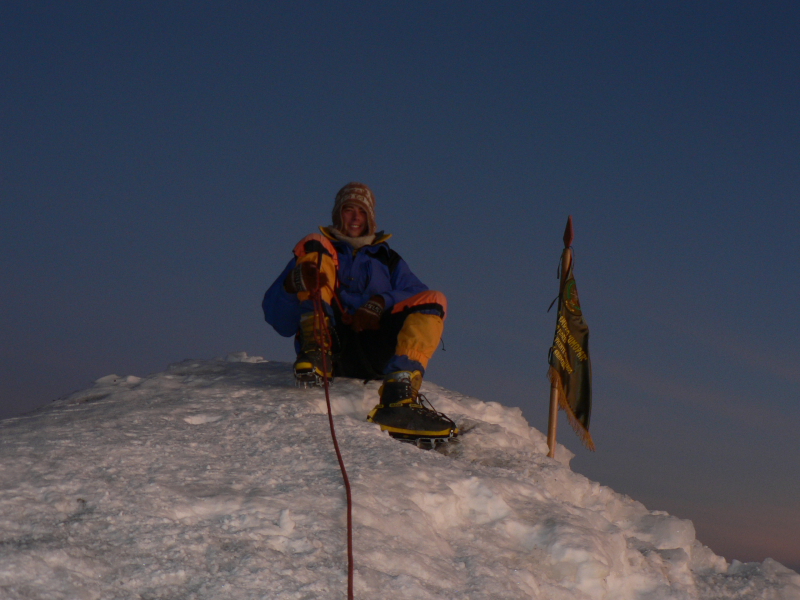
Picture of me at the summit.

Me at the summit of Huayna Potosi, 6088 meters above sea level.

I barley got any sleep last night. Technically, it was still the middle of the night when I got up at 1:00, but I still barely slept. Shortly after I went to bed, the wind picked up and started whipping through the tent, which was clearly not designed for mountain weather conditions. On top of that, a dog was barking in the middle of the night! In South America, it doesn't matter if you're on the remotest island, in the biggest city, in the smallest town, in the middle of the jungle, or on the highest mountain. The number one rule of the continent is that there will always be a barking dog at night.

When I got up, I couldn't eat anything, but Gervacio was kind enough to heat up some water. I had a cup of coffee for energy and a mate de coca to help with the altitude. While I was drinking my mate, a group of French climbers walked past me and got started up the mountain. Seeing them gave me a surge of adrenaline and my headache instantly went away. I got all of my gear together and was stoked to start climbing.

From the beginning, the pace was painfully slow. When I'm trekking, I like to walk fast, but Gervacio assured me that we'd get to the summit in about five hours (just in time for sunrise) if we kept this pace. I figured he knew what he was talking about and just followed him. Indeed, when we got to the top of the first ridge, we passed a few other people who were resting, so I knew that the slow pace was normal for ascending a mountain.

We kept going up and up in the dark, often using our ice axes for support on the steeper parts. After awhile, we passed the French group, who started about half an hour before us. There was nobody in front of us anymore. We only stopped for short water breaks a few times, so I didn't get too hot or cold during the entire climb.

There was one slightly dangerous climb up a steep cliff where I had to use my ice ax to pull myself up. Gervacio and I were roped together the entire time for safety, so he went up first and we kept the rope taught between us. That way if I fell, he'd hopefully be able to hold me up. After we scampered to the top, we lost sight of the other climbers' head torches for good.

After several more hours of walking, Gervacio announced that we were at the last push, a 200 meter wall before the summit. Dawn hadn't even begun to break yet, so we took a fifteen minute break where I downed some chocolate and lots of water. Once again we kept the rope taught and made an explosive effort to the top. It wasn't a problem for me to find safe footing because my stride is so big. Before I knew it, Gervacio stopped, and when I caught up with him, he announced that we were at the summit.

I couldn't see much at first, but it was obvious we had awhile. I was originally told that I could only stay at the summit for five minutes to allow the next group to get to the top, but the next group was just getting to the bottom of the wall. As the sun started to come up, I began to see El Alto, Illimani, and the rest of the Cordillera Real. Seeing the sun come up over the world was one of the most amazing experiences of my life. There was nothing higher than me to block my view, so I could see forever. We stayed on top for half an hour or so, then began our descent when it got too cold.

From the bottom of the last wall, we watched the others struggle to make it to the top. The sun had been up for about an hour, so I got a clear view of what I just climbed. I'm glad I made it to the top in the dark because the last part seemed like a very difficult task. In fact, Gervacio told me that when a lot of the people he takes on the mountain see what they still have to do to reach the summit, they decide that they can't take anymore and turn back. I had no such worries, though, because I couldn't see anything that was still ahead of me.

The walk back to high camp was long but beautiful. I finally got to see the entire area during the day. Back at high camp, I had lunch and got ready to go the rest of the way down. That's when the fatigue and tiredness from not sleeping last night hit me. The last two hours to the bottom were more difficult for me than the five hours to the top, but I eventually made it. I got one last look at what I had accomplished and jumped into a taxi back to La Paz.

My first mountain climbing experience was a great one. The view from the top made the whole thing worthwhile. Huayna Potosi isn't a very difficult mountain to climb, but the altitude alone keeps a lot of people from reaching the summit. This was a great test for me as I realized that I can handle high altitudes as long as I give myself time to acclimatize. Mountaineering may just become something I do more often in my future travels.

The photo album for this entry is here.