Author Archives: Dan Perry

About Dan Perry

Dan created this blog to document his South America trip, which covered every country on the continent and lasted over two years. He currently lives in Madison, WI.

The Pisac Ruins

July 25, 2007
Day 665

Picture of people.

Tina, me, Q, and Helen in front of an Inca tunnel.

Zach, Tina, Q, Helen and I all piled into a taxi before sunrise this morning and went to the Pisac ruins, far above the town. Nobody was there yet, including anyone checking for tickets. It was great walking around the ruins as the sun came up and not having to waste the little precious energy I had on walking from town. The houses, terraces, and urinals seemed incredibly well-preserved, but when I followed a flowing stream of water back to its source, I found a rubber hose. I don't think I was supposed to see that. My favorite part of the ruins was the door with the dish next to it for leaving your keys and cell phone when you came home. Those Incas were great future thinkers.

The photo album for this entry is here.

Holistic Healers With Money

July 24, 2007
Day 664

There is one more set of ruins near Ollantaytambo called Pumamarca, and you don't even need the tourism ticket to see it because it's not on the radar of the big tour groups yet. I went there this morning, but there was a problem: I barely had the energy to make it there, despite it being only a short walk from town. As I tried to catch my breath while looking at the ancient terracing, I realized there was no way I could do a long trek in my current condition. I think I still had giardia, the nemesis of my entire trip. You get it by drinking contaminated water, which is practically impossible to avoid sometimes in the Third World. You can kill it with antibiotics, but if you don't eradicate it 100%, eventually it will gain strength and take over your body once again. I think that's what has happened with me. I simply would have to wait a few more days to recuperate before attempting the Choquequirao trek.

After returning from Pumamarca, I took a bus across the Sacred Valley to Pisac. On the bus I met an interesting group. Zach from Afghanistan, Helen from the Dominican Republic, and Q from Barcelona were all living in New York and on summer break from teaching at the UN school there. Q's sister Tina was working in Lima, and the four of them were traveling around Peru together. They told me there was a conference for the native population this afternoon, so I decided to tag along.

The conference was at the Royal Inca Hotel, the nicest hotel in town. I thought it was going to be about preserving the local native culture, but something seemed amiss when the first presenter to speak was a fat white American woman. She started talking about contributions that have helped build schools where kids were taught Spanish to go along with their native Quechua. That sounded fine, but then she mentioned that the kids were being taught how to heal with musical instruments, and soon they would make fine "doctors of sound."

Next, another white man came out and started playing a conch shell while the woman went around the room shaking a pile of dried leaves in everyone's faces. Exactly which disease was this supposed to cure? Between songs they talked about how the world was coming to an end and women shouldn't cross their legs because they are the key to new life. A lot of the presentation was of a strange, no-so-subtle sexual nature. Whenever I looked around the room, I saw a bunch of rich-looking white people dressed in nice clean clothes nodding in approval. The few local people in the audience were dressed in the jeans and t-shirts that they normally wear and had confused expressions on their faces.

There were a few Indians presenting, but they were of North American ancestry. One guy played a tambourine and started humming a tune that sounded authentic until we realized it was "The Itsy Bitsy Spider." The audience soon caught on and sang right along. Then a boy started singing a song about Mickey Mouse and Donald duck being stars in Disneyland. The bizarre performances continued for three hours.

After the conference, as we were walking out, the audience members started talking amongst themselves about how amazing it was. Someone told me that these people all paid big money for this retreat from the US to get back to their native roots. That sounds fine on the surface, but I saw nothing having to do with the local Quechua culture at the conference. We were all invited to a bonfire afterward, but the UN teachers, who were as baffled by it all as I was, decided they had seen enough.

Later at night in the center of town, we ran into the white guy who was dressed as an Indian and played a mad conch shell. He was standing in the threshold of his holistic healing shop talking to a few of the conference's participants. The light from the shop was glowing on his face like someone telling a scary story with a flashlight under his chin. His eyes were wide, his pupils dilated, and he wore an impish grin across his face. "Come on in, the water's warm," he said as we walked past. Uh, no thanks, maybe I'll join your cult some other time.

Ripping Off the Tourists

July 23, 2007
Day 663

Picture of fortress.

The fortress outside of Ollantaytambo.

I decided on a change of venue for a few days. Last time I was in the area, I briefly went to the Sacred Valley of the Incas on my way to the Inca Trail, but I wanted to see it more thoroughly this time around. I took a bus to Ollantaytambo, a small town with hundreds of hour groups visiting every day. It was more laid-back than Cusco, but so small that I had already seen it all shortly after arriving.

For me, the main attraction in Ollantaytambo was the Inca fortress just outside of town. I walked to the entrance, but learned that I would have to buy a tourism ticket, at a cost of $22, just to enter. Ah yes, I remember the good old tourism ticket. The government claims that you only have to buy one ticket to see all the attractions around Cusco, but then you learn that if you want to visit any of the best museums, churches, or ruins in the area, they're not even included in the ticket. What is included in the ticket? A couple museums the size of living rooms, one or two churches that you can enter for free anyway, and some of the crappier ruins, most of which don't even have anyone checking for tickets at the entrance. It's a big rip off. I bought the stupid ticket last time and was hugely disappointed. This time I decided to give it a miss and took a few pictures of the fortress from afar.

The photo album for this entry is here.

An Olinda Reunion

July 21-22, 2007
Day 661-662

Today I met up with Katie, a French girl I originally met through Couchsurfing back in Olinda, Brazil. She was traveling around with several of her fellow countrymen and happened to be passing through Cusco at the same time I was there. We got caught up and all of us went out for some laughs in Cusco's thriving, if freezing, nightlife.

I still haven't gotten any takers from my trekking offer. It's really frustrating because I spent two full days planning the entire trek, but I can't find anyone to go with me. On top of that, I've been sick lately, first with a head cold, then likely another bout with my old friend giardia. I've barely been able to eat anything the last few days, and tonight when I finally tried to force down some food, I had to excuse myself from the Frenchmen to empty the contents of my stomach and bowels. I've decided to take a short trip into the Sacred Valley while I'm recovering, then if I still don't have anyone to go with, I'll do the trek on my own.

A School Parade

July 20, 2007
Day 660

Picture of soldiers.

Young soldiers getting ready to march.

This time of year is graduation in Peru, and today there was a large parade in the central plaza of Cusco to celebrate it. The director of the private schools in town began the proceedings with some announcements, and then the kids began marching. Their uniforms were either military style or more traditional, and a band constantly played while they marched. The parade drew a large crowd of gringos, parents, vendors, and bored siblings. It was great to watch.

The photo album for this entry is here.

Trek Preparations

July 18-19, 2007
Day 658-659

I saw an article about Choquequirao a few weeks ago and decided it was somewhere I wanted to go. The ancient Inca site has been known about for a long time, but archaeologists have only recently discovered how important it really was. In fact, people are now calling it a sister city of Machu Picchu. Only a small amount of it has been excavated, there's no road or rail line to the site, and only a few thousand tourists go there each year, so it still has an adventuresome feel to it, and I'd love to see it before it's discovered by the mainstream tourists. The problem was how to get there.

I did a lot of searching and found a decent topographical map of the area in a bookstore. I talked to a guy at my hostel named Jose who has been to Choquequirao as a cook, and he figured that most people walk there from the nearest town for two days, stay for a day, then walk back on the same path. That sounded a bit boring to me, but I soon discovered that it is possible to continue walking all the way to Machu Picchu.

Jose gave me a lot more info about the region, and now I definitely want to do the longer trek. I've already been to Machu Picchu, but it's been a year and three quarters, so I figure it's worth another look as long as I'm already in the area. The only major task remaining was to find some people to go with me. I printed up a dozen notices inviting anyone interested and put them up on message boards and in bars around the city. The waiting game has begun.

Return to Cusco

July 17, 2007
Day 657

This morning I took a bus to Cusco. The bus originated back in Puno, and at least half the passengers were tourists. Juliaca doesn't get tourists for obvious reasons. The ride took most of the day and passed through some pretty empty high altitude territory.

It was strange walking around Cusco again. I last was there in October, 2005, about one year and nine months ago, at the beginning of my trip. I had forgotten how nice Cusco was, with buildings that actually had completed roofs and paint, colonial architecture everywhere, two huge cathedrals in the central plaza, and no garbage in the streets. The center of the city was full of upscale restaurants, jewelry shops, and friendly police officers.

On the other hand, I had also forgotten how many tourists Cusco has. In the center of the city, tourists easily outnumber the locals. Many of them walk around in large guided groups, while others take along the whole family. They bring in a lot of money to Peru, but they also drive the prices up in the city and attract a multitude of thieves. It's not even possible to sit on a park bench for five minutes without ten different people coming up to you and trying to sell you something. Walking around is even worse. People constantly attempt their sales pitches on me: "My friend, come eat at my restaurant, only fifteen soles" (never mind that you can get a meal for two soles at many places), "Painting my friend?" "Finger puppets my friend?" "Massage my friend?" "Weed my friend?" (before shaving), "Charlie my friend?" (after shaving).The sheer amount of these annoying types is greater in Cusco than anywhere I've ever been, and this is only due to get worse now that Machu Picchu has been named one of the new seven wonders of the world, and Cusco is on the radar of high-end tourists around the world. Still, for better or worse, Cusco now is the center of tourism in Peru because it once was the center of the Inca empire, a fact that the Peruvians are quite proud of and tourists come here to experience.

Rockin' Out Juliaca

July 14-16, 2007
Day 654-656

Picture of Leo and Keru.

Leo and Keru before the concert.

Today I had to get up before sunrise to get as early a start as possible. The plan was to go to Juliaca, Peru for a heavy metal festival with Keru and his friends, who play in a band. They used to be called "SadomasoChrist," but now they're simply known as "The Undead." I met Keru, Eaves, Leo, Marcello, and Krubs near the cemetery where all the buses would leave from, while it was still dark and freezing cold.

We took the bus up the hill through the city to El Alto just as the sun was coming up. Once we got past El Alto it was just a few hours through the Altiplano to get to Desaguadero, on the border with Peru. I got my passport stamped out, walked across the open border, then got stamped back in on the other side. The others filled out some forms and hired a cart to take their luggage across because they had to cover their instruments, less they face a steep charge from the customs officials. We then had a longer ride around Lake Titicaca to Puno, then finally an hour or so in another bus to Juliaca.

Juliaca is different from most cities in Peru in that it's flat as a pancake. This makes the city perfect for tricycle taxis, which we rode to our hotel. At first it was great riding in front of a tricycle through the city, being free from a noisy, polluting engine, but soon the novelty wore off when a hundred cars, each sporting a noisy, polluting engine spread their fumes upon us.

We dropped our stuff off at the hotel and took a walk around town. Right away I noticed how, uh, unaesthetic it was. The buildings all had steel rods sticking up from them and looked unfinished, nothing was painted, there was garbage everywhere, there was not one tree or even a patch of grass, it was cold (Juliaca sits at 3840 meters), windy, and dusty. On top of that, there were disorganized markets everywhere, selling just about everything except paint, shingles, and garbage cans. The vendors flowed over the sidewalks and into the streets, so there was nowhere to walk. Cars kept passing us and nearly hitting us, but they weren't the biggest problem. The aforementioned tricycles, silent with no lights or reflectors, were constantly sneaking up on us and trying to put us out of commission. On several occasions, I witnesses a tricycle driver attempt to plow through an uncontrolled intersection rather than waste energy slowing down and speeding back up, only to come within inches of getting sideswiped by a motor vehicle.

After eating lunch and spending the afternoon shopping for heavy metal t-shirts, we went back to the hotel where the band prepared for the concert. We took another tricycle taxi to the outdoor arena just in time to see another band starting. I didn't recognize any of their songs, but the music was loud and fast, and the lead singer's voice had a certain simian quality to it. The audience was about ninety percent male, and everyone wore but one color: black. At one point, someone asked me with a straight face if I preferred death metal, black metal, or death black metal. I told him I liked Black Sabbath and he seemed pleased with my response.

Keru's band started playing later, and I decided to make the most of it and joined the mosh pit. It was great fun slamming into the Peruvian metalheads who were half my size and ten years my junior. I think I was the only person there who was not from Peru or Bolivia. Even though everyone tried to look as tough as possible, I didn't see any fights break out, nor were there even any police in sight. The night turned out to be a lot of fun, and I was glad I traveled as a roadie of sorts with The Undead.

The photo album for this entry is here.

Reflections of Bolivia

July 7-13, 2007
Day 647-653
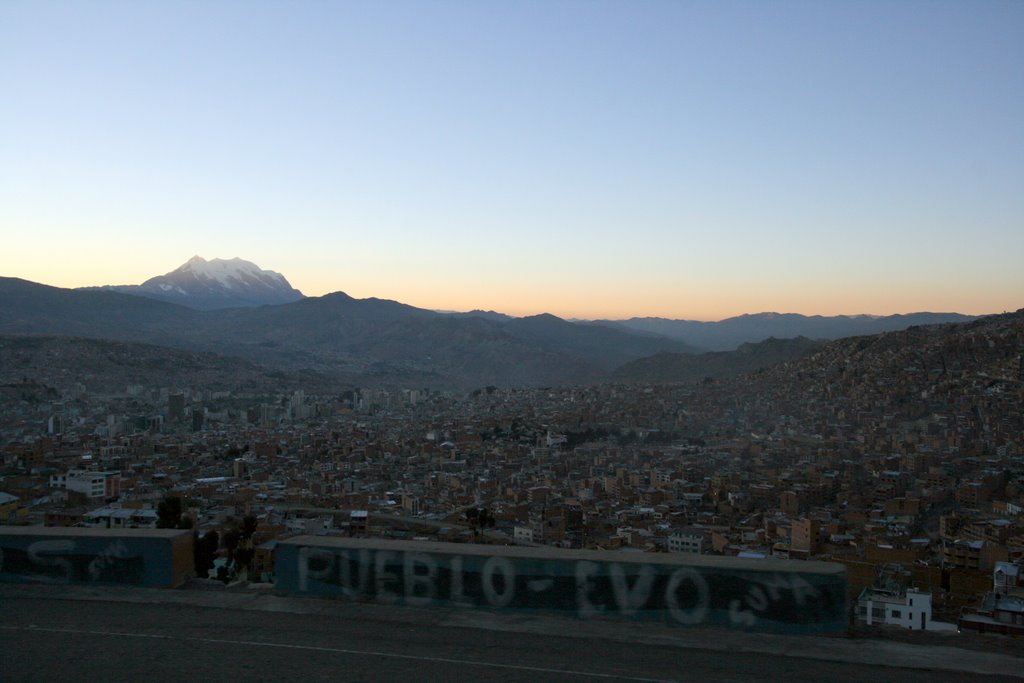
Picture of La Paz.

La Paz, with Illimani in the background, and a sign for Evo Morales in the foreground.

My plan after getting back from the mountains was to rest a few days and catch up on some menial tasks. I washed my tent and all of my clothing, cleaned out my stove and pots, and bought a few small things I knew I'd need soon. I was soon ready to head to Peru.

I went to the bus station to buy my ticket, but the lady at one company said she couldn't sell me one until Friday. I thought that was strange and went to the next company. This time the salesperson told me the same, but added that there was a strike in Peru and all of the roads leading into the country were blocked. Every other company I talked to gave similar advice. It sounded like it was the miners once again. I got lucky a week ago when I missed the mining strike in Bolivia that left some of the main roads blocked. This time I wasn't so lucky and would have to wait a few days for the roads to open back up again.

It all seems to be happening in this region right now. Besides the mining strikes in both Peru and Bolivia, the bakers in La Paz recently went on strike, leaving no bread in the entire city. It started snowing in El Alto, and with no infrastructure for snow removal, many of the roads became impassible. I saw a bunch of kids and teenagers walking down the road one day dressed up like witches and shouting, but it turned out that they were just on there way to watch the latest Harry Potter film (yeah, it's even popular in Bolivia). There are protests in Sucre because the government wants La Paz to be the only capital of Bolivia, whereas Sucre has maintained its historical capital identity for decades. This latest strike will apparently shut down all commerce in La Paz one day next week. The city still seems peaceful, however. The only reason I know all of this stuff is happening is because the local people tell me. There are protests almost constantly in Bolivia, but they rarely turn violent.
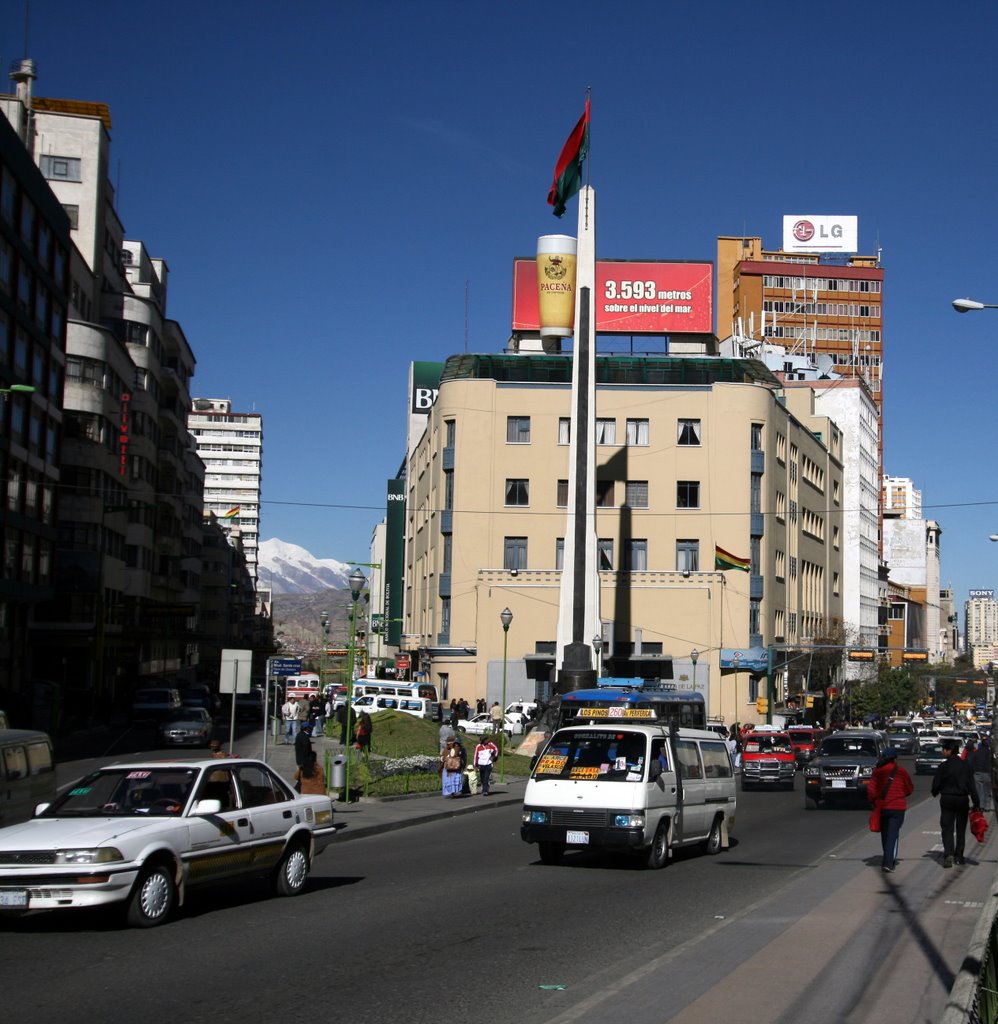
Picture of beer sign.

A beer sign boasts La Paz's altitude of 3593 meters, while the much higher Illimani sits in the background.

In the meantime I spent some time hanging out with Keru, a local Pace?ño I met when I came to the city after the animal park, and his friends. We watched several Copa America soccer games, in which the US lost all of its games, Brazil barely beat Uruguay in the semifinals in a shootout, Argentina crushed Mexico in the other semifinal game, and Brazil easily won the championship, as expected. We also went to El Alto to visit the largest flea market in South America. Absolutely anything you could possibly want was for sale there. We saw tools, old t-shirts, bootleg CD's and DVD's, refrigerators, cars, and much, much more. I heard the Brewers were doing well this year, so I bought a new Brewers hat for $3. Leo got a Tickle Me Elmo for $2.50 and a "Pig Floyd: Pork Side of the Moon" t-shirt for $1.25. It took all day to see only twenty-five percent of the fair, and I was told that it was empty because it was a weekday. Oh yeah, the view of La Paz and the surrounding mountains was great too..

Bolivia is a great country to visit. There are so many interesting and unique things to see and do here. For example...

The Jungle: You can take a tour in the Amazon rain forest and discover the vast diversity of wildlife that exists there, or you can do as I did (twice) and buy a canoe and paddle it down an Amazon tributary to your heart's content. Or, if you really want, you can volunteer at an animal park walking through the jungle with a puma, no experience necessary.

The Mountains: There are several incredible mountain ranges in Bolivia. You can undertake treks that require major expeditions, like those in the Cordillera Apolobamba, or ones for which you don't even need a stove, tent, or guide, like those in the Cordillera Real. And if walking around the mountains isn't enough for you, you can also climb them. There are 6000-meter peaks that are climbable by anyone with a reasonable level of fitness, and those that require extreme technical climbing skills.

Culture: The European conquests have touched Bolivia less than any other country in South America. Outside the big cities, many people still speak native languages like Aymara and Guarani before they learn Spanish. People still practice ancient rituals like burying a llama fetus in their yard to ward off evil spirits. There are villages all over with no modern technology where life still is almost the same as it was before the Spanish arrived in South America. There are even still uncontacted tribes in the Amazon, not that I'd recommend visiting them. Even La Paz is interesting, sitting in a "bowl" at 3500 meters, with its mixture of (a small amount of) European influence and native traditions.

Unique Experiences: You can ride a bicycle down the world's most dangerous road. Or visit a silver mine with almost no modern technology. Or drive across the world's largest salt lake. Or see geysers erupting at 5000 meters at temperatures well below freezing (or at least try). Or see flamingos on colorful high altitude lagoons. The possibilities are nearly endless.

Money: If you don't have much of it, Bolivia is the place to be. You can get a hotel room for $2. Restaurant meals normally cost anywhere from fifty cents to $1. I once had a meal of soup, bread, salad, rice, a milanesa de pollo (a flat breaded piece of chicken), desert, and a glass of juice for sixty-three cents in La Paz. You can get a licuado (a smoothie of banana, papaya, strawberry, or a number of other fruits blended with milk) for twenty-five cents, or a large glass of fresh-squeezed orange juice for eighteen cents. A taxi across the city will cost $1, but if that's too much, you can take the bus for eighteen cents. And my favorite thing, the Internet, will cost you a quarter an hour to use.

Of course, Bolivia is a very poor country. A lot of people say it's dangerous, but if you take some simple precautions, it's unlikely anything bad will happen to you. I spent six months traveling around Bolivia and never got robbed there. The tourism infrastructure is bad, and you have to build a few extra days into your schedule for the inevitable delays, but travel there can be quite rewarding. For now the tourists who do come to Bolivia are almost all backpackers with very few high-end tours finding their way into the country. Still, Bolivia can be a great travel destination for anyone with some time, lots of patience, and a heart for adventure.

The photo album for this entry is here.

Time to Head Back to the Big City

July 6, 2007
Day 646
Condoriri Climb Day 4

I finally got to sleep all night last night. For once I had a real breakfast, too. After eating only stale bread for breakfast the last two days, my bowl of instant porridge felt like a meal fit for a king. My tent was covered with frost from the freezing high altitude air, but before I had time to dry it out, our donkeys arrived and it was time to leave.

Once again, I walked past the dam and reservoir, curving around a landscape sprinkled with mountains. The walk back seemed to take an instant now that my body had become accustomed to much higher altitudes and I didn't have to carry anything but my camera.

Back in Tuni, we had to wait forever for our taxi to show up. I was mad that we had to leave high camp so early, only to wait for over an hour for our taxi. When we finally left Tuni, the driver must have sensed that it was getting late. The long gravel road took an hour, but as soon as we hit pavement, we covered a larger distance in five minutes. I'm not sure how fast we were going because the speedometer wasn't working, as per the usual Bolivian specs, but we were flying around other cars and buses so quickly it felt like Ludicrous Speed compared to our gravel road travel.

When we got back to El Alto, it was a complete mess. I thought an earthquake had struck, but it turned out that the road was just under heavy construction, and there was no clearly-marked detour to take. We searched around the wreckage for half an hour before finding a small path leading into a drainage canal and back up to a passable road on the other side. Other cars all around us were also frantically searching for a similar route.

Eventually we made it back down to La Paz. I dropped off all of my rented gear and said goodbye to Teo and Pedro. I could finally catch up on sleep in a real bed and take a couple days to relax. Climbing mountains in Bolivia has been an amazing experience, but now I'm worn out and need to take a few days off.

The photo album for this entry is here.